In the field of road safety facilities, solar road studs based on their advantages of active illumination and energy conservation have become the core choice for modern traffic control. Among them, plastic solar road studs, with their high cost-effectiveness and multi-scenario adaptability, have gradually replaced traditional metal and glass road studs and become the preferred choice for most road projects.
This article will comprehensively analyze the definition, core advantages, material comparison, applicable scenarios and selection techniques of plastic solar road studs, helping you find the most cost-effective road safety solutions (cost-effective road safety solutions).
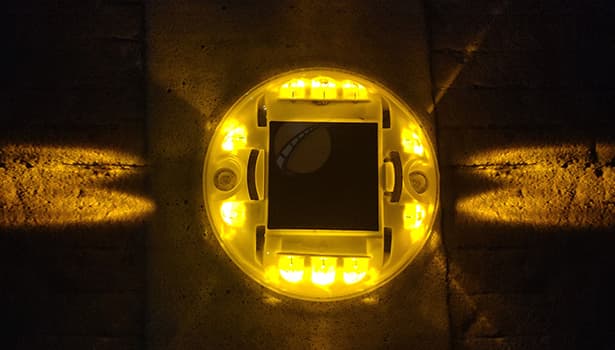
Plastic solar road studs, also known as plastic solar protruding road signs, are a type of active lighting traffic safety facility with a plastic shell that relies on solar power. They do not require an external power source and have a simple and efficient core working logic.
During the day, the solar panels on the surface of the road studs absorb sunlight and convert it into electrical energy, which is stored in the built-in energy storage devices (batteries or capacitors); at night or when there is insufficient light (less than 80 Lux), through an optical switch, the stored electricity is automatically released to drive the LED lights to illuminate, clearly outlining the road contour and guiding the direction of vehicle travel.
As an active lighting facility, it breaks the dependence of traditional reflective road studs on vehicle lights, and has a more prominent warning effect in adverse weather conditions, being a key device for improving road safety at night.
The shell of plastic solar road studs mainly uses ABS or PC engineering plastics, and some high-end models use ABS/PC hybrid materials. Both materials have their own advantages, giving the road studs excellent performance.
ABS plastic has good processing performance and dimensional stability, and has a moderate cost; PC plastic (also known as bulletproof PC) has stronger impact resistance and weather resistance, and higher strength, which can adapt to more complex outdoor environments.
Overall, the core characteristic of plastic materials is lightweight and certain elasticity - the weight is much lower than that of metal road studs, and it has certain toughness, which can absorb energy when subjected to impact, reducing the risk of damage.
The rise of plastic solar road studs is mainly due to its multiple advantages compared to other material road studs, whether in terms of cost, installation or user experience. Plastic solar road studs can meet the needs of most road projects, and the specific advantages are as follows:
Cost is the core consideration for most road project selections. The cost advantage of plastic solar road studs is particularly prominent.
Firstly, the market prices of plastic raw materials (ABS, PC) are much lower than those of aluminum alloys and other metal materials, reducing the production cost of the product from the source; Secondly, the production process of plastic road studs is relatively simple, without complex forging or electroplating processes, suitable for large-scale batch production, further reducing the cost per unit.
Overall, whether in terms of the price of a single set of products or the total cost of road project laying, plastic solar road studs are much lower than metal road studs, making them a cost-effective choice.
The weight of plastic solar road studs is usually 0.3-0.5 kg per unit, significantly lower than that of aluminum road studs (typically 1-2 kg per unit), and the lightweight design brings two core advantages.
On the one hand, transportation costs are significantly reduced - for the same number of road studs, the transportation volume and weight of the plastic model are smaller, reducing the number of loading times for transportation vehicles and lowering logistics costs; On the other hand, the installation process is more efficient. The plastic road studs do not require heavy equipment assistance and can be laid manually. The installation method is simple (mostly fixed with epoxy resin), which can significantly reduce labor costs and shorten the construction period.
The outdoor road environment is complex, and factors such as sun exposure, rain, and salt spray can cause erosion to the road studs. However, the plastic solar road studs have excellent corrosion and weather resistance, suitable for various harsh environments.
The ABS and PC engineering plastics used in them all have UV-resistant properties. They will not age, crack, or fade when exposed to sunlight for a long time; at the same time, they have good waterproof and salt spray resistance, and can be used in coastal areas and regions with heavy rain and fog, without the problem of rust or corrosion like metal road studs. Their service life is more guaranteed.
The core of road safety is "visibility". The active lighting design of the plastic solar road studs makes them far more visible at night and in bad weather than traditional road studs.
It is equipped with ultra-bright anti-fog LED bulbs, with an illumination brightness of over 2000 MCD, which is 6-7 times that of ordinary reflective road studs. The visible distance can exceed 1000 meters. Unlike traditional reflective road studs, it does not rely on vehicle lights for reflection and can actively emit light. In low visibility weather conditions such as rain, fog, and heavy rain, it can clearly mark the road boundaries and effectively guide drivers, reducing the incidence of traffic accidents.
Vehicles' rolling and pedestrians' stepping on the road studs can cause impacts on the road studs. The flexibility of the plastic solar road studs is highlighted in this aspect.
The plastic material itself has certain elasticity and toughness. When subjected to vehicle rolling or external force impact, it can deform itself to absorb impact energy, avoiding direct fracture and damage; compared with the rigid structure of metal road studs (easily crushed by heavy vehicles) and the brittle structure of glass road studs (easily broken), plastic road studs have stronger impact resistance, effectively reducing the damage risk caused by vehicle rolling and lowering replacement costs.
The maintenance cost of plastic solar road studs is extremely low, and their service life is long, further enhancing their cost-effectiveness.
It relies entirely on solar power for supply and does not require external power sources, avoiding a series of troubles such as line laying and power supply maintenance; at the same time, its shell material is corrosion-resistant and anti-aging, and the internal components (LED lights, batteries) have strong stability. Under normal use conditions, the service life can reach 5-8 years, and some high-quality products can even exceed 8 years. There is no need for frequent replacement, significantly reducing maintenance costs and labor input.
In the context of global advocacy for environmental protection and energy conservation, the environmental advantages of plastic solar road studs have become an important competitive advantage and one of the core reasons for their popularity.
It uses solar energy as the sole energy source, does not consume grid electricity, effectively reduces carbon emissions, and conforms to the development concept of green transportation; at the same time, some plastic road studs can be made from recyclable plastic materials, with high recycling rates, reducing the generation of plastic waste, and further practicing the concept of sustainable development.
In such scenarios, with moderate traffic flow and no long-term rolling by heavy vehicles, plastic solar road studs can maximize their cost-effectiveness advantages, adapting to their anti-pressure and weather resistance properties, and are the most mainstream application scenarios:
Suitable for main roads, secondary roads, crosswalks, intersections, etc., for marking lane boundaries and guiding vehicles to avoid pedestrians, and some models can be linked with traffic lights to achieve dynamic warnings; It is particularly suitable for sections with insufficient lighting at night. By virtue of its self-illuminating feature, it can clearly outline the road contours even in rainy and foggy conditions, thereby enhancing traffic safety.
Rural road construction conditions are limited and maintenance is inconvenient. Plastic solar road studs do not require an external power source, are easy to install, and are corrosion-resistant and weather-resistant. They can adapt to the outdoor environment of rural areas exposed to sunlight and rain, effectively solving the problem of insufficient night-time warning on rural roads
Including parking lots of shopping malls, office buildings, and surrounding roads of commercial pedestrian streets. They are used to mark parking lines and entrance/exit passages, helping drivers quickly find parking spaces and safely travel at night. Installation is convenient and does not damage the ground pavement.
Applicable to roads in residential areas, industrial parks, scenic areas, etc. No complex construction is required, and it can quickly enhance the night-time safety of the road. Moreover, the plastic material is aesthetically pleasing and can blend with the environment of the park and community.
For such scenarios, the performance requirements for the road studs are moderate. The flexible structure and low maintenance cost of plastic solar road studs can perfectly match, meeting temporary or special needs:
Considering the compressive strength of plastic solar-powered road studs (typically 10-16 tons), the following scenarios are not recommended for use due to large vehicle tonnage and high rolling frequency to avoid affecting service life and warning effect:
Expressways have a large volume of traffic and are constantly crushed by large trucks and heavy vehicles. Plastic road studs have insufficient compressive resistance and are prone to damage from being crushed. It is recommended to use aluminum alloy road studs.
Such as dedicated freight lanes around ports, logistics parks, and mines, where the tonnage of vehicles is large and the frequency of compaction is high, the service life of plastic road studs will be significantly shortened. Therefore, high-pressure-resistant metal road studs should be selected.
It is not recommended to install it in the middle of the road to avoid direct and frequent vehicle traffic, which may cause damage to the road studs. Manufacturers usually do not offer a warranty for road studs installed in the middle lane.
When choosing solar road studs, material comparison is crucial (plastic vs aluminum solar road studs, solar road stud materials comparison). Through the following table, a clear comparison of the core performance of plastic, aluminum, and glass solar road studs is provided, helping you make a quick selection:
|
Comparison Dimension |
Plastic Solar Road Studs |
Aluminum Solar Road Studs |
Glass Solar Road Studs |
|
Cost |
Low – low raw material and production costs, highly cost-effective |
High – expensive metal materials and complex manufacturing process |
Medium – moderate material cost and processing difficulty |
|
Weight |
Light (0.3–0.5 kg/unit) – easy to transport and install |
Heavy (1–2 kg/unit) – higher transport and installation costs |
Medium (0.6–0.8 kg/unit) – moderate handling difficulty |
|
Compressive Strength |
Medium (10–16 tons) – suitable for normal vehicles, not ideal for heavy loads |
High (24–38 tons) – suitable for highways and heavy-load traffic |
Medium to high (>25 tons) – but brittle and prone to breakage |
|
Corrosion Resistance |
Excellent – suitable for coastal and rainy environments |
Average – prone to corrosion from salt and moisture, requires maintenance |
Excellent – waterproof and corrosion-resistant, but durability affected by brittleness |
|
Installation Difficulty |
Low – manual installation, high efficiency, no heavy equipment needed |
Medium – heavy weight requires auxiliary equipment, longer installation time |
Medium – fragile, requires careful handling during installation |
The quality of plastic solar road studs on the market varies. When choosing, pay close attention to the following key parameters to avoid pitfalls and ensure product performance and service life:
This is the core requirement for outdoor road studs. An IP68 grade can achieve complete waterproofing and dustproofing, preventing rain and dust from entering the interior and damaging components, ensuring stable operation in rainy and humid environments. This is the basic standard for high-quality plastic solar road studs.
Prioritize products with LED brightness ≥ 2000MCD and visibility distance ≥ 1000 meters to ensure visibility at night and in adverse weather conditions, avoiding the impact on warning effect due to insufficient brightness; you can also choose products that support both flashing and constant lighting modes, suitable for different scene requirements.
Lithium batteries have a large capacity, long endurance, and long service life (usually 5-8 years), but are slightly more expensive; nickel-hydrogen batteries have a lower cost, endurance and lifespan are slightly shorter (usually 3-5 years). You can choose based on project budget and usage requirements. It is recommended to prioritize the use of high-temperature-resistant lithium batteries, suitable for outdoor extreme temperature environments.
Choose based on the application scenario. For ordinary scenarios such as urban roads and parking lots, a product with a pressure resistance of 10-16 tons is sufficient; If there are a small number of light trucks passing through, products with a pressure resistance of over 16 tons can be chosen to ensure they can withstand the pressure of vehicles without being damaged.
Based on the above analysis, plastic solar road studs are undoubtedly the **most cost-effective road safety solution**, especially suitable for most medium and low traffic flow scenarios.
It has advantages in cost, installation, maintenance, and environmental protection, perfectly balancing safety and economy - it not only has high safety with active lighting, effectively enhancing road safety at night, but also reduces the procurement, transportation, installation and maintenance costs of the project, suitable for various scenarios such as urban roads, parking lots, and community roads.
If you are looking for cost-effective road safety solutions and the project scenario has no long-term heavy vehicle crushing, plastic solar road studs are definitely a core solution worth choosing. They can not only meet the road safety requirements but also control the project cost and achieve the maximization of cost performance.