Plastic road studs, with their advantages of light weight, low cost, and easy installation, are widely used in modern road safety construction. However, long-term exposure to outdoor environments can cause aging and UV degradation of the plastic shells, directly shortening the service life of the studs and reducing the road warning performance.
Many road management and engineering teams are facing the problem of premature aging of plastic road studs and frequent replacements, resulting in high maintenance costs. This article will conduct a deep analysis of the causes of plastic road stud aging, the differences in UV resistance among different materials, and optimization solutions for durability, guiding you to select high-weather-resistant road studs and effectively extend the equipment's service life.
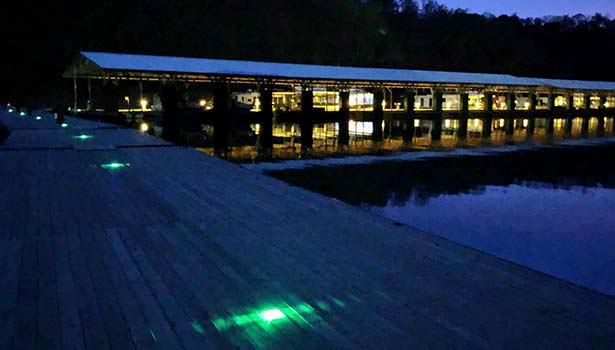
plastic road studs are constantly exposed to complex and harsh outdoor environments, and multiple external factors continuously erode the plastic material, causing continuous degradation of performance.
The main environmental influencing factors include: long-term ultraviolet radiation, extreme high temperatures, rain erosion, coastal salt fog corrosion, and repeated vehicle rolling impacts.
After long-term outdoor use, plastic road studs will experience various failure problems. Common aging phenomena include surface discoloration, shell cracking, material brittleness, decreased reflective brightness, and overall structural failure.
These aging defects will directly weaken the night-time warning effect of the studs, reduce road safety, and bring frequent replacement and maintenance costs to the project.
Among all outdoor environmental factors, ultraviolet (UV) radiation is the primary cause of plastic road stud aging and performance decline.
UV rays in sunlight will damage the polymer molecular chains of plastic, triggering a continuous oxidative degradation reaction within the material. This irreversible chemical change fundamentally destroys the structural stability of the plastic.
As exposure time increases, plastic road studs will show problems such as powdering, yellowing, and color change, while the impact resistance and toughness of the material inside will significantly decrease.
plastic road studs exposed to strong light for a long time are prone to cracking easily when subjected to vehicle rolling or external impact, completely losing their functionality.
Long-term ultraviolet radiation will damage the color stabilizers on the surface of plastic road studs and the protective coating of the reflective sheet.
This causes the road stud shell to gradually fade and yellow, and the reflective performance of the core reflective component to continuously decline.
The most direct impact is that the visibility distance of the road stud at night shortens, the edge warning and lane guidance effects are significantly weakened, and it seriously threatens driving safety.
The outdoor day-night temperature difference cycle will continuously affect the toughness of the plastic material, and long-term cold and hot alternation will cause the material to gradually become brittle and lose toughness.
The aging road studs cannot withstand regular vehicle rolling and external force impact. Once subjected to heavy-load vehicles, they are prone to cracking and breaking.
In winter, the brittleness of plastic material will further increase, and the probability of road stud cracking and failure will significantly rise.
For solar road studs with built-in circuits, UV aging and high-temperature erosion will trigger more complex equipment failures.
Strong light and high temperature will accelerate the aging of the built-in batteries, reduce the stability of the LED light source, and cause the sealing glue to age and fail.
After the sealing structure is damaged, water vapor, rain, and air oxidation will seep into the road stud interior, causing circuit board short circuits and damage, and ultimately leading to the complete scrapped of the equipment.
The UV resistance, anti-aging, and weather resistance performance of different plastic materials vary greatly. Choosing the right material is the core way to enhance the outdoor durability of the studs. The following is a performance comparison of three mainstream stud materials.
|
Material Type |
UV Resistance |
Anti-Aging Performance |
Impact Resistance |
Applicable Scenarios |
Cost Range (USD) |
|
ABS Plastic |
Weak |
Poor, prone to cracking and chipping |
Average |
City low-traffic roads, parking lots |
Low cost |
|
PC Plastic |
Strong |
Excellent, anti-yellowing, anti-fading |
Good |
Highways, high-temperature outdoor areas |
Medium cost |
|
PC-ABS Composite Material |
Extremely strong |
Excellent, stable long-term weather resistance |
Excellent |
High-end solar road studs, long-term outdoor projects |
Medium-high cost |
ABS plastic road studs are currently the most basic and widely used plastic road studs, mainly used in conventional road projects.
Their core advantages are low production cost, good injection molding performance, and simple installation, which can meet the basic road marking requirements in low-traffic scenarios.
However, the UV resistance and anti-aging performance of ABS material have obvious shortcomings, and long-term outdoor exposure will cause the material to quickly crack.
After several months to one year of outdoor use, ABS studs are prone to surface aging, cracking, and peeling problems, and have poor long-term durability.
PC (polycarbonate) studs are upgraded durable studs that completely solve the core aging problems of ABS material. The PC material has superior UV resistance, high temperature resistance, and impact resistance compared to ABS. Its polymer molecular structure is more stable, effectively resisting UV light degradation.
Under long-term intense sunlight exposure and high-temperature conditions, PC road studs do not yellow, flake, or crack.
With excellent weather resistance, PC road studs become the preferred product for high-standard scenarios such as highways, open-air high-temperature areas, and long-term outdoor fixed projects.
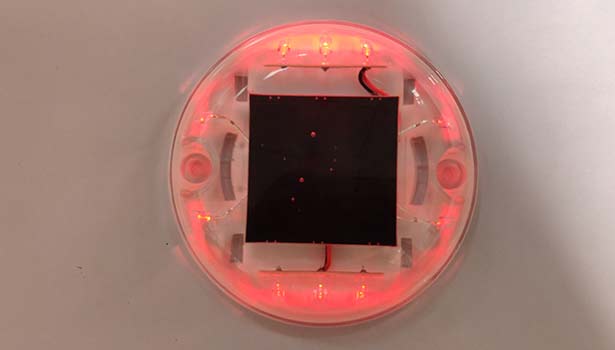
The PC-ABS composite material combines the core advantages of both ABS and PC materials and has now become the mainstream new material for high-quality anti-aging road studs and solar road studs.
It retains the excellent processing and forming properties of the ABS material while inheriting the strong UV resistance and weather stability of the PC material.
The composite structure significantly enhances the mechanical strength, thermal stability, and surface durability of the road studs, making them suitable for more complex outdoor environments and significantly extending the overall lifespan of the equipment.
Most of the current high-end solar road studs on the market use PC-ABS composite casings to cope with long-term outdoor harsh conditions.
Adding professional UV stabilizers is the core material optimization solution to delay plastic aging. High-quality weather-resistant road studs will add three types of functional additives during production.
|
Additive Type |
Main Function |
Protection Mechanism |
Key Benefit |
|
Ultraviolet Absorbers |
Block harmful ultraviolet radiation |
Intercept ultraviolet rays and prevent damage to molecular chains |
Improve UV resistance and reduce material cracking and fading |
|
Light Stabilizers |
Reduce photo-aging effects |
Inhibit the material's photo-oxidation reaction |
Enhance outdoor durability and extend service life |
|
Antioxidants |
Prevent thermal degradation |
Delay the material's thermal aging and degradation process |
Maintain material stability and mechanical performance over time |
The modified anti-UV plastic can effectively resist outdoor light degradation and heat aging, significantly extending the road stud lifespan.
Surface coating protection is an effective auxiliary means to enhance the outdoor durability of road studs.
Professional anti-UV yellowing coating and antioxidant protection layer can form a dense protective film on the surface of the plastic casing.
Transparent wear-resistant coating can prevent ultraviolet rays, rain, and air oxidation, avoiding surface flaking and fading, and maintaining the appearance and performance stability of the road stud for a long time.
The aging failure of solar road studs is not only due to material issues, but more often due to sealing structure defects.
In accordance with the prEN1463-3 standard requirements, high-durable road studs all adopt IP68 full-sealing design and ultrasonic welding technology. Integrated moisture-proof and waterproof structure can prevent water ingress caused by temperature difference deformation, eliminate internal electronic equipment moisture-related failures, and match the long-term weather resistance performance of the shell material.
The EN1463 series is the authoritative international standard in the field of reflective road studs, covering a complete set of performance and durability testing specifications.
EN1463-1:2021 stipulates the initial performance indicators of road studs, including reflectivity, structural stability and basic weather resistance.
EN1463-2:2021 focuses on the durability test of road scenarios, using the retention rate of luminous intensity coefficient as the core criterion for evaluating anti-aging performance, eliminating low weather resistance inferior products.
The latest standard has eliminated uncertain performance grades and listed long-term weather resistance and durability tests as mandatory assessment items for qualified road studs.
Before high-quality weather-resistant road studs leave the factory, they need to pass multiple accelerated aging tests to simulate long-term outdoor usage conditions:
|
Test Item |
Purpose |
What It Evaluates |
|
UV Accelerated Aging Test |
Simulates long-term sunlight exposure |
Evaluates the material’s resistance to yellowing, fading, and degradation |
|
Salt Spray Test |
Simulates coastal and salt-alkali environments |
Detects the road studs’ anti-corrosion performance and durability |
|
High and Low Temperature Cycling Test |
Simulates extreme temperature fluctuations |
Verifies the product’s structural stability and thermal resistance |
|
Compression Test |
Simulates continuous vehicle rolling pressure |
Evaluates the road studs’ long-term load-bearing capacity |
|
Waterproof Test |
Simulates wet and humid outdoor conditions |
Verifies the product’s sealing performance and moisture-proof durability |
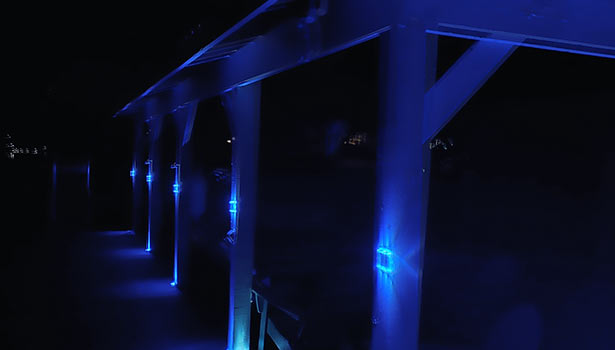
Urban low-traffic roads, residential roads, and parking lots have weak environmental erosion and small vehicle loads.
For cost-sensitive conventional projects, ABS plastic road studs can fully meet daily usage needs, with a low overall procurement cost (about 0.8-1.5 US dollars per piece), and an extremely high cost-performance ratio.
Highway traffic is heavy, and the vehicles have a large load, and they are constantly exposed to strong sunlight and high-temperature exposure.
It is recommended to prioritize the use of PC road studs or PC-ABS composite road studs, and carefully check the product's UV resistance stability, compression performance and IP waterproof grade to ensure long-term stable operation.
Coastal areas are constantly exposed to salt spray corrosion and high air humidity, which easily accelerates plastic aging and metal component corrosion.
It is necessary to select road studs with anti-salt spray materials, reinforced sealing structure, and through anti-corrosion and moisture-proof design to effectively avoid premature failure in high-humidity salt spray environments.
With the continuous improvement of road engineering durability standards, traditional single plastic materials have gradually been replaced by modified composite materials.
Nano-modified materials, high-weather-resistant composite resins, and high-performance polymer materials, with stronger UV resistance, anti-aging, and corrosion resistance capabilities, have become the mainstream material development direction for long-life road studs.
Modern intelligent solar-powered road studs integrate LED light sources, lithium batteries, control circuit boards, and intelligent sensors.
The complex electronic structure puts higher standards on the overall weather resistance of the road studs: the shell needs to have anti-aging and insulation performance, and the internal structure needs to meet moisture-proof and anti-corrosion requirements.
Future road stud design will focus on matching the weather resistance of the material and the durability of electronic components, and adapting to all-weather outdoor intelligent transportation application scenarios.
The material aging caused by ultraviolet rays is the main reason for the shortened lifespan of plastic road studs. The material selection directly determines the basic outdoor durability performance of the road studs.
ABS material is suitable for low-cost and low-demand conventional scenarios; PC and PC-ABS composite materials, with excellent UV resistance and weather resistance, are the best choice for long-term outdoor high-standard projects.
To maximize the lifespan of the road studs, multiple optimization methods need to be combined: using UV-resistant modified materials, installing high-performance surface protective coatings, and optimizing IP68 waterproof sealing structure.
All high-durability road studs must pass the aging and durability tests according to EN1463 standards. Choosing high-quality anti-aging and UV-resistant plastic road studs can significantly reduce the later replacement and maintenance costs, creating long-term economic benefits for road projects.
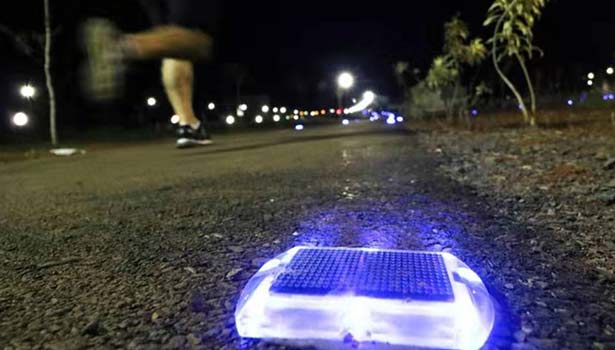
The service life varies greatly depending on the material and the usage scenario. Ordinary ABS plastic road studs have an outdoor service life of 1-2 years; PC road studs can be used stably for 3-5 years; high-quality PC-ABS solar road studs that have been modified with UV resistance and IP68 sealing treatment can have a service life of over 5 years.
The original UV resistance of ordinary ABS road studs is relatively weak. Products without special UV-resistant modification will easily turn yellow, powder, and become brittle after long-term exposure to sunlight, and are not suitable for outdoor harsh scenarios with strong light and high temperatures.
PC-ABS composite material is the best outdoor road stud material with the best comprehensive performance, combining the processing advantages of ABS with the extremely strong anti-aging and UV resistance of PC. High-end solar road studs and long-term outdoor projects should prefer PC-ABS material; for ordinary high-speed road scenarios, PC material has a higher cost-performance ratio.
The ultraviolet rays in the sun will damage the polymer molecular chains of the plastic, causing material oxidation and brittleness. Combined with outdoor temperature and humidity cycles and vehicle rolling impact, the cracked and brittle plastic shell will undergo irreversible cracking and fracture failures.
The core authoritative standards are the EN1463 series, including EN1463-1 (initial basic performance testing) and EN1463-2 (field durability testing). Through multiple tests such as UV aging, salt spray, temperature cycling, compression, and waterproofing, the retention rate of reflective performance is used as the core evaluation basis to determine whether the durability performance of the road studs meets the standards.