In the intelligent transportation management system, solar traffic signs have become core facilities in scenarios such as urban and rural roads, expressways, and industrial parks, thanks to their advantages of energy conservation, environmental protection, and no need for an external power supply. It can not only stably transmit traffic information day and night, as well as in bad weather, but also reduce the rate of traffic accidents through scientific design.
Among the design elements of solar traffic signs, "shape" is an overlooked yet crucial core - when drivers recognize traffic signs, they often quickly determine the type of information (such as instructions, warnings, and guidance) based on the shape first, and then read the specific content. This process only takes 0.3 to 0.5 seconds. Therefore, the choice of the shape of solar traffic signs directly determines the efficiency of information transmission and the strength of traffic safety guarantees.
Next, NOKIN System will disassemble the common standard shapes of solar traffic signs, customization options, key factors influencing shape selection, and provide practical selection suggestions to offer references for traffic management departments, engineering parties, and purchasers.

To visually present the core values of various shapes, the following table sorts out the key information of common standard shapes of solar traffic signs:
|
Shape Type |
Core Traffic Significance |
Typical Application Scenarios |
|
Octagon (Stop Sign) |
Requires vehicles to come to a complete stop; proceed only after ensuring safety |
Intersections, residential area entrances/exits, sections near schools |
|
Inverted Triangle (Yield Sign) |
Indicates the need to slow down or stop, giving priority to main road traffic or merging vehicles |
Intersections without traffic lights, merging sections from secondary to main roads |
|
Diamond (Warning Sign) |
Alerts drivers to potential dangers ahead |
Curves, slopes, construction zones, areas with frequent animal crossings |
|
Square/Rectangle (Regulatory, Guide, or Information Signs) |
Conveys traffic rules, directions, or auxiliary information |
Speed-limited sections, expressway exit guidance, parking lot indications |
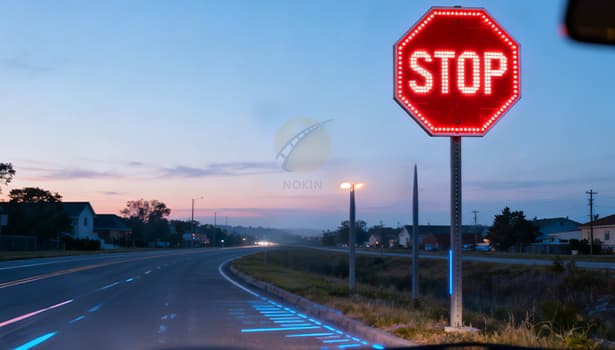
The octagon is one of the very few cases among traffic signs where the shape is strongly bound to the purpose - almost all countries around the world have designated the octagon as the exclusive shape for "Stop" signs. This design is not accidental but stems from its unique visual advantages:
Octagonal shapes have eight symmetrical corners and edges. In road conditions, they can be quickly distinguished from conventional shapes such as circles and squares. Even when drivers are driving at high speeds, they can instantly identify them through the "irregularity" of the corners and edges. Meanwhile, the "ruggedness" of the octagonal shape naturally conveys the attribute of "compulsory and unbreakable" instructions, which perfectly matches the highest-level traffic instruction of "stop".
In solar traffic signs, octagonal stop signs are usually set with a red background, white borders and the character "Stop". At night, they are illuminated by solar-powered LED beads, further enhancing the visual impact. Its application scenarios are highly clear, mostly set up at intersections with blocked visibility or in densely populated pedestrian areas, such as the sections near school gates, to force vehicles to stop and give way to students.
The inverted triangle and the octagon both belong to the category of "instruction flags", but they convey a lower instruction intensity, with the core being "Yield". The design logic of this shape stems from "visual guidance" : the tip of the inverted triangle points downward, naturally giving people a psychological hint of "sinking and slowing down", which echoes the traffic demand of "slowing down and giving way".
In practical applications, solar-powered inverted triangle yielding signs are often set up at the intersections of secondary roads and main roads. For instance, when a branch road in a suburban industrial park is connected to a national highway, an inverted triangle sign will remind the vehicles in the park to "give priority to avoiding the traffic flow on the national highway". Some high-end products are also equipped with radar sensing functions - when a vehicle approaches the main road, the sign will automatically flash, further enhancing the reminder effect.
Unlike the octagonal sign, the inverted triangle sign is not a "forced stop" sign. Instead, it allows drivers to decide whether to stop based on the traffic flow situation. This not only ensures the traffic efficiency of the main road but also reduces the safety risk of merging on side roads. It is an important tool for "flexible regulation" of traffic flow.
The rhombus is the mainstream shape of warning solar traffic signs, and its core value lies in "high recognisability". The four acute angles of a rhombus can form a distinct visual focus in complex road backgrounds such as trees, buildings, and other signs, allowing drivers to quickly capture the "need to be vigilant" signal.
The application scenarios of diamond-shaped signs are highly segmented, almost covering all road hazard points. For example:
The "continuous curve" warning sign on mountainous roads, through diamond-shaped Outlines and curve patterns, reminds drivers to slow down.
The "Construction Ahead" sign on the construction section, combined with solar LED flashing lights, can provide early warnings even at night.
The "Animal Presence" signs on rural roads, featuring a diamond shape and animal graphics, reduce the risk of collisions between pedestrians and vehicles.
It is worth noting that the "warning level" of the diamond-shaped sign can be enhanced through color assistance - a yellow background indicates "general warning", while an orange background is used for "temporary warnings such as construction". The solar-powered traffic sign's constant lighting or flashing function can ensure that such warnings remain effective in low visibility weather such as rain and fog.
Squares and rectangles are the most "flexible" shapes of traffic signs. Due to their high area utilization rate and low production cost, they are widely used in the transmission of various types of information such as regulations, guidelines, and miscellaneous items. The application differences between the two mainly lie in the "information types" :
Squares are more suitable for conveying "static regulatory information", such as "Speed limit 50km/h" and "No parking", etc. This type of information is brief and does not need to be updated frequently. The "regularity" of the square can enhance the "seriousness of the rules".
Rectangles are better at "direction guidance and long text information". Due to the "length-to-width ratio difference" of a rectangle, it can naturally guide the line of sight to move laterally, making it suitable for presenting linear information such as "distance from the expressway exit" and "direction of the scenic area".
In addition to standard shapes, custom shapes are a significant advantage of solar traffic signs - for special scenarios such as private roads, industrial parks, and scenic spots, custom shapes can enhance the accuracy and uniqueness of information transmission. At present, the mainstream custom shapes can be divided into two categories
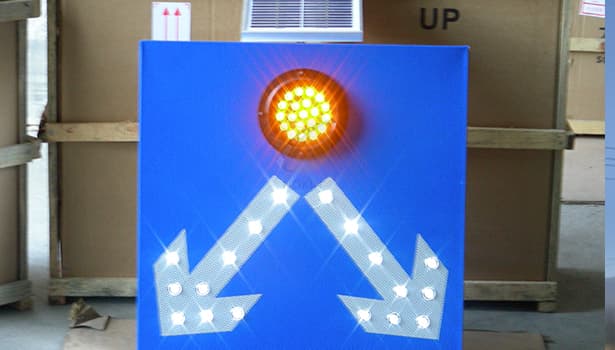
The arrow-shaped is the most widely used type among custom shapes. Its core function is "direction guidance and traffic flow diversion". Its advantage lies in "intuitiveness" - the direction of the arrow can directly convey information such as "turn left, turn right, go straight", without the need for additional textual explanations, making it suitable for various complex traffic scenarios.
The most prominent feature of the solar arrow-shaped logo is its "dynamic design". By storing energy through solar panels, the sign can be set to either "constantly on" or "flashing" mode:
Flashing arrows are mostly used for temporary traffic control, such as "temporary diversion" guidance during road construction. The flashing frequency is usually 1-2 times per second, which can quickly attract drivers' attention.
The always-on arrows are used for fixed guidance, such as the "entrance direction" signs in large parking lots, ensuring clear identification day and night.
For private areas and special scenarios, solar traffic signs can be customized into exclusive graphics. Common types and applications are as follows:
In scenarios such as industrial parks and mining areas, it is often necessary to convey "industry-specific information". Customized graphics can enhance recognition efficiency. For instance, the "No Smoking or Fire" sign in a chemical industrial park can be customized into a unique graphic of "flame + red slash", paired with solar-powered warning lights, which is more targeted than the standard square sign. The sign for the "Truck Weighing Area" in the logistics park can be designed in the shape of a "truck outline", allowing truck drivers to identify it at a glance.
Traffic signs in scenic spots, ancient towns, and other areas can incorporate regional elements to achieve the unity of "functionality and aesthetics". For instance, the "Walking path guidance" sign in the Jiangnan Water Town scenic Area is custom-made in the shape of a "black-roofed boat". The "Viewing Platform Direction" sign in the desert scenic area is designed in the shape of a "camel". Such signs not only convey traffic information but also serve as "miniature business cards" of regional culture.
Private roads, high-end communities, and other enclosed areas can achieve "exclusive management" through customized shapes. For instance, the sign of "Private Road, No entry without Permission" in high-end villa communities can be customized in the shape of the community's LOGO. The "No Entry" sign of the private farm is designed in the shape of a tractor. Such signs can clearly define regional boundaries and, at the same tim,e reflect personalized management needs.
Customized shapes are not a gimmick but the key to addressing the pain points in special scenarios:

The shape of traffic signs has a strong "legal attribute" - almost all countries and regions have clearly defined the correspondence between "shape and information type" through regulations. Shape designs that violate regulations may face administrative penalties and even lead to traffic safety liability disputes.
Regulations in different regions may have minor differences, but the core logic is consistent: achieving "cross-regional cognitive unification" through a uniform shape. Therefore, before choosing a shape, it is necessary to first check the current standards of the local traffic management department, especially for "legally controlled areas" such as public roads and expressways. Compliance is the primary consideration factor.
The core advantage of solar traffic signs is that they are "visible day and night", and the shape directly affects the "visibility efficiency" - good shapes can be quickly captured in complex environments, while poor shapes may be submerged by the background.
Human recognition of shapes follows the "feature first" principle: the number of edges and corners, symmetry, and contour complexity are the key to judgment. For example:
Octagons are easier to recognize than squares because the differences between the edges and corners are more obvious.
Rhombuses are more suitable for warning than circles because they can disrupt visual balance and draw attention.
Arrow-shaped shapes are more suitable for guidance than those without directions, as they can directly direct the line of sight.
To quantify the visibility differences of shapes, the following table compares the performance of common shapes in different environments (out of 10 points) :
|
Shape Type |
Normal Weather (Day) |
Night (No Street Lamps) |
Rain/Fog/Low Visibility |
Complex Background (Multiple Signs) |
|
Octagonal |
9.5 |
9.0 |
8.5 |
9.2 |
|
Inverted Triangle |
9.0 |
8.5 |
8.0 |
8.8 |
|
Rhombus |
9.2 |
8.8 |
8.6 |
9.0 |
|
Square/Rectangle |
8.5 |
8.0 |
7.5 |
8.2 |
|
Arrow-Shaped (Flashing) |
9.6 |
9.5 |
9.0 |
9.3 |
As can be seen from the data, the combined visibility of arrow-shaped (flashing) and octagonal shapes is the best, making them suitable for scenarios with high requirements for recognition efficiency. The visibility of squares/rectangles is relatively weak, making them more suitable for low-speed and low-interference environments.
The shape must be highly consistent with the "type of information" conveyed by solar traffic signs; otherwise, it will cause cognitive confusion. The types of information traffic signs are mainly divided into three categories, and the corresponding shape selection logic is as follows:
Instruction information (such as stop and give way) requires "absolute clarity and no misunderstanding", so shapes that are "exclusive and highly recognizable" should be selected. Octagonal (stop) and inverted triangle (give way) are the best choices - both are "for the only purpose", without ambiguity, and can ensure that drivers quickly receive mandatory or semi-mandatory instructions.
Warning information (such as dangerous sections of road, construction) requires "quickly attracting attention", so shapes that "break the routine and have a strong visual impact" should be chosen. The sharp-angled outline of a rhombus can form a "visual focus" in the road background. When combined with warning colors such as yellow and orange, it can immediately trigger the driver's "vigilant mentality", meeting the need for the transmission of warning information.
For guidance types (such as directions and distances) and miscellaneous information (such as parking lots and restrooms), it is required to "clearly present the content", so shapes with "high area utilization and reading-friendly" should be selected. Square or rectangular shapes can maximize the use of layout space and are suitable for placing detailed content such as text and arrows, allowing drivers to quickly read specific information and meet practical needs.
First, it is necessary to determine whether the usage scenario is a "public area" or a "closed area", as the regulatory requirements for the two are vastly different:
Based on the type of information conveyed, narrow down the range of shape selection. The specific corresponding relationship is as follows:
If the instruction "Stop, give way" is given: In public areas, select an octagonal/inverted triangle. The enclosed area can follow the standard shape or add customized elements based on the standard shape.
Adjust the shape details according to the "degree of interference" of the usage environment:
The cost of custom shapes is usually 30% to 50% higher than that of standard shapes, so it is necessary to judge the necessity of customization rationally.
If the standard shape meets the requirements, it is preferred (for example, a square shape is sufficient for the "Speed limit 20km/h" sign in an industrial park, and no customization is needed).
If the standard shape cannot convey exclusive information, then consider customization (for example, the "No Tractor Entry" sign on a private farm can be customized in the shape of a tractor).
When customizing shapes, it is necessary to control "complexity": Overly complex graphics (such as detailed portraits of people) will increase production costs and may reduce recognition efficiency. It is recommended to focus on "simple Outlines".
The shape selection of solar traffic signs is essentially the "precise expression of traffic language" - from octagonal mandatory instructions to rhombic danger warnings, from rectangular clear guidance to customized graphic exclusive transmission, each shape carries the core mission of "making roads safer". If you still have questions about the shape selection for specific scenarios (such as scenic spots, industrial parks), you are welcome to contact NOKIN at any time and provide scene details and information requirements to obtain a customized selection plan tailored to your needs.