Approximately 70% of night driving safety accidents are directly related to insufficient visual visibility. Road lighting and pavement markings, as the two core elements ensuring the safety of night traffic, their facility selection directly affects the safety and economy of the traffic system.
The current mainstream road lighting environment guarantee facilities can be classified into three categories: solar road studs, traditional street lights and solar street lights. Although all three fall under the category of "road lighting facilities", they have essential differences in functional positioning, cost structure and scene adaptability.
This article will systematically analyze the differentiated characteristics of the three from two core dimensions: cost structure and application scenarios, providing scientific selection basis for scenarios such as road engineering planning and traffic facility upgrading.
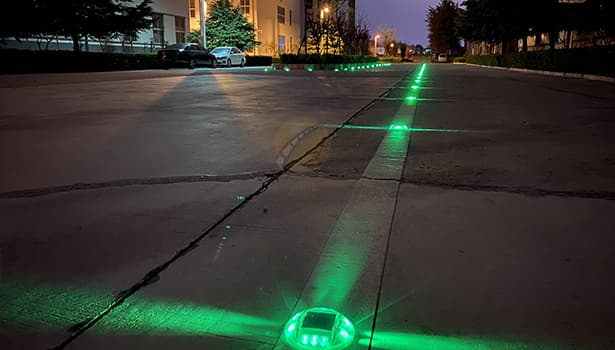
The initial investment in solar-powered road studs is relatively high, and the core reason lies in their special application environment requirements. As a facility directly deployed on the road surface, it is necessary to use high-strength and durable materials that are resistant to pressure, water and aging. At the same time, it should integrate high-efficiency LED light-emitting modules and small energy storage units to ensure long-term stable operation in complex road conditions.
The initial investment in street lights shows a significant type differentiation. The initial cost of traditional street lights is relatively low. The core components of street lights are only light poles, lighting fixtures and basic installation parts. There is no need to configure an additional energy supply system, and they can directly rely on the existing urban power grid wiring to provide power.
The initial investment in solar street lights is significantly higher than that of the former two. Besides the light posts and lights, the cost structure also includes core components such as high-efficiency photovoltaic panels, large-capacity energy storage batteries, and intelligent charge and discharge controllers. Moreover, the system parameters need to be customized according to the lighting conditions of the installation area, further increasing the initial investment.
|
Facility Type |
Operation Power Supply Mode |
Electricity Expenditure Situation |
Operation Cost Characteristics |
|
Solar-powered road studs |
Photovoltaic power generation + built-in energy storage, self-sufficient |
No electricity expenses |
No need for external power grid, achieving zero operating costs |
|
Traditional street lights |
Powered by the urban power grid, relying on continuous supply |
High electricity expenses |
Electricity costs accumulate annually with lighting duration and power, leading to heavy long-term burden |
|
Solar street lights |
Photovoltaic panels + energy storage system, self-sufficient |
No electricity expenses |
Zero operating cost advantage; only temporary storage shortage may occur in extreme weather |
The maintenance cost of solar-powered road studs is extremely low. Their structural design is simple, with no complex electrical circuit interfaces. Daily maintenance only requires regular cleaning of surface dust and stains to ensure the visibility of the light-emitting module. The service life of core components such as LED beads and energy storage units can generally reach 5 to 8 years, during which professional maintenance is basically not required.
The maintenance cost of traditional street lights is significantly high, and the maintenance scope covers both the lights themselves and the supporting power grid infrastructure. Faulty lighting fixtures need to be replaced in a timely manner. However, the investigation and repair of problems such as aging power grid lines, transformer faults, and damaged junction boxes not only require professional technicians to operate but may also involve additional procedures such as road excavation and power outage operations, further increasing the time and financial costs of maintenance.
The maintenance cost of solar street lights is at a moderately low level, with the core maintenance focusing on two major components: photovoltaic panels and batteries. Photovoltaic panels need to be cleaned regularly to ensure power generation efficiency, while batteries should undergo condition checks and performance evaluations every 3 to 5 years, and be replaced when necessary. The overall maintenance process is relatively simple and does not involve the inspection and repair of complex power grid systems.
From a full life cycle perspective, solar-powered road studs demonstrate an extremely high cost-performance ratio. Although the initial investment is higher than that of traditional street lights, the advantages of zero operating costs and low maintenance costs will continue to be magnified over time. Usually, the initial investment can be recovered within 3 to 5 years through the savings in electricity and maintenance fees, and "zero-cost operation" can basically be achieved in the subsequent usage stage.
The long-term comprehensive cost of traditional street lights is the highest. The initial low-cost advantage will be quickly offset by the accumulated electricity and maintenance fees over the years. Take a 1-kilometer urban main road as an example. The annual electricity cost of traditional street lights can reach tens of thousands of yuan, and with an average annual maintenance cost of several thousand yuan, the total expenditure over a 10-year period far exceeds that of solar road studs and solar street lights.
The long-term comprehensive cost of solar street lights is lower than that of traditional street lights, but slightly higher than that of solar road studs. The high initial investment will be spread out within 5 to 6 years through electricity cost savings. Moreover, with the iteration of photovoltaic module and battery technologies, the cost of core components continues to decline, and the cost-effectiveness throughout the entire life cycle is still constantly improving.
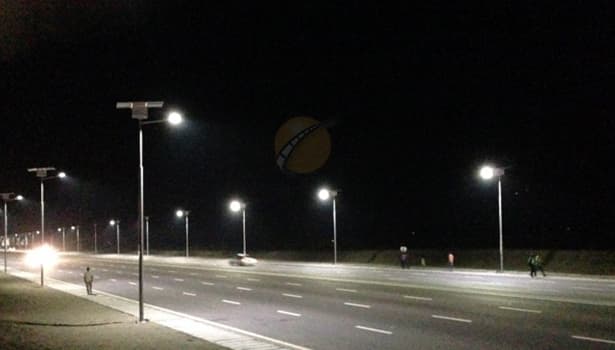
The core functional positioning of solar-powered road studs is "precise road surface marking and safety warning". It precisely marks key points such as road boundaries, lane dividers, curves, slopes, and construction areas through the light-emitting modules embedded in the road surface, providing drivers with clear road outline guidance. Its functional essence is to "define the form of the road" rather than "illuminate the road environment".
The core function of traditional street lights is "stable large-area lighting". Relying on high-power lights deployed on high poles, they project a wide range of light onto the ground, reducing the contrast between light and dark in the environment, allowing drivers to clearly observe pedestrians and obstacles on both sides of the road. Its core function is to "enhance environmental brightness" and achieve universal visibility within the area.
Solar street lights inherit the core attribute of "large-area lighting" of traditional street lights in terms of function, while adding the additional advantage of "energy independence". It can not only cover a wide area like traditional street lights, but also break away from the reliance on the power grid, achieving a dual functional combination of "lighting coverage + independent energy supply".
Solar-powered road studs demonstrate unique advantages in special weather conditions. Ordinary reflective signs rely on vehicle lights to reflect and display, while solar-powered road studs have their own active light-emitting characteristics. In low-visibility weather such as heavy fog, heavy rain, and sandstorms, the light-emitting distance can reach over 200 meters, which is far superior to the 50-80 meters of reflective signs, providing drivers with more sufficient reaction time.
The performance adaptability of traditional street lights is concentrated in areas with well-covered power grids. Due to its reliance on a stable power grid for supply, it performs stably in areas with mature power grid infrastructure such as the core urban areas and old urban districts. It can set a fixed lighting duration and brightness according to demand, meeting the requirements of long-term and highly stable lighting. However, in remote areas not covered by the power grid, it is simply impossible to deploy and operate.
The performance adaptation of solar street lights is directly related to the lighting conditions and they are most suitable for deployment in areas with sufficient annual sunshine hours. Meanwhile, its energy storage system endows it with emergency power supply capabilities. Some high-end models can automatically switch to energy storage power supply mode when there is a sudden power outage in the power grid, ensuring several hours of emergency lighting. This feature makes it irreplaceable in places such as highway service areas and remote scenic spots.
The ideal application scenarios of solar-powered road studs can be divided into two categories: One is areas that require precise road guidance, such as the lane edges of expressways, the curves of interchanges, and both sides of zebra crossings on urban roads; Another category consists of remote areas without power grid coverage, such as rural roads, mountain access roads, and temporary passages in industrial parks. These areas cannot support the operation of traditional street lights but urgently need basic road markings to ensure safety.
traditional street lights are more suitable for public areas with mature power grids and stable lighting demands. In places such as the core streets of cities, residential areas in old urban districts, and large parking lots, where the power grid wiring is complete and 24-hour or fixed-period lighting coverage is required, traditional street lights can be quickly deployed relying on the existing infrastructure to meet the basic lighting needs.
Solar street lights have become the preferred choice for areas with inconvenient power grids and scenarios with energy-saving demands. In areas such as the main roads in rural areas, sightseeing roads in scenic spots, and newly-built roads in suburban development zones during the construction of new rural areas, where the cost of power grid wiring is high or the laying has not yet been completed, solar street lights can operate independently. Meanwhile, in urban energy-saving renovation projects, solar street lights can effectively reduce the load on the power grid and meet the demands of green and low-carbon development.
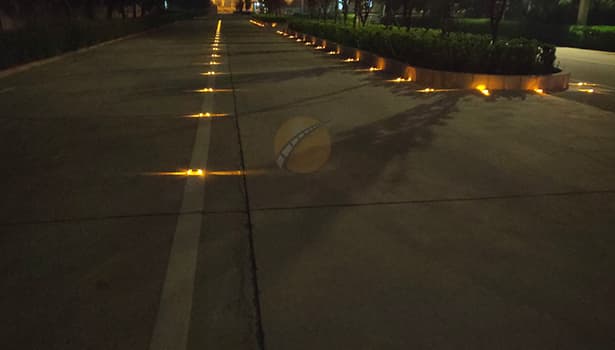
If the project is located in a remote area without power grid coverage and the core demand is road marking rather than large-scale lighting, solar-powered road studs are the best choice. Its feature of not requiring grid support can save a huge amount of line laying costs, and at the same time, zero operating costs can significantly reduce the long-term maintenance burden.
For instance, in the renovation project of rural roads in mountainous areas, the roads are narrow and full of curves. The key demand is to mark the edges of lanes and dangerous sections. At this time, the cost of deploying solar road studs is only one-third of that of traditional street lights, and there is no need to pay electricity bills in the later stage. The cost can be recovered within three years.
In urban environments that require large-scale lighting, the choice between traditional street lights and solar street lights needs to comprehensively consider the budget cycle and energy-saving requirements.
If the short-term budget of the project is limited and the power grid in the area where it is located is mature, traditional street lights can be used as a transitional option. Their low initial investment can reduce the initial financial pressure of the project. However, it is necessary to assess the long-term electricity bill expenses in advance to avoid cost control in the later stage.
If a project aims for long-term returns or has clear energy-saving goals, solar street lights have more advantages. In scenarios such as road construction in newly developed areas and energy-saving lighting renovations in old urban areas, although the initial investment in solar street lights is relatively high, the total expenditure after 5 to 6 years will be lower than that of traditional street lights, and they can also receive policy support for green buildings or energy-saving projects.
Most road projects do not have a single demand. They need to achieve a dual guarantee of "lighting coverage + precise warning" through the combination of facilities. The coordinated application of the three types of facilities can maximize safety and economic benefits.
For the main road scene, a combination of "solar street lights + solar road studs" can be adopted: solar street lights are responsible for large-scale lighting to ensure the overall visibility of the road. Solar-powered road studs should be installed at key points such as intersections, zebra crossings and curves to enhance precise guidance and safety warnings and reduce the incidence of traffic accidents.
The scenic area road scene is suitable for the combination of "solar street lights + solar road studs" : Solar street lights provide soft ambient lighting, which meets the environmental requirements of the scenic area. Solar-powered road studs are deployed along the edges and steps of the walkway to mark the passage path and prevent tourists from getting lost or falling at night.
For the renovation of old urban areas, a transitional solution of "traditional street lights + solar road studs" can be adopted: retain the existing traditional street lights to meet basic lighting needs, and add solar road studs in densely populated areas such as school gates and community entrances and exits to enhance safety warnings for pedestrians and vehicles at night, achieving safety upgrades at a low cost.
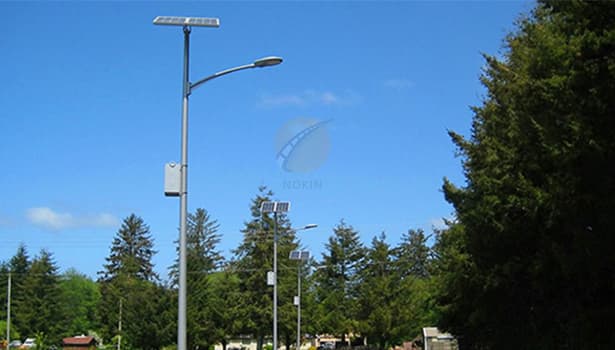
Solar-powered road studs, traditional street lights and solar street lights are not in a replacement relationship, but rather form a "three-dimensional system" for ensuring the light environment of roads. The three have their own advantages and disadvantages in terms of cost structure, and complement each other in functional positioning, adapting to the differentiated demands of different scenarios.
With the iteration of photovoltaic technology and the decline in energy storage costs, the cost performance of solar road studs and solar street lights will continue to improve. In the future, the coordinated application of the three will become the mainstream model for the construction of road safety facilities, which not only meets the safety requirements of night passage but also conforms to the development concept of green and low-carbon, providing a fundamental support for the construction of a smart transportation system.