In the road transportation infrastructure industry, almost all solar road stud manufacturers use highly similar marketing rhetoric: improving nighttime driving safety, reducing the probability of road accidents, and optimizing road visibility.
However, the core issue remains unresolved: almost no brand can provide verifiable, quantifiable, and retrospective objective evidence. "Safety" has become a generic marketing adjective, lacking unified standards, data support, and calculation basis.
For transportation department decision-makers, infrastructure contractors, and safety consulting agencies, vague safety claims are of no reference value. Bidding, project acceptance, and road safety renovations require verifiable and quantifiable performance, not marketing gimmicks.
This article maintains the core stance that road safety is not a subjective adjective, but a precisely calculable physics and mathematics problem. We will complete two core tasks to thoroughly clarify the safety value of solar-powered road studs:
First, based on standard braking physics formulas, we will accurately convert the visibility distance of reflective road studs and active LED solar-powered road studs into driver reaction time and parking safety redundancy.
Second, we will review authoritative third-party academic research and industry technical reports globally, using publicly available data to demonstrate the safety advantages of active solar-powered road studs and construct a traceable selection basis.
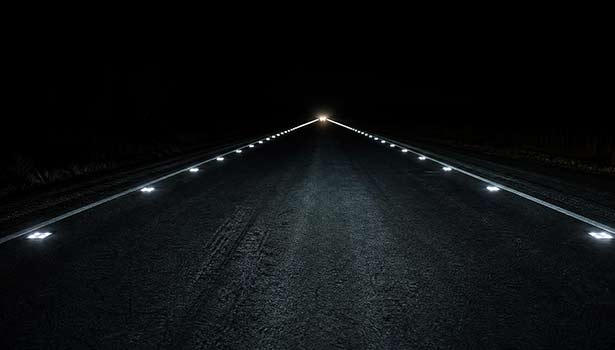
Many people mistakenly believe that the core function of road studs is simply "to help drivers see the road edges." However, from a driving safety perspective, road studs carry a complete identification-reaction-braking safety chain; a break in any link can lead to a traffic accident.
A complete safe parking process consists of three indispensable steps:
Visual Recognition: The driver detects road stud lights/reflective signals from a distance, identifying road direction, curves, side lines, and obstacles.
Neural Response: The brain receives signals, assesses road conditions, and makes a decision to decelerate or brake.
Braking and Stopping: The vehicle completes the braking action, gradually decelerating until it comes to a complete stop.
Nighttime driving environments are complex, and two key variables directly determine the final parking distance, which are also the core basis of this calculation:
Nighttime visibility is limited, and visual fatigue is increased. The industry standard reaction time is 1.5–2.5 seconds, encompassing signal recognition, road condition assessment, and operational decision-making. This paper uses the median value of 2 seconds for calculation, which aligns with most driving scenarios.
The standard deceleration on a dry, flat road surface is 5.9 m/s² (0.6g). In rainy, foggy, or flooded conditions, deceleration decreases significantly, resulting in a significantly longer parking distance and a lower safety margin.
The essence of road stud visibility distance is not a gimmicky parameter like "seeing farther," but rather providing drivers with ample lead time for the entire stopping chain.
If visibility is insufficient, by the time the driver notices the road condition, the remaining stopping distance is already less than the minimum braking distance required, causing the safety chain to break directly, and greatly increasing the likelihood of rear-end collisions, lane departures, and rollovers.
To intuitively quantify the safety differences between 90m reflective road studs and 800m active LED solar-powered road studs, we used the commonly used physical formula for minimum stopping distance in the transportation industry, covering three mainstream road speed limits: 60km/h, 80km/h, and 120km/h, to complete accurate calculations.
Minimum Stopping Distance = Reaction Distance + Braking Distance
Reaction Distance = Vehicle Speed (m/s) × Reaction Time
Braking Distance = v² / (2a) (v is vehicle speed, a is road deceleration)
This calculation uses the following unified standards: reaction time 2 seconds, standard deceleration of 0.6g on dry road surface. All values are accurate estimates, and the order of magnitude conclusions are stable and valid.
|
Parameter |
60 km/h |
80 km/h |
120 km/h |
|
Speed Conversion |
16.7 m/s |
22.2 m/s |
33.3 m/s |
|
Reaction Distance (2 s) |
≈ 33 m |
≈ 44 m |
≈ 67 m |
|
Braking Distance (Dry Road) |
≈ 24 m |
≈ 42 m |
≈ 94 m |
|
Minimum Stopping Distance |
≈ 57 m |
≈ 86 m |
≈ 161 m |
|
Reflective Road Stud Visibility Distance |
90 m |
90 m |
90 m |
|
Safety Redundancy – Reflective Road Studs |
≈ 33 m ✅ |
≈ 4 m ⚠️ |
Insufficient ❌ |
|
LED Solar Road Stud Visibility Distance |
800 m |
800 m |
800 m |
|
Safety Redundancy – LED Solar Road Studs |
≈ 743 m ✅ |
≈ 714 m ✅ |
≈ 639 m ✅ |
Note: This table is an estimate based on a standard braking physics model. Actual stopping distances may be slightly adjusted due to factors such as tire wear, road slope, rain/snow, and vehicle condition, but the safety differences between different road studs and the overall conclusions will not change.
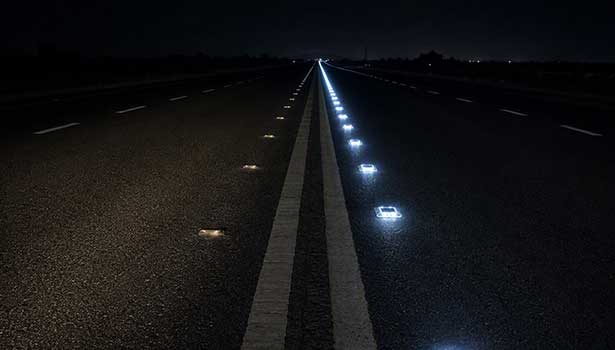
At a high speed of 120km/h, a 90m visibility distance is physically "too late to stop"—the moment the driver sees the road stud, the required braking distance has already exceeded the visible range, leaving no safety margin for error; while an 800m visibility distance provides nearly 640 meters of safety redundancy for driving. This is the core value of active solar road studs.
This calculation also overturns the one-sided perception that "sufficient visibility is enough," and corrects the absolute assertion that "the greater the visibility, the more redundant."
In scenarios involving national and provincial highways at speeds of 80 km/h, 90m reflective road studs only have a 4m safety margin remaining, offering virtually no tolerance for error and making them highly susceptible to failure in rainy weather, at night, or during periods of fatigued driving.
This also confirms that road stud selection cannot be standardized; it must be strictly matched to the road's design speed. Active LED solar-powered road studs must be prioritized for highways.
This article compiles five publicly verifiable, authoritative, and independent research reports and academic documents to objectively demonstrate the safety value of active solar-powered road studs, while also truthfully presenting the limitations of the research to ensure the content's authenticity and credibility.
Source: Latest industry research report from TRL, publicly reported by highways-news.com
Core Conclusion: In sections with actively illuminated solar-powered road studs, drivers' nighttime visibility, road condition judgment, and driving confidence are significantly improved. This facility can effectively regulate driving trajectories and reduce unintentional lane crossings, lane departures, and other dangerous driving behaviors.
Source: *Active Road Studs as an Alternative to Lighting on Rural Roads*
Key Findings: In rural road scenarios lacking streetlights or other lighting, active solar road studs are an efficient and low-cost lighting alternative. They can effectively improve driver confidence at night, expand safe nighttime travel scenarios, and significantly reduce the probability of accidents on rural roads.
Source: *Solar-Powered Active Road Studs and Highway Infrastructure Effect on Vehicle Speeds*
Key Findings: Long-term field monitoring along a 20-kilometer national arterial road section confirms that active solar road studs can positively influence driver behavior, suppressing dangerous maneuvers such as speeding and reckless lane changes, and continuously optimizing road traffic safety and order.
Source: FHWA website, "Pavement Marking Safety Studies" public research page
Core safety benefit data: Adding both edge and center lines simultaneously can reduce road accidents by 36%; adding edge marking facilities on top of existing center lines can further reduce accident risk by 8%.
Objective research limitations: Chapter 6 of the FHWA study clearly points out that in a four-lane highway scenario, traditional raised road marking facilities have no significant effect on improving overall accidents and nighttime accidents. The benefits of road safety facilities vary greatly depending on the scenario and cannot be applied uniformly.
Source: EU Research & Innovation official success case, "Smart road studs guide drivers to safety"
Core conclusion: The intelligent solar-powered road stud upgrade project demonstrates clear practical value and promotion potential in three dimensions: improved driving safety, control of road maintenance costs, and optimization of carbon emissions, making it a preferred solution for smart highway upgrades.
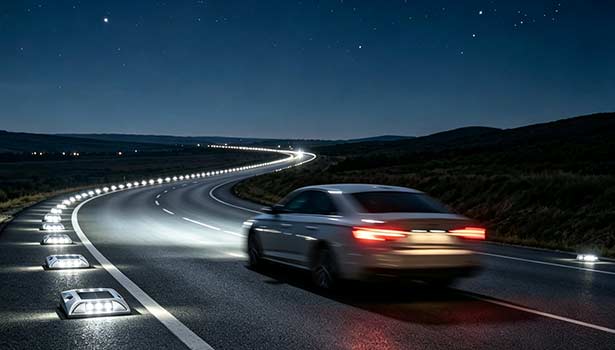
Many road stud brands on the market directly claim "accident rates reduced by 30% or 50% after installation." While such absolute figures seem enticing, they are extremely imprecise and do not conform to the logic of traffic engineering.
We proactively disclose data limitations and adhere to the principles of professional and objective advertising, which is also the core bottom line of a reliable infrastructure supplier.
Most road sections with installed solar-powered road studs undergo multiple safety upgrades simultaneously, including lane marking repainting, road surface renovation, speed limit adjustments, and guardrail repairs.
The subsequent decrease in accident rates is the result of the combined effect of multiple upgrades and cannot be attributed solely to the road stud product. Any claim of a single, quantifiable reduction lacks scientific basis.
The large-scale commercial application of solar-powered active road studs has only been around for 5-10 years. Compared to traditional traffic facilities, there is a lack of long-term, cross-seasonal, and all-scenario accident statistics, and there is currently no unified standard for calculating the reduction across the entire region.
Annual traffic volume variations, frequency of extreme weather, driver adaptation periods to new facilities, and adjustments to regional traffic control policies can all interfere with accident data statistics, making it impossible to accurately isolate the impact of a single variable.
We do not promise to "reduce the accident rate by XX%"—no responsible manufacturer should make such an absolute promise. What we can rigorously prove is that an 800-meter visibility distance provides hundreds of meters of real safety redundancy for highway driving, giving drivers ample reaction and braking time. This is a law of physics, not marketing rhetoric.
For bidding, procurement, and acceptance scenarios for transportation departments and engineering contractors, we have compiled actionable selection criteria and a checklist of inquiries, eliminating blind selection and using data to control project quality.
Strictly align with the international standard of road studs. Vague descriptions are prohibited in tender documents; two core indicators must be clearly stated:
Scenario-Specific Visibility Distance: Clearly define the measured visibility distance on dry roads, wet roads, and in low-light conditions at night.
Test Condition Labeling: Clearly specify test speed, ambient brightness, and observation height, eliminating falsely labeled parameters.
During procurement discussions, the following documents can be directly requested from suppliers to verify product authenticity and professionalism:
Third-party authoritative light intensity test report: Verify that the product's CD light intensity parameters meet the optimal safety range.
Description of actual visibility distance test scenarios: Differentiate between darkroom simulation data and real-world road test data.
Nighttime footage of implemented projects, maintenance follow-up records, and project acceptance reports.
Product waterproofing, pressure resistance, and weather resistance test reports: Adaptability to different road conditions and climates.
Based on the core physical formulas presented in this paper, rapid project adaptation verification can be completed: Substitute the minimum stopping distance into the formula according to the project's road design speed, compare it with the product's nominal visibility distance, verify the adequacy of safety redundancy, and eliminate safety hazards caused by falsely advertised parameters.
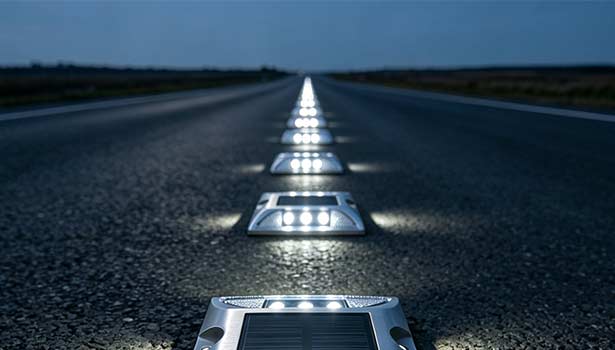
Combining physical calculations and third-party research data, we can clearly state that road safety is never a matter of emotional propaganda, but rather a precise and controllable mathematical problem.
Traditional reflective road studs with a 90-meter visibility distance can only barely meet the needs of low-speed roads. Their fault tolerance is extremely low on medium-to-high-speed sections above 80 km/h, and they are completely ineffective in high-speed scenarios at 120 km/h.
Active LED solar-powered road studs with an 800-meter ultra-long visibility distance retain sufficient safety redundancy across all speed ranges, physically eliminating the accident hazard of "not having enough time to stop," making them the optimal choice for highways, mountain roads, and sections prone to rain and fog.
Only products that dare to use formulas for verification, dare to use data for evidence, and dare to be honest about their limitations are worthy of being included in the bidding list.