Road construction and maintenance areas often present various traffic safety hazards. Issues such as temporary lane changes, construction area isolation, curve guidance, and insufficient nighttime visibility can easily lead to traffic chaos and accidents.
Solar-powered road studs and traffic cones are two of the most commonly used safety facilities in road construction. They are complementary in function but have different focuses: traffic cones primarily serve as temporary traffic guidance and area isolation, while solar-powered road studs emphasize precise road surface illumination for guidance. The Federal Highway Administration (FHWA) in the United States classifies traffic cones as standard temporary traffic guidance facilities, while solar-powered road studs are long-term road surface guidance devices. This article will compare their core differences, applicable scenarios, and selection solutions to provide a reference for engineering procurement and on-site construction.
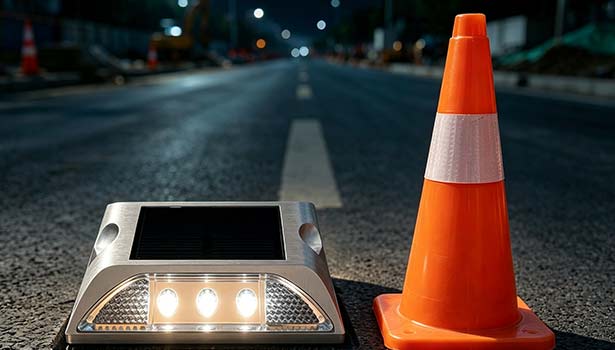
Solar-powered road studs are active light-emitting road surface guidance devices that do not require an external power source. They rely on solar energy storage and intelligent light-sensitive start/stop. The device integrates solar panels, rechargeable batteries, LED light sources, and photosensors. It stores energy during the day and automatically emits light at night, stably marking lanes, road edges, curves, and detour routes, enhancing driving visibility at night and in low-light conditions.
Traffic cones are portable temporary traffic devices compliant with MUTCD standards. They feature a high-visibility orange body, reflective strips, and a counterweight base. They require no installation, can be quickly deployed, and are flexibly adjustable. Primarily used for short-term construction and emergency scenarios for traffic separation, lane closures, and construction area warnings, they are a core piece of equipment for temporary traffic control.
The core differences between the two devices lie in their working principles, installation methods, and applicable scenarios. The table below visually illustrates their functional differences:
|
Comparison Dimension |
Solar-Powered Road Studs |
Traffic Cones |
|
Core Function |
Road-level luminous guidance and lane delineation |
Temporary traffic diversion, channelization, and area warning |
|
Installation Method |
Fixed installation on the road surface |
Movable and freely placeable |
|
Visibility Position |
Road-surface level |
Elevated, three-dimensional position above the road surface |
|
Light Source |
Built-in LED for active illumination |
Reflective strips for passive light reflection |
|
Nighttime Guidance Mode |
Continuous active illumination with autonomous visibility |
Relies primarily on vehicle headlights for reflective visibility |
|
Mobility |
Very low |
Very high |
|
Deployment Speed |
Relatively slow; requires professional installation |
Fast; can be quickly deployed on-site |
|
Post-Deployment Flexibility |
Limited adjustment after installation |
Highly flexible; can be repositioned at any time |
|
Lane Marking Adaptability |
Highly adaptable |
Well suited to common temporary lane-marking scenarios |
|
Long-Term Guidance Adaptability |
Highly suitable |
Less suitable |
|
Emergency Deployment Capability |
Limited |
Excellent |
|
Adaptability to Frequent Site Relocation |
Poor |
Excellent |
In short, solar LED road studs provide stable, layered illumination for road surface guidance, while traffic cones offer flexible, visible temporary overhead traffic guidance. The two devices are complementary safety features, not simple replacements.
The core advantage of solar-powered road studs is their active illumination and visibility, completely independent of vehicle headlights, achieving autonomous nighttime visibility.
During the day, the device absorbs light energy through solar panels and stores it in a rechargeable battery. At night or in low-light conditions, a light sensor automatically triggers the LED light source to continuously illuminate.
The device is installed flush with the road surface, forming a continuous illuminated road surface guide line, providing drivers with clear road boundaries and driving path references in real time.
Traffic cones employ a dual visual warning mode of "color recognition + passive reflection," without autonomous illumination capabilities.
The high-saturation orange main body is highly recognizable in strong daylight, allowing drivers to quickly identify the construction area from a distance.
The reflective strips attached to the cones reflect vehicle headlights, creating bright spots to meet basic nighttime visibility requirements. The MUTCD standard explicitly requires that traffic guidance equipment used during nighttime construction must be equipped with standard reflective structures to ensure basic traffic safety.
By utilizing a raised, three-dimensional deployment, traffic cones create prominent vertical visual markers, helping drivers clearly distinguish traffic flow separation zones.
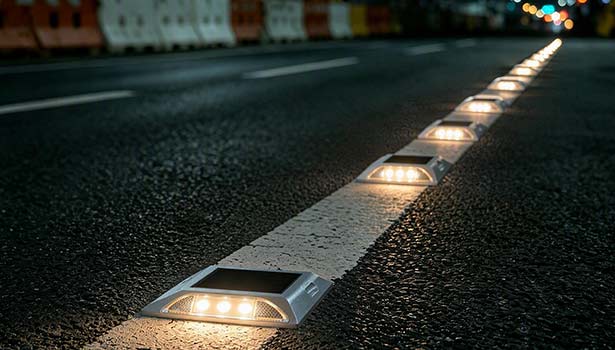
Nighttime road construction commonly faces challenges such as insufficient ambient light and poor driver visibility. Solar-powered road studs provide 24-hour uninterrupted road guidance without the need for external power supply.
Widely used for temporary lane markings, construction entrance/exit demarcation, and temporary detour route marking, effectively reducing the risk of vehicles deviating from their lanes or accidentally entering construction zones at night.
For long-term road reconstruction, bridge repair, and long-term lane adjustments, the construction layout remains stable over time, eliminating the need for frequent adjustments.
Compared to traffic cones that require repeated deployment, solar road studs serve as fixed auxiliary guidance devices, maintaining a consistent and clear road boundary and lane indication effect over the long term, reducing the labor costs of repeated construction and deployment.
Sharp curves, horizontal curves, lane merging, and transition sections are high-risk areas for traffic accidents in construction zones.
The continuous road surface illumination guidance of solar LED road studs can accurately mark the direction of curves, compensating for the limitation of traffic cones in not being able to represent continuous road curvature, helping drivers anticipate road conditions and adjust their driving direction in advance.
When road construction causes traffic to detour or temporarily change course, solar-powered road studs can visually regulate vehicle routes and streamline chaotic traffic flow.
Important Note: Solar road studs only provide path guidance and do not offer physical isolation or protection; they cannot independently achieve safety isolation in construction areas.
In low-visibility scenarios such as nighttime, rain, fog, and construction dust, ambient light is significantly reduced, severely limiting driving visibility.
The active illumination of solar road studs provides stable auxiliary visual references, improving the visibility of road boundaries and driving paths. It should be noted that the equipment cannot completely eliminate the risks of traffic in extreme weather conditions; it can only optimize guidance.
Small-scale temporary operations such as short-term road repairs, pipeline maintenance, and road inspections are the core application scenarios for traffic cones.
Traffic cones conforming to FHWA and MUTCD standards are standard equipment for short-term construction traffic control, quickly enclosing construction areas and providing traffic warnings, with low deployment costs and high efficiency.
The flexibility of traffic cones is particularly prominent in scenarios such as temporary road closures, lane narrowing, and traffic separation.
Construction personnel can flexibly arrange traffic cones according to the actual lane conditions on site, building standardized temporary traffic boundaries and adapting to various temporary lane transition schemes.
Scenarios such as road accident handling, sudden road surface damage, and emergency pipeline repairs require rapid on-site safety protection deployment.
Traffic cones require no installation and can be deployed immediately, quickly marking dangerous areas and isolating normal traffic flow to prevent secondary accidents—a core advantage that fixed solar-powered road studs cannot match.
For construction projects with frequent site changes, traffic cones are the optimal choice for phased construction, daily changes in the construction area, and frequent adjustments to lane layouts.
Traffic cones can be moved and rearranged at any time according to the construction progress and traffic plans, without fixed constraints, offering extremely high flexibility in adapting to different scenarios.
The table below clearly defines the suitability and optimal solutions for these two types of equipment in different construction scenarios, providing an intuitive reference for B2B procurement:
|
Construction Scenario |
Solar Road Studs |
Traffic Cones |
Selection Recommendations |
|
Short-Term / Emergency Construction |
△ |
✓ |
Preferred: Traffic cones — Quick deployment and cost-effective for temporary applications. |
|
Nighttime / Long-Term Construction |
✓ |
✓ |
Recommended: Combined use — Balances traffic isolation with precise nighttime guidance. |
|
Precise Road Marking |
✓ |
△ |
Preferred: Solar road studs — Provide accurate pavement-level marking and long-term stability. |
|
Construction in Severe Weather |
✓ |
✓ |
Recommended: Combined use — Provides multi-layered safety protection under challenging weather conditions. |
In summary, the core advantage of traffic cones is their flexible deployment and dynamic adaptation to traffic flow adjustments; the core advantage of solar road studs is their stable and continuous road surface illumination guidance. They are not competing substitutes, but rather complementary and synergistic safety solutions for construction areas.
The core value of using these two devices together is to create a comprehensive, three-dimensional safety warning and guidance system for the construction area.
Traffic cones, as vertical 3D markers, fulfill the core functions of isolating construction area boundaries, guiding traffic flow, and separating lanes, helping drivers quickly identify the overall construction area.
Solar-powered road studs, as illuminated road surface markers, accurately mark driving paths, road edges, and curve directions, solving the problem of unclear micro-path guidance during long-distance travel.
In nighttime partial lane closure construction scenarios, the combined protection effect of these two devices is most significant.
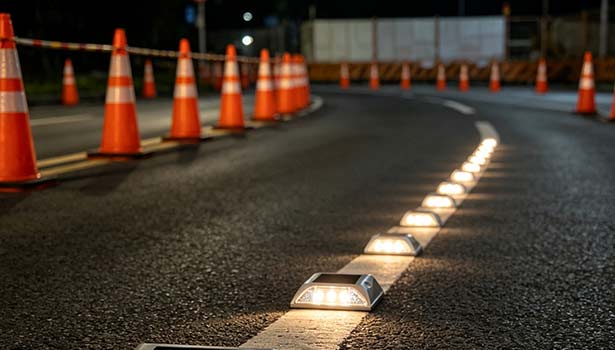
Construction workers deploy traffic cones outside the construction area, forming a closed isolation zone to prevent vehicles from accidentally entering the dangerous construction area from a three-dimensional perspective.
Simultaneously, solar LED road studs are laid along the edge of temporary traffic lanes, continuously illuminating and guiding vehicles smoothly along standard temporary routes.
This solution achieves dual protection of "vertical 3D warning + precise road surface guidance," significantly reducing the risk of traffic accidents in nighttime construction areas.
For short-term maintenance and emergency construction scenarios (1-3 days), traffic cones requiring no complex installation offer better cost-effectiveness and faster deployment.
For long-term construction projects lasting weeks or even months, solar-powered road studs provide stable and long-term traffic guidance, reducing the labor costs of repeated deployments.
For construction areas primarily operating during the day, highly visible traffic cones are sufficient for basic warning and traffic guidance needs.
For projects with extended nighttime operations and poor site lighting, actively illuminating solar-powered road studs are essential equipment. They can be combined with reflective or illuminated traffic cones to comprehensively enhance safety protection.
For scenarios where construction plans are adjusted daily and lane layouts frequently change, flexible and movable traffic cones are the optimal choice.
For sites with stable construction layouts and long-term fixed traffic paths, the core advantage of continuous guidance from solar-powered road studs can be fully utilized.
For scenarios requiring precise road path positioning, such as curves, ramp transitions, and narrow temporary lanes, solar-powered road studs are irreplaceable.
For simple isolation and large-scale traffic flow warning scenarios on straight roads, traffic cones fully meet the needs.
When sudden road emergencies or emergency repairs require immediate enclosure and protection, traffic cones that can be deployed quickly are preferred.
For planned phased construction, solar-powered road studs can be installed in advance to establish a long-term and stable guidance system.
In complex construction scenarios such as urban road reconstruction, highway maintenance, and long-distance nighttime construction, single equipment has significant protective shortcomings.
The combination of solar-powered road studs and traffic cones fully covers the three core needs of warning, isolation, and guidance, making it the most professional safety configuration for high-standard construction areas.
Focus on LED brightness, emission color, operating mode, and viewing angle. High-brightness LEDs are required for construction scenarios to ensure clear visibility in rain, fog, and darkness. The system offers selectable constant-on or strobe modes depending on the scenario, and its wide-angle design meets the observation needs of multi-lane vehicles, eliminating blind spots.
Construction areas experience frequent traffic from engineering vehicles and heavy trucks, requiring the selected solar road studs to possess high strength and resistance to pressure and impact.
Procurement should match the load-bearing capacity to the on-site traffic flow and vehicle type to prevent repeated vehicle crushing and equipment failure.
Outdoor construction areas face complex environments such as rain, mud, dust, and temperature fluctuations; products with high IP protection ratings are preferred.
Excellent weather resistance ensures stable operation of the equipment throughout the year, reducing the probability of failure and replacement costs.
Key performance indicators include battery type, battery capacity, solar panel conversion efficiency, and full-charge runtime.
High-efficiency photovoltaic panels and large-capacity batteries ensure sustained illumination even on cloudy or rainy days, preventing insufficient power from affecting nighttime guidance performance.
Common installation methods include ground-mounted, recessed, adhesive-mounted, and mechanically fixed. Different installation methods correspond to different service lives and road surface suitability scenarios.
Ground-mounted cones are suitable for temporary fixed construction scenarios, while recessed cones are more suitable for long-term, stable road reconstruction projects.
Traffic cone height must match the road grade and traffic speed, complying with MUTCD and FHWA standards. For highway construction, cones of 36 inches or higher are required to ensure long-distance visibility.
For low-speed urban roads, 18-28 inch traffic cones can be used; there is no uniform standard, and local traffic regulations and project requirements must be followed.
Traffic cones for nighttime construction must be equipped with standard reflective strips. The quality of the reflective material, strip width, and reflectivity uniformity should be carefully checked.
High-quality reflective strips can create stable, high-brightness reflections under low-light vehicle headlights, ensuring a good warning effect at night and in low-visibility scenarios.
Construction areas are susceptible to strong winds and vehicle airflow; therefore, traffic cones must be equipped with weighted rubber bases to improve stability and prevent them from tipping over or shifting.
The MUTCD standard explicitly requires that traffic cones used in open roads and high-traffic areas must be equipped with a weighted structure to ensure stable deployment.
High-elasticity PVC + rubber integrated material is preferred, offering excellent impact resistance. It automatically rebounds after being run over by vehicles, making it less prone to cracking and damage.
Good high and low temperature resistance allows it to withstand summer sun exposure and winter low temperatures, meeting the needs of long-term outdoor construction.
The table below provides procurement personnel with a simplified selection reference, quickly matching scenario needs and improving procurement efficiency:
|
Comparison Dimension |
Solar Road Studs |
Traffic Cones |
|
Core Functions |
Precise road-level traffic guidance and path marking |
Vertical temporary traffic guidance, area isolation, and warning |
|
Visibility |
24-hour active LED illumination with autonomous visibility |
High daytime visibility with passive nighttime reflection |
|
Installation Attributes |
Fixed installation; cannot be easily moved once installed |
Portable placement; can be freely repositioned |
|
Deployment Speed |
Medium; requires professional installation |
Fast; ready for immediate use |
|
Mobility Flexibility |
Low |
High |
|
Layout Adjustability |
Low |
High |
|
Nighttime Guidance Capability |
Stable and highly visible active illumination; less dependent on external light sources |
Relies primarily on reflective materials/configuration; nighttime visibility depends on external light |
|
Long-Term Use Adaptability |
Excellent; suitable for long-term construction projects and stable traffic layouts |
Mainly suitable for temporary applications |
|
Emergency Scenario Adaptability |
Limited due to installation requirements |
Excellent; suitable for various emergency repairs and rapid traffic control |
|
Core Application Scenarios |
Road-edge marking, lane guidance, precise curve guidance, and nighttime path delineation |
Temporary lane closures, construction-area isolation, traffic channelization, and emergency road repairs |
|
Combined Use Effect |
Complementary and synergistic; provides pavement-level illuminated guidance in complex work-zone scenarios |
Complementary and efficient; provides flexible vertical channelization and warning in complex work-zone scenarios |
.jpg)
Yes. Solar road studs are particularly suitable for long-term construction, nighttime operations, curve guidance, and low-visibility construction scenarios. However, they cannot replace all temporary traffic control equipment and must be used in conjunction with traffic cones and other equipment depending on site conditions.
Yes. Traffic cones that meet MUTCD standards and are equipped with qualified reflective strips can meet basic warning requirements for nighttime construction. For high-risk nighttime construction scenarios, it is recommended to use luminous traffic cones or solar LED road studs to improve safety levels.
No. The two devices have completely different functional roles: solar-powered road studs are responsible for precise path guidance at the road surface level, while traffic cones are responsible for temporary area isolation and traffic flow guidance. They cannot completely replace each other, and most engineering scenarios require reasonable combination.
Yes, and combined use is the optimal solution for complex construction scenarios. Especially suitable for nighttime construction, complex lane changes, and long-term road reconstruction projects, providing dual-layer safety protection with vertical isolation warnings and precise road surface guidance.
They have no fixed attribute; it depends on the product structure and installation method. Embedded solar road studs are suitable for permanently fixed road scenarios, while ground-mounted and adhesive products can be used for semi-temporary construction projects, offering flexible application options.
Solar road studs provide active, road-level luminous traffic guidance; traffic cones provide portable, three-dimensional temporary traffic guidance and safety warnings.
The selection of solar road studs and traffic cones requires a comprehensive judgment based on the construction cycle, work period, scenario characteristics, and traffic demands, without unilaterally pursuing the superiority of a single device.
Construction projects requiring continuous road-level guidance, frequent nighttime operations, curve/road edge marking, stable construction layout, and active luminous warnings.
Short-term maintenance, emergency repairs, scenarios requiring rapid deployment, temporary road closures, and frequent adjustments to construction layouts.
Complex nighttime construction, frequent changes in temporary lanes, and high-risk construction scenarios in low visibility conditions, where projects require both three-dimensional warning barriers and precise road guidance.
In conclusion, solar road studs and traffic cones are not competitors but complementary safety partners. Properly combining these two devices can maximize traffic safety in construction areas, mitigate traffic accident risks, and establish a standardized and regulated temporary traffic control system.