Traffic safety cones are indispensable safety protection tools in scenarios such as road construction, temporary control, and accident handling. Their core function is to clearly define dangerous areas and guide vehicles and pedestrians to pass through in an orderly manner, which is directly related to the life safety of road workers and traffic participants.
However, in practical applications, many users, due to their neglect of regulations or improper operation, have greatly reduced the protective effect of traffic safety cones, and in some cases, even exacerbated traffic risks. According to the industry guideline "Practice Specifications for Traffic Control in Work Areas", over 40% of road temporary restriction-related accidents are directly related to the improper use of traffic safety cones. This article will systematically sort out the top ten common mistakes in the use of traffic safety cones, analyze their hazards and provide practical correction solutions to help users avoid risks and ensure traffic safety.
In different driving speeds and various types of road scenarios, uniformly use traffic safety cones of the same size. For instance, in the construction areas of expressways with a speed limit of over 80km/h, small traffic safety cones with a height of only 300mm should be used. Or when repairing urban sidewalks, use large traffic safety cones with a height of 1000mm.
The size of traffic safety cones directly determines their visible distance and guiding effect. Different road scenarios have clear requirements for the height and volume of traffic safety cones.
On high-speed sections, vehicles travel at high speeds, and drivers need a longer predictive distance. Small traffic safety cones are difficult to be clearly identified from a distance.
However, the use of large traffic safety cones in low-speed scenarios such as sidewalks will occupy excessive passage space, affect the normal movement of pedestrians, and increase the risk of tripping and scraping.
At the same time, traffic safety cones of inappropriate size cannot effectively demarcate dangerous areas, causing vehicles to mistakenly enter construction areas.
Select the height of the traffic safety cone strictly in accordance with the road type and speed limit standards. For instance, in scenarios such as urban side roads and sidewalks where the speed limit is ≤30km/h, a traffic safety cone with a height of 500mm should be chosen. In scenarios such as urban main roads and secondary roads where speed limits range from 30 to 60km/h, traffic safety cones with a height of 750mm should be selected. In scenarios such as expressways and fast roads where the speed limit is ≥60km/h, traffic safety cones with a height of 1000mm should be selected.
In addition, the appropriate type should be selected based on the scene requirements. For instance, anti-waterlogging traffic safety cones should be chosen for waterlogged sections, and anti-freezing traffic safety cones for low-temperature environments.
When setting up traffic safety cones, the spacing was not adjusted according to the road speed and actual usage intentions (such as conical guidance and longitudinal isolation), resulting in situations where the spacing was too dense (such as less than 5 meters on expressway sections) or too sparse (such as more than 20 meters on urban branch roads).
The spacing of traffic safety cones is directly related to the vehicle's traveling speed. A reasonable spacing can help drivers clearly judge the passage path and smoothly adjust lanes. On high-speed sections, the speed of vehicles is high. Excessive spacing can cause visual pressure on drivers, leading to operational tension. Too sparse spacing cannot form continuous guiding lines, making it difficult for drivers to accurately identify the boundaries of the area. However, on low-speed sections, overly dense spacing will occupy too much passage space, while overly sparse spacing will fail to promptly alert pedestrians and non-motorized vehicles.
Too sparse spacing can make it difficult for drivers to determine the guiding path and they are prone to deviating from the safe area. If the distance between them is too close, it may cause drivers to brake suddenly and change lanes frequently, increasing the risk of vehicle scratches. In the conical guidance area, improper spacing may also prevent vehicles from smoothly entering the target lane, causing traffic congestion or accidents.
The spacing standard based on driving speed is adopted. In scenarios where the speed limit is ≤30km/h, the spacing should be controlled within 5 to 8 meters. In scenarios with a speed limit of 30 to 60 kilometers per hour, the spacing should be controlled at 8 to 15 meters. In scenarios where the speed limit is ≥60km/h, the distance should be controlled between 15 and 30 meters. When performing conical guidance, a progressive narrowing arrangement is adopted. The spacing at the entrance is slightly wider, gradually reducing to the width of the target lane to ensure a smooth transition for vehicles.
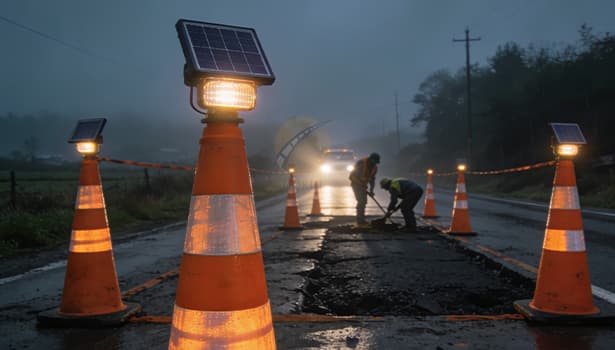
In low-visibility scenarios such as at night, in the early morning, or on rainy and foggy days, traffic safety cones without reflective tapes are still used, or traffic safety cones with aged, damaged or contaminated reflective tapes are used.
In low visibility scenarios, the visual recognition ability of drivers and pedestrians drops significantly. The reflective band is the core component for traffic safety cones to serve as a warning. Traffic safety cones without reflection or with poor reflection are difficult to be detected in low visibility environments and cannot play an effective warning and guiding role.
Visibility is significantly reduced, making it impossible for drivers to detect dangerous areas in advance, which can easily lead to collisions and rear-end collisions. Pedestrians may mistakenly enter the construction area, causing accidents such as tripping and falling. The accident risk of using non-reflective traffic safety cones at night is eight times that of using qualified reflective traffic safety cones.
In low-visibility scenarios, traffic safety cones with qualified reflective rings or reflective bands must be selected. The width of the reflective band should be no less than 5cm and it should cover the side of the traffic safety cone 2 to 3 times. Regularly check the integrity of the reflective strips. If aging, damage or contamination is found, clean or replace them in a timely manner. In extremely low visibility conditions such as rain, fog and night, install cone lights or flashing lights for traffic safety cones to enhance the warning effect.
In scenarios such as windy weather, frequent borderline driving of vehicles, or on high-speed sections, traffic safety cones that are too light in weight are used without taking any reinforcement measures.
The stability of traffic safety cones directly determines the sustainability of their warning function. Air currents generated by vehicle movement on high-speed sections, strong winds, and accidental collisions of vehicles can all cause light traffic safety cones to tip over or shift. A toppled traffic safety cone not only loses its warning effect but may also become an obstacle on the road.
When traffic safety cones are blown over by the wind or knocked down by vehicles, the definition of the dangerous area becomes invalid, causing vehicles and pedestrians to mistakenly enter the dangerous area. A toppled traffic safety cone may be run over by vehicles behind, causing secondary dangers such as a tire blowout and loss of control.
Select the appropriate weight of traffic safety cones based on the usage scenario. For ordinary urban roads, traffic safety cones with a weight of ≥2kg should be chosen. For high-speed sections or areas with frequent strong winds, traffic safety cones with a weight of ≥3kg and designed with a heavy base or rubber base should be selected. In extreme weather conditions (such as strong winds and heavy rain), stability can be enhanced by adding weights (such as sandbags) to the bottom of the traffic safety cones, connecting the traffic safety cones with chains, or using guardrails to assist in fixation.
Ignoring the clear regulations of different countries/regions regarding the size, color, width of the reflective band, and arrangement method of traffic safety cones, traffic safety cones are selected and arranged at will.
Road management authorities in various countries and regions have formulated specific technical standards for traffic safety cones. These standards are based on local road conditions, traffic flow, climatic environment and other factors, aiming to ensure the warning effect of traffic safety cones and traffic safety. Violating the norms may lead to administrative penalties from relevant departments, such as fines and orders to suspend work for rectification. When an accident occurs due to the non-compliant use of traffic safety cones, the user shall bear more legal responsibilities. At the same time, non-compliant traffic safety cones (such as those with incorrect colors or insufficient reflector width) cannot be accurately identified by traffic participants, increasing safety risks.
Before using traffic safety cones, it is essential to follow the "Work Area Traffic Control" regulations of the local road management authority or industry. For instance, in the Singapore region, the technical specifications issued by lta.gov.sg must be followed, which clearly stipulate that the height of traffic safety cones on expressways should be no less than 1000mm, the width of the reflective band should be no less than 6cm, and the color should be orange. Some states in the United States require that traffic safety cones in construction areas be paired with flags of specific colors. It is suggested to establish a standardized query list to ensure that projects in different regions all comply with local requirements.
In complex working conditions such as road construction and large-scale event traffic control, relying solely on traffic safety cones for traffic guidance without integrating other control measures such as temporary road signs, indicator lights, traffic guides or road surface markings.
The core function of traffic safety cones is to define areas and assist in guidance, but their information transmission capacity is limited.
In complex working conditions (such as multi-lane changing, intersection control, and crowd guidance during large-scale events), traffic safety cones alone cannot clearly convey detailed information such as no-entry, detour, and speed limits, making it difficult to meet the diverse traffic guidance needs.
Complex intersections are prone to traffic congestion, which affects the construction progress.
In extreme cases, it may cause traffic accidents.
Incorporate traffic safety cones as part of the diversion/temporary isolation measures to establish an integrated traffic control system. Set up road signs reading "Construction ahead, slow down" at the entrance of the construction area, and install indicator lights at key nodes of the traffic safety cone-guided path. At large-scale events or busy intersections, traffic guidance personnel should be arranged to cooperate with traffic safety cones to guide the flow of people and vehicles. Meanwhile, road markings can be used to assist traffic safety cones in defining the passage area, ensuring sufficient information transmission.
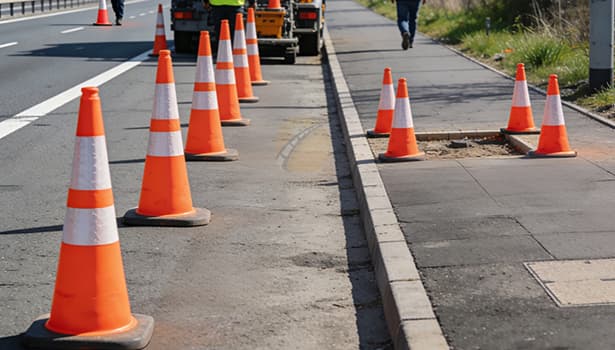
Placing too many traffic safety cones in small areas (such as small repair points, narrow sidewalks) or short sections of roads, exceeding actual needs; Or unused traffic safety cones are randomly piled up by the roadside without proper storage.
Too many traffic safety cones can cause visual confusion, making it impossible for traffic participants to accurately identify the core dangerous areas and passage paths. Randomly piled up unused traffic safety cones will occupy passage space and distract drivers and pedestrians, thereby reducing their attention to the effective warning area.
Due to visual interference, drivers may find it difficult to determine the compliant path and may exhibit operations such as excessive deceleration and frequent lane changes, increasing the risk of collision. Pedestrians may detour to the motor vehicle lane due to an excessive number of traffic safety cones, causing the risk of mixed traffic of pedestrians and vehicles. Randomly piled traffic safety cones, if blown down by the wind or knocked over by vehicles, will also become road obstacles.
Reduce the number of traffic safety cones according to actual needs, follow the principle of "minimum necessity", and only arrange traffic safety cones in core dangerous areas and key guidance nodes to ensure they are neatly arranged, form clear guidance lines, and convey clear intentions. Unused traffic safety cones should be stored in dedicated storage boxes or designated areas, and should not be piled up within the passage area. The arrangement of traffic safety cones should follow the principle of "straight lines as the main and curves as the auxiliary" to reduce visual confusion.
Traffic safety cones have been exposed outdoors for a long time without a regular maintenance mechanism established, resulting in cracks, deformations, and aging of the traffic safety cones. The reflective strips have been covered with vehicle oil, soil, dust, etc., losing their reflective effect.
The material of traffic safety cones and the performance of reflective strips will gradually decline over time and under the influence of the environment. Traffic safety cones with cracks or deforms have reduced stability, are prone to toppling over, have weakened warning and guiding effects, increase safety hazards, shorten service life, and increase the cost of repeated purchases.
Dirty and aged reflective strips can significantly reduce visibility, especially in low-visibility scenarios, where they fail to serve as a warning. Regular maintenance is the key to ensuring the continuous effectiveness of traffic safety cones.
Conduct a regular inspection once a month and a comprehensive maintenance once a quarter.
|
Inspection / Management Item |
Specific Inspection Content |
Handling Measures |
Management Requirements |
|
Appearance Integrity Inspection |
Check whether the traffic safety cone has structural issues such as cracks, deformation, or visible damage |
Replace the traffic safety cone immediately if cracks or deformation are found to ensure structural safety and normal use |
Conduct regular visual inspections and remove damaged cones from service without delay |
|
Reflective Performance Inspection |
Inspect whether reflective strips are intact, firmly attached, and free from dirt or contamination |
Clean reflective strips to remove stains; promptly replace reflective material if it is detached, worn, or ineffective |
Ensure reflective performance meets visibility requirements for night-time and low-visibility conditions |
|
Base Stability Inspection |
Check whether the cone base is stable and free from looseness, cracks, or damage |
Replace the base or the entire cone immediately if instability or damage is detected to prevent tipping |
Use cones with adequate base weight and conduct stability checks before deployment |
|
Maintenance and Replacement Management |
Identify traffic safety cones with functional defects, including structural damage or reflective failure |
Repair minor defects when feasible; replace cracked, deformed, or non-reflective cones promptly |
Maintain sufficient spare cones to ensure continuous availability and reduce safety risks |
|
Management Ledger and Record Keeping |
Record procurement, deployment, inspection, maintenance, and replacement data for traffic safety cones |
Update records in a timely and accurate manner to reflect the current status of each cone |
Establish a standardized traffic safety cone management ledger to achieve full lifecycle traceability and facilitate audits and management |
When installing additional equipment such as cone lights and brackets for traffic safety cones, improper installation methods, such as installing the cone lights in reverse, incorrect bracket angles, or additional equipment blocking the reflective strips of the traffic safety cones.
The function of the additional equipment is to enhance the warning effect of the traffic safety cone. If it is installed incorrectly, it will not only fail to function but also affect the reflective performance of the traffic safety cone itself. Reflective strips are the core warning components of traffic safety cones. Once they are blocked, their visibility will be significantly reduced, especially in low-visibility scenarios, which may prevent traffic participants from recognizing the traffic safety cones.
Install the additional equipment strictly in accordance with the installation instructions provided by the accessory manufacturer
When installing the cone lamp, make sure the lamp surface faces the road surface or the direction of oncoming vehicles to avoid installing it in reverse.
When installing the bracket, adjust the Angle properly to ensure that the equipment is stable and does not block the reflective strip of the traffic safety cone.
After installation is completed, conduct a test light and visual inspection to confirm that the light direction is correct, the reflective strips are unobstructed, and the additional equipment is firmly installed.
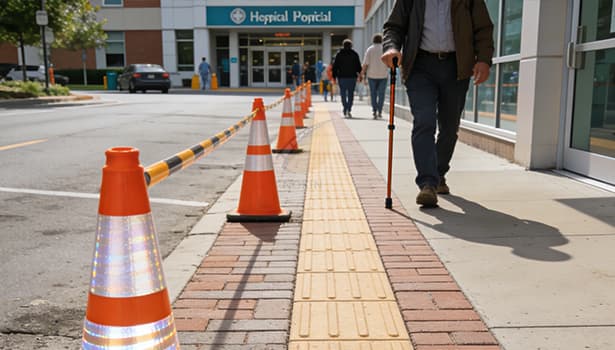
When setting up traffic safety cones in areas with a large number of pedestrians or special groups (such as visually impaired people and those with mobility difficulties), such as sidewalks, around schools, and near hospitals, the width of pedestrian passages, the need for barrier-free passage, or the impact of night reflection on pedestrian recognition were ignored.
Pedestrians, especially special groups, have higher requirements for the safety and convenience of the passage environment. Too narrow pedestrian passages can impede the passage of those with limited mobility. Visually impaired people are unable to recognize traffic safety cones visually. If they lack other means of indication, they are prone to mistakenly enter dangerous areas. Excessive reflection at night may irritate pedestrians' eyes and affect their vision.
When setting up traffic safety cones in pedestrian areas, ensure that the reserved width of the pedestrian passage is no less than 1.2 meters to meet the requirements of barrier-free passage. For areas where visually impaired people frequently pass through (such as around blind paths), tactile prompt bricks or auditory warning devices (such as voice prompters) can be set up in combination. When setting up at night, choose traffic safety cones with moderate reflective intensity and avoid the reflective strips directly facing the direction of pedestrian passage. In areas such as around schools and hospitals, the layout of traffic safety cones can be appropriately increased to enhance the guiding effect, and obvious pedestrian warning signs can be set up.
The standardized use of traffic safety cones is the key to the safety of temporary road control. Ignoring the above ten mistakes may lead to serious safety accidents and economic losses. By choosing the appropriate traffic safety cones, standardizing the layout spacing, doing a good job in maintenance and upkeep, and building a comprehensive traffic control system, the protective effect can be significantly enhanced. If you need further information on traffic safety cone selection, compliance assessment or procurement advice, please feel free to contact NOKIN's professional team. We will provide you with customized road safety solutions.