What are solar-powered road studs? Many people actually don't know that even though they have safely passed through one intersection after another under the guidance of solar-powered road studs, it's because solar-powered road studs are so obscure, especially during the day when they are almost invisible. Only the solar panels are silently receiving sunlight and storing electricity for the night glow.
In fact, despite their small size, solar-powered road studs play a significant role that should not be underestimated. On sections of the road without street lamps or other lighting tools, the solar-powered road studs at night are like tiny lighthouses, dutifully guiding the direction for vehicles. Even in weather conditions with very low visibility such as rain, fog or heavy snow, the solar-powered road studs still tenaciously emit light, ensuring that drivers can promptly notice changes in road conditions and guarantee driving safety. Such reliable solar-powered road studs are inseparable from their production materials and processes. Now, Nokin will introduce them to you!
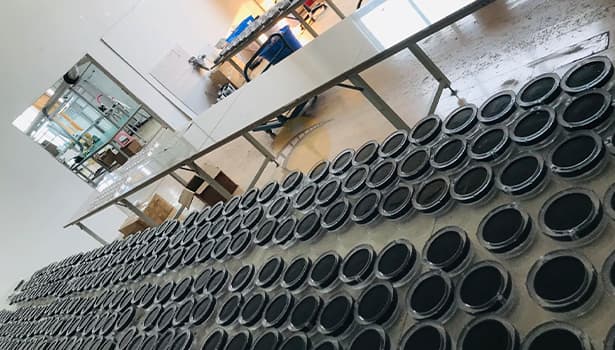
The performance of solar-powered road studs directly depends on their material composition and manufacturing process. High-quality materials are the foundation for road studs to possess properties such as durability, impact resistance, and weather resistance. A scientific and reasonable manufacturing process can ensure that the performance of the material is fully exerted, guaranteeing the structural stability and good luminous and reflective effects of the road studs.
If the material is not properly selected, the road studs may age, break, fade and other problems in a short period of time, losing their original functions. Any omissions in the manufacturing process, such as the reflector not being installed firmly or the forming process not meeting the standards, will affect the overall performance and service life of the road studs. Therefore, a thorough understanding of the material composition and manufacturing process of solar-powered road studs is of great significance for choosing the right road stud products and ensuring road safety.
Performance advantages: Comprehensive strength, toughness and processability of ABS; Polycarbonate features high light transmittance and impact resistance (stable at -40 to 120℃).
Cost advantage: The raw material price is 40% lower than that of metal, and the injection molding efficiency is high
Easy installation: It weighs only 1/3 of metal and supports tool-free pasting installation
Process characteristics: High-pressure casting achieves a precision of ±0.1mm, and the surface is treated with anodic oxidation
Environmental adaptability
The compressive strength is ≥150MPa, meeting the heavy-load requirements of expressways
It has no corrosion after 500 hours of salt spray test and is suitable for coastal and de-icing roads.
Super-hard properties: Mohs hardness 9 (second only to diamond), wear resistance 10 times that of metals
Applicable under extreme working conditions
During the road tests in the mining area, the anti-rolling life reached more than five years
It maintains stable performance within the temperature range of -50 to 800℃.
Safety optical design
After crushing, particles with an obtuse Angle of less than 5mm are formed, conforming to the EN 12899-1 standard
The reflectivity of the microprism is over 90%, and the viewing Angle reaches ±45° (while traditional glass beads are only ±15°).
|
Material Type |
Main Components / Description |
Hardness / Strength |
Impact Resistance |
Corrosion Resistance |
Cost |
Applicable Environment |
|
Plastics (ABS, PC) |
ABS: copolymer of acrylonitrile, butadiene, and styrene; PC: polycarbonate with relatively low content |
Medium |
Medium |
Medium |
Low to moderate |
Suitable for sections with less traffic, such as secondary urban roads and rural roads |
|
Aluminum (Die-cast Aluminum Alloy) |
Aluminum alloy, high quality; often surface-treated for enhanced durability |
High |
High |
High (especially after treatment) |
Moderate to high |
Ideal for medium/high-speed highways, high-traffic roads, coastal areas, and regions with frequent salt fog |
|
Ceramic (Alumina Ceramic) |
Alumina ceramic with extremely high Al₂O₃ content |
Very high |
Medium |
Excellent |
High |
Suitable for harsh environments such as mining area roads and sections with heavy vehicle traffic |
|
Glass (Tempered Glass, Silicate) |
Glass and silicate materials with high reflective performance |
High (brittle under strong impact) |
Low to medium |
Good |
Moderate to high |
Suitable for various road environments requiring high reflectivity and strong visibility |
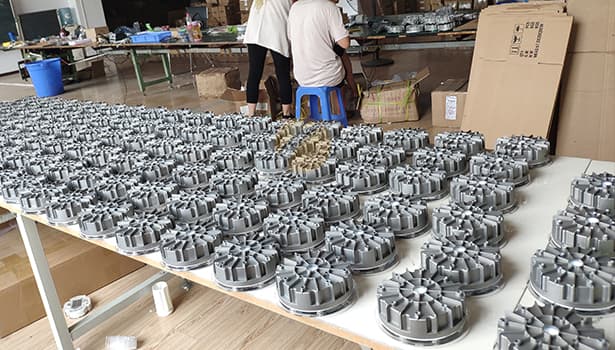
The manufacturing of plastic road studs begins with the selection and proportioning of materials. According to the performance requirements of the road studs, suitable ABS or polycarbonate raw materials are chosen, and necessary additives such as UV absorbers and toughening agents are added to enhance the performance of the plastic.
Then, the injection molding process is carried out: the prepared plastic raw materials are added to the barrel of the injection molding machine, and the plastic is melted into a flowing state through heating. Then, the screw of the injection molding machine injects the molten plastic into the precisely designed mold cavity at a certain pressure and speed. After the molten plastic cools and solidifies in the mold, open the mold and take out the formed plastic road stud blank. Finally, the blank is subjected to subsequent treatments such as trimming and grinding to meet the designed dimensions and surface quality requirements.
The injection molding process has the advantages of high production efficiency, high dimensional accuracy of products, and good consistency, which can meet the large-scale production demands of plastic road studs.
The manufacturing of aluminium road studs usually adopts the die-casting process. Firstly, a die-casting mold is made based on the design drawings of the road studs. The precision of the mold directly affects the size and shape accuracy of the road studs.
Then, put the aluminum alloy raw materials into the furnace and heat them to a molten state; Pour the molten aluminum alloy liquid into the injection chamber of the die-casting machine, and then inject the aluminum alloy liquid into the mold cavity at high pressure and high speed through the injection punch. The molten aluminum alloy rapidly cools and solidifies in the mold, forming the main structure of the aluminum road stud. After the casting has cooled to a certain extent, open the mold to take out the casting and carry out cleaning, deburring, grinding and other treatments.
For some aluminum road studs with complex structures or special requirements, other metal forming processes, such as forging and stamping, may also be adopted to meet different performance and structural demands. Die-casting process can produce aluminum road nail bodies with dense structure, high strength and good surface quality, ensuring their sufficient firmness and durability.
The manufacturing process of ceramic road studs is rather complicated. First, mix the alumina powder evenly with an appropriate amount of binder, lubricant, etc. to make a billet with certain fluidity. Then, through injection molding, dry pressing and other methods, the blank is made into the rough blank of the road stud. After the green body undergoes drying treatment, it is placed in a high-temperature kiln for sintering.
During the sintering process, the moisture and binder in the billet evaporate, and diffusion and fusion occur among the alumina particles, forming a dense ceramic structure. The sintering temperature is usually as high as over 1600℃. After holding for a certain period of time, it is cooled slowly to reduce internal stress and enhance the strength and toughness of the ceramics. Finally, the sintered ceramic road studs are ground, polished and other processed to meet the design requirements.
The manufacturing of glass road studs involves first mixing glass raw materials in a certain proportion and then heating them in a furnace until they reach a molten state. Then, the molten glass liquid is poured into the mold, and the glass blanks of the road studs are made through forming methods such as blowing and pressing. Then, the glass blank is subjected to tempering treatment, that is, it is heated to a temperature close to the softening point and then rapidly cooled, creating compressive stress on the surface of the glass and tensile stress inside, thereby enhancing the strength and safety of the glass.
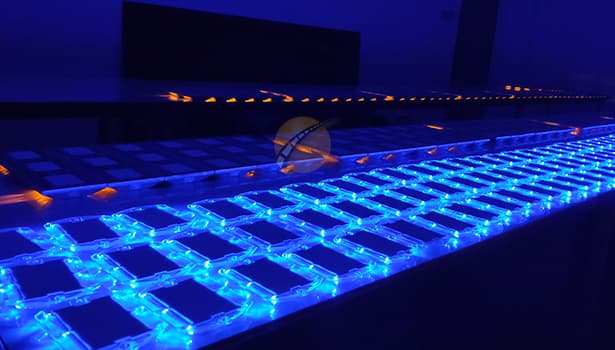
The commonly used reflective elements in solar road studs mainly include three types: glass beads, reflective sheets and microprisms.
|
Reflective Element |
Description |
Reflective Principle |
Cost / Efficiency |
Key Advantages |
Typical Application |
|
Glass Beads |
Tiny round glass particles with excellent reflective properties; widely used in early road stud products |
Light enters the beads, refracts, reflects inside, then refracts out to create a reflective effect |
Low cost; moderate efficiency |
Affordable, simple to produce |
Early-generation road studs or cost-sensitive projects |
|
Reflective Sheets |
Made by coating reflective material (e.g., aluminum foil) on plastic film or metal foil |
Utilizes specular reflection of the material to return light |
Low efficiency; moderate cost |
Flexible, easy to process and apply |
Supplemental reflective elements; flexible surfaces |
|
Microprism |
High-precision optical component with multiple tiny prisms; currently widely used in solar-powered road studs |
Light undergoes two refractions and one reflection, returning along the original path for very high efficiency |
Higher cost; extremely high efficiency |
Excellent visibility, wide viewing angle, highly effective |
Modern solar-powered road studs; high-visibility and safety-focused applications |
To ensure that the reflective elements are firmly combined with the main body of the road studs, during the manufacturing process, the reflective elements are usually placed in the mold before the main body of the road studs solidifies.
Take plastic road studs as an example. During injection molding, reflective elements (such as microprism plates) are first placed at designated positions in the plastic mold, and then molten plastic is injected. During the cooling and solidification process of molten plastic, the reflective elements will be tightly wrapped, firmly bonding them to the main body of the plastic.
For aluminum road studs, during the die-casting process, the installation positions of reflective elements can be preset in the mold. Once the molten aluminum alloy liquid is injected into the mold and solidifies, the reflective elements will be firmly embedded in the aluminum main body.
This method of placing reflective elements before the main body solidifies can prevent problems such as detachment and loosening that may occur during the later installation of reflective elements, ensuring that the reflective elements maintain a good reflective effect throughout the long-term use of the road studs.
During the manufacturing process of solar-powered road studs, strict quality inspections at multiple stages are required to ensure product quality.
During the material warehousing process, raw materials need to be inspected, such as the molecular weight and melt index of plastic raw materials, the composition and purity of aluminum alloys, the particle size and purity of ceramic powders, and the chemical composition of glass raw materials, to ensure that the raw materials meet quality standards.
During the molding process, sampling inspections should be conducted on each batch of products to measure their dimensional accuracy, shape deviation, etc., to ensure that the structure of the products meets the design requirements. At the same time, check the surface quality of the product, such as whether there are cracks, bubbles, depressions, scratches and other defects.
During the reflector integration stage, it is necessary to check whether the installation position of the reflective elements is accurate and firm, and whether the reflective performance meets the standards. The reflectivity, viewing Angle and other parameters can be measured by dedicated detection equipment to ensure good reflection effect.
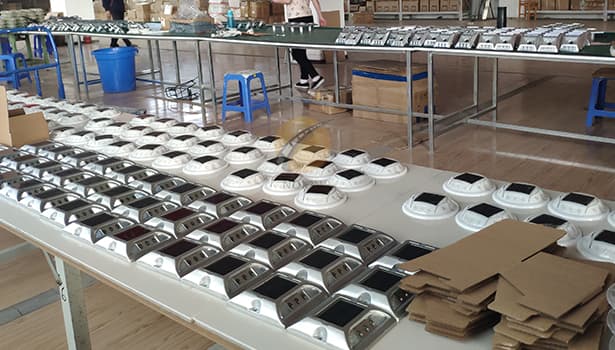
The core objective of quality control is to ensure that solar-powered road studs meet the relevant standards for durability, impact resistance and clear visibility.
Durability test: By simulating various factors in the road environment, such as temperature changes, ultraviolet radiation, rain erosion, salt spray corrosion, etc., accelerated aging tests are conducted on road studs to evaluate their performance changes after long-term use. After the test, the road studs should show no obvious signs of aging, damage or fading, and still maintain good structure and function.
Impact resistance test: Methods such as drop weight impact test are adopted to simulate the impact force on the road studs under the conditions of vehicle running over and collision. After the test, the road studs should have no serious damage such as cracking or deformation and still be able to work normally.
Clear visibility test: Under different lighting conditions, such as at night and in rainy or foggy days, professional detection instruments are used to measure parameters such as the luminous intensity and reflection distance of the road studs to ensure that they can be clearly observed by drivers in various environments, meeting the requirements of road safety.
Only solar road studs that pass all the above-mentioned quality inspections can be regarded as qualified products and be allowed to leave the factory and be applied in road engineering.