Solar road stud manufacturers have learned that according to the Global Road Safety Report, over 60% of road traffic accident deaths worldwide come from developing countries, among which the accident rate in rural and remote areas is three times that in urban areas. Insufficient visibility at night and the lack of effective warning facilities at sharp bends and intersections have become the core causes of the high incidence of accidents.
Take Africa as an example. About 70% of rural roads are not equipped with any lighting facilities. The incidence of vehicle-pedestrian collisions at night is 47% higher than that during the day. This kind of safety hazard not only threatens life safety, but also restricts economic exchanges in remote areas.
Traditional road lighting relies on power grid extension and municipal power supply. However, developing countries are confronted with a dual predicament: on the one hand, there is a huge gap in power grid coverage, with 1.3 billion people still living in areas without power grid coverage worldwide, 90% of which are concentrated in developing countries in Asia, Africa and Latin America. On the other hand, even if the conditions for extending the power grid are met, the cost is still prohibitive - the cost of laying one kilometer of high-voltage transmission lines in remote areas is as high as 150,000 to 200,000 US dollars, and continuous investment of human and material resources is required for later maintenance.
Solar-powered road studs use photovoltaic panels as the energy collection end, store electrical energy through energy storage batteries, and automatically light up for warning at night, without relying on the municipal power supply or wiring construction. This self-sufficiency feature precisely matches the "safety necessity" and "cost constraint" of road infrastructure in developing countries, making it a popular choice for infrastructure upgrades in recent years.
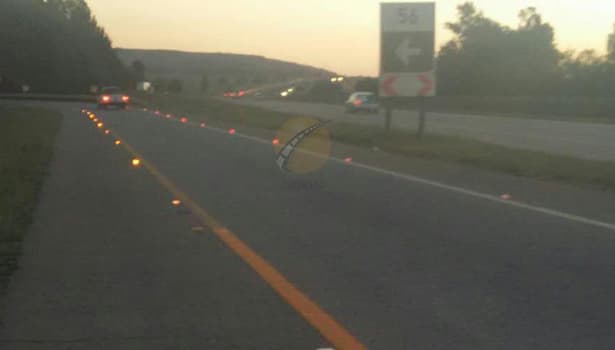
The core safety value of solar-powered road studs lies in "precise supplementary lighting" and "active light emission", building a protective net in the blind spots of traditional lighting.
Dark environment: The solar-powered road studs use high-brightness LED beads, with a luminous intensity of over 200cd and a visible distance of more than 800 meters, far exceeding the 300-meter visible range of traditional street lamps.
Sharp bends and intersections: Solar-powered road studs, densely laid at intervals of 50 centimeters, can form continuous light bands, alerting drivers to slow down and give way 100 meters in advance.
Severe weather: With an IP68 waterproof rating and anti-fog design, the solar road studs have a light penetration power 2.3 times that of traditional street lamps in low visibility scenarios such as heavy rain and thick fog.
Kenya's rural road renovation project in 2022 shows that after installing solar-powered road studs on 120 kilometers of unlit sections, the rate of night-time traffic accidents dropped from 17 per month to 3, a decrease of 82%. Test data from Indonesia also confirmed this value: after deploying solar-powered road studs on sharp bends in mountainous areas, vehicle rolking accidents decreased by 76%.
|
Comparison Dimension |
Solar Road Studs |
Traditional Street Lamps |
|
Visible Distance |
800–1,000 meters |
300–500 meters |
|
Blind Zone Coverage |
No blind zone (forms a continuous light band) |
Has illumination blind zones |
|
Performance in Bad Weather |
Suitable for anti-fog and waterproof use, strong light penetration |
Light is easily weakened by rain or fog |
|
Installation Flexibility |
Density, position, and spacing can be adjusted as needed |
Adjustment is possible but cost is high |
The cost of extending power grids in remote areas of developing countries is extremely high, while the "ready-to-use" feature of solar-powered road studs significantly reduces the initial investment. From equipment procurement to installation costs, the cost of installing solar-powered road studs on the same road is much lower than that of traditional street lamps.
The economy of solar-powered road studs is not only reflected in the initial investment, but also runs through the entire service life:
Electricity bill: Relying solely on solar energy, a 10-kilometer section of the road can save approximately $120,000 in electricity bills annually (calculated at $0.5 per kilowatt-hour based on mains electricity).
Maintenance cost: With an anti-aging ABS shell and a long-life lithium battery (cycle life ≥ 3,000 times), the average maintenance cycle is 3 to 5 years. In contrast, traditional street lamps require bulb replacement and circuit inspection every 6 to 12 months, resulting in a maintenance cost difference of nearly 800,000 US dollars over 10 years.
Most developing countries have limited infrastructure budgets, making the "lightweight procurement model" of solar-powered road studs easier to implement. For instance, Uganda has completed the deployment of solar road studs on 500 kilometers of rural roads with only 20% of its annual road safety budget through the "batch procurement + local matching" model. However, if the traditional street lamp solution were adopted, this proportion would need to be increased to 75%.
According to data from the United Nations Energy Agency, only 45% of the population in sub-Saharan Africa has access to stable power supply, and in some rural areas of South Asia, power outages occur as frequently as 15 to 20 times a month. The absence and instability of the power grid make traditional road lighting solutions almost impossible to implement in remote areas.
Solar road studs adopt a closed-loop system of "photovoltaic collection - energy storage release", featuring three major characteristics:
High-efficiency collection: Equipped with monocrystalline silicon photovoltaic panels, the photoelectric conversion efficiency exceeds 22%. Under an average of 4 hours of light per day, it can meet the 12-hour light emission demand at night.
Smart energy storage: Equipped with a built-in lithium iron phosphate battery, it features overcharge and overdischarge protection, ensuring normal operation even in three consecutive days of rainy weather.
Autonomous control: The "charging - emitting light" mode is automatically switched through the light-sensing element without the need for manual intervention.
In remote areas without grid coverage and post-disaster reconstruction scenarios, the energy independence of solar-powered road studs is even more crucial. After the 2023 earthquake in Turkey, the rescue team deployed solar-powered road studs in the temporary passageways of the earthquake-stricken area. It only took two hours to complete the construction of the night passage warning system, providing a safety guarantee for the transportation of rescue supplies. In the post-earthquake reconstruction of rural roads in Nepal, solar-powered road studs have been made standard equipment, avoiding the long waiting period for the power grid to be restored.

The installation of solar-powered road studs does not require road excavation or cable laying. It only needs to be fixed with expansion screws or adhered with epoxy resin. The installation time for a single one is less than 5 minutes. This feature makes it adaptable to various types of road surfaces:
Asphalt pavement: Fixed with expansion screws, with an anti-rolling strength of over 10 tons;
Cement pavement: Through epoxy resin bonding, the adhesion can reach 2.5MPa;
Temporary dirt road: Equipped with a movable base, it is convenient to adjust the position according to road rerouting.
In response to the issue of weak grassroots operation and maintenance capabilities in developing countries, solar-powered road studs have simplified the maintenance process in their design:
Fault identification: Built-in LED fault indicator light, which automatically flashes to prompt when abnormal.
Component replacement: The lithium battery and LED beads adopt a modular design, allowing for disassembly and replacement without the need for professional tools.
Remote monitoring: Some smart models support NB-IoT communication, allowing real-time viewing of the operating status through a mobile phone APP.
Climate differences among developing countries are significant. Solar road studs achieve full climate adaptation through targeted design.
|
Climate Type |
Adaptation Design Features |
Typical Application Areas |
|
High-Temperature Arid Regions |
High-temperature resistant lithium batteries (-40℃ to 85℃) and sand-proof casings |
Countries around the Sahara Desert |
|
Rainy and Humid Areas |
IP68 waterproof and anti-corrosion metal contacts |
Southeast Asian and Central American countries |
|
Strong Earthquake & Windy Areas |
Seismic structure (withstands 8-magnitude earthquake) and wind resistance design |
Countries around the Himalayas |
|
High-Cold Regions |
Low-temperature starting battery (operates normally at -30℃) |
Mongolian and Bolivian plateaus |
In recent years, developing countries have been promoting the popularization of solar-powered road studs through policy upgrades.
Road safety standards: In 2021, India revised the "Road Traffic Regulations", requiring that active luminous warning facilities must be installed at sharp bends and intersections on rural roads. Brazil has included solar-powered road studs in its "National Road Safety Action Plan" and offers a 30% subsidy for procurement projects.
Green energy support: Kenya's "National Photovoltaic Program" has included solar road studs in its priority procurement list, offering a 15% tax reduction. Vietnam offers electricity price discounts to enterprises that produce solar-powered road studs.
Solar-powered road studs are becoming an important accessory for urbanization and rural development in developing countries.
Smart City: In the construction of the new urban area in Lagos, Nigeria, solar-powered road studs are linked with traffic surveillance cameras to build an integrated intelligent transportation system of "perception and warning".
Rural revitalization: In the "Rural Road Upgrading Project", Bangladesh has installed solar-powered road studs on 12,000 kilometers of rural roads, which has increased the efficiency of agricultural product transportation by 25% and reduced logistics costs by 18%.
Developing countries are under the dual pressure of economic growth and environmental protection. The low-carbon characteristics of solar road studs meet their sustainable development needs. The United Nations Environment Programme (UNEP) has calculated that every 1,000 solar-powered road studs can reduce carbon emissions by approximately 12 tons annually, equivalent to planting 660 trees. Countries such as South Africa and Morocco have included the deployment of solar-powered road studs in their nationally Determined Contributions (NDCS) targets as an important measure for carbon reduction.
Despite its significant advantages, the popularization of solar-powered road studs in developing countries still faces bottlenecks:
In response to the above challenges, the industry has explored multiple solutions:
With the development of Internet of Things technology, solar-powered road studs are upgrading from single warning facilities to intelligent transportation nodes: