On a rainy night in the suburbs, the street lights were sparse and the light was dim. The reflection formed by the rain on the road surface made the lane lines blurry. On a winter morning, the road is shrouded in thick fog, and the road conditions 50 meters away are almost unrecognizable - this is the "visual predicament" that countless drivers have encountered. According to data from the transportation department, the incidence of traffic accidents at night and in bad weather is 2.3 times higher than that during clear days. Among them, "judgment errors caused by insufficient visibility" are the main contributing factors. When you drive through such sections of the road and see the devices embedded in the road that emit soft light bands, you might wonder: What are these "little lights"? What message do they want to convey by showing up here?
This device is the solar cat's eye road stud (also known as the solar-powered road stud). It is not merely a "road surface decoration", but an indispensable "invisible guardian" in the modern road safety system. Whether it is road sections without street lights at night, low visibility environments such as rain, fog or snow, or areas with changes in road structure, it can provide key guidance to drivers through active lighting, reducing the risk of accidents. Next, we will thoroughly understand "what solar road stud reflectors on roads mean" from three dimensions: definition, function, and principle.
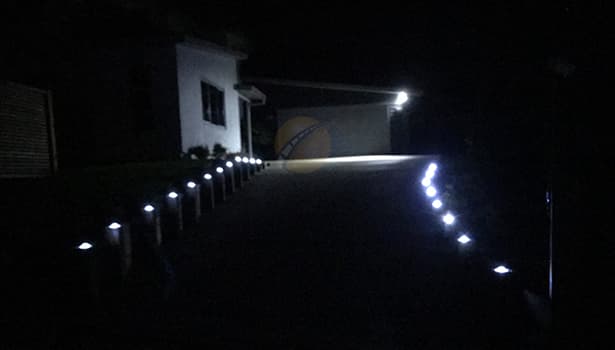
The solar cat's eye road stud is an active LED lighting device embedded in the road surface and powered by solar energy. Its core structure includes solar panels, energy storage batteries, LED beads, light-sensing control components and a waterproof and pressure-resistant housing.
It is different from the working mode of traditional reflectors that "passively reflect light" - traditional reflectors need to rely on vehicle lights to reflect light. Once there is insufficient light (such as no headlights or foggy weather), they will lose their function. Solar cat’s eyes road studs can absorb sunlight during the day to store energy and automatically light up LED lights at night or in low-light conditions, actively conveying road information to drivers, effectively making up for the shortcomings of passive reflectors.
At present, it has been widely applied to highway ramps, mountainous roads, urban sections without street lights, tunnel entrances and exits, and construction areas, becoming a key facility for enhancing road safety at night.
To more intuitively demonstrate the value of solar-powered road stud reflectors, we compare the differences between them and traditional reflectors through a table:
|
Comparison Dimension |
Solar Cat's Eye Road Stud (Active Type) |
Traditional Passive Reflector |
|
Working Principle |
Solar energy storage + LED active light emission |
Relies on external light reflection |
|
Visible Distance |
Over 500 m on a clear night; up to 100 m on foggy days (depending on vehicle headlights) |
Usually 50–100 m; less than 30 m on foggy days |
|
Applicable Scenarios |
Suitable for low-visibility conditions such as night, rain, fog, snow, and tunnels |
Only suitable where sufficient external light is available |
|
Maintenance Cost |
No wiring required; battery life 3–5 years; low maintenance frequency |
Prone to losing reflective effect due to wear and dust; requires regular cleaning and replacement |
|
Information Transmission |
Can transmit information through flashing lights or colors (e.g., red alerts) |
Can only reflect a single color; cannot convey complex information |
As can be seen from the table, the core advantages of solar-powered road stud reflectors lie in "active light emission" and "environmental adaptability", which are also the key to ensuring safety under harsh conditions.
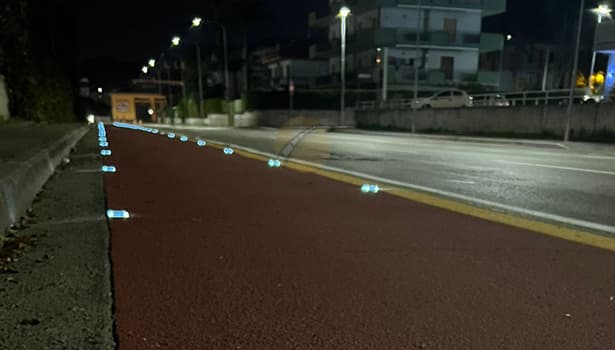
When solar-powered road stud reflectors appear on the road, they are not randomly installed but are transmitting specific road information to drivers. It can be specifically divided into four categories: guiding directions, enhancing visibility, defining lanes, and warning of risks.
On suburban roads or mountain roads without street lights, drivers are most likely to drive off the road due to "inability to see the edge of the road clearly" - especially when meeting oncoming vehicles at night, the strong light from the oncoming headlights can cause a brief "blind view". Without clear road boundaries to guide, accidents are very likely to occur.
At this point, the solar cat's eyes road studs installed along the edge of the road take on the role of a "virtual curb" : they are continuously laid along the outer edge of the road, emitting soft white or yellow light bands. Even under strong light interference, drivers can judge the width of the road through the light bands and avoid the wheels running off the shoulder.
In addition to boundary guidance, it can also convey "direction change" information: at curves, roundabout or highway ramps, solar-powered road studs will be laid along the curve trajectory, forming a "curved light band". For instance, in mountainous areas with continuous curves, the solar cat's eyes road studs will start to light up along the curve direction 50 meters in advance, reminding the driver that "there is a curve ahead. Slow down and adjust the direction", which is more intuitive and timely than the traditional curve warning signs.
In weather conditions such as rain, fog and snow, the reflection on the road surface and the obstruction of fog can make drivers "unable to see the road conditions ahead clearly", which is the main cause of rear-end collisions and scratches. The LED light of the solar cat's eye road stud has the feature of "strong penetration", which can effectively deal with such scenarios.
Take foggy days as an example: Traditional reflectors lose their function due to "light scattering" in foggy weather, and drivers can often only see clearly a distance of 10 to 20 meters ahead. The directional light beams emitted by the LED lights of the solar-powered road studs can penetrate the fog and be detected by drivers from 50 to 100 meters away. Meanwhile, some solar cat's eyes road studs will also be set to a "foggy mode" - by reducing the brightness of the lights and increasing the flashing frequency (such as once per second), to avoid strong light irritating the driver's eyes, while ensuring that the light signals can be clearly identified.
On snow-covered sections in winter, even if the road surface is covered with snow, the outer shell of the solar-powered road studs is usually 5 to 10 millimeters higher than the road surface. The LED lights on top of them can still be exposed above the snow surface, marking the lane position for drivers and preventing them from deviating from the driving route due to "not being able to find the lane".
On urban main roads or expressways, the lane width is usually around 3.75 meters. However, when there are no street lights at night, drivers find it difficult to accurately determine the lane boundaries merely by relying on the vehicle's headlights, which can easily lead to problems such as "crossing the line" and "lane deviation", increasing the risk of scratches.
At this point, the solar cat's eyes road studs laid along the lane divider lines will form a "continuous light band", clearly demarcating the range of each lane. For instance, on expressways, road studs are set up on both sides of each lane, with the distance between adjacent studs being approximately 10 meters, forming two parallel light bands. Drivers only need to keep their vehicles traveling between the two light bands to ensure they do not cross the line or deviate from the lane.
For the "tidal lanes" (variable lanes) in urban roads, solar-powered road studs can also convey the lane's purpose through "color switching" : during the morning rush hour, the studs emit green light, indicating that the lane is an "inbound lane". During the evening rush hour, it switches to red light, indicating the "exit lane", which is more conspicuous than traditional traffic signs and reduces violations caused by drivers "reading the wrong lane".
In addition to its basic guiding function, the solar cat's eyes road studs can also serve as a "warning signal", informing drivers in advance of potential hazards or structural changes on the road ahead, allowing them sufficient time to react.
50 to 100 meters ahead of hazard points such as potholes on the road surface, damaged manhole covers, and bridge expansion joints, red flashing solar road studs will be installed. The red light has a "warning effect", which can remind drivers that "the road ahead is uneven and they need to slow down and give way."
During road construction, road studs will be set up 100 meters ahead of the construction area. First, there are yellow constantly lit road studs (indicating "Construction area is approaching"), which switch to red flashing road studs when approaching the construction area (indicating "slow down immediately and get ready to avoid"). These are more likely to attract drivers' attention than traditional construction warning signs, especially during night construction when the warning effect is more obvious.
In areas where lanes are reduced (such as from three lanes to two lanes) or roads are merged, solar-powered road studs will be laid along the "new lane boundary" to form a "gradual light band" - for instance, when a three-lane road is changed to two lanes, the studs in the leftmost lane will gradually decrease, guiding vehicles to merge into the middle lane to prevent accidents caused by "sudden lane changes".
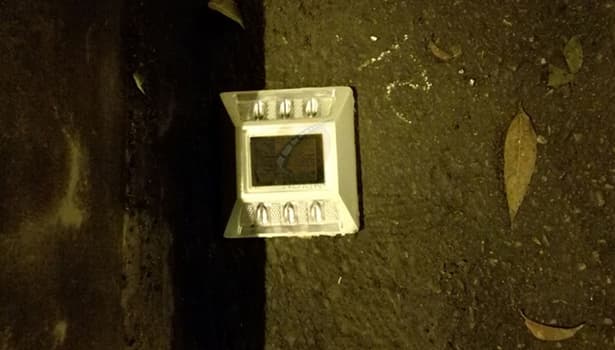
Many people are puzzled: Why can solar cat's eyes road studs keep glowing at night without external wires? Can it still work normally even in continuous rainy weather? Behind this lies its "self-sufficient" energy circulation system.
The "energy collection" of solar cat's eyes road studs is mainly accomplished during the day, with the core relying on the built-in solar panels and energy storage batteries:
The solar panels on the top of the road studs are usually made of monocrystalline silicon, with a photoelectric conversion efficiency of approximately 18% to 22% (the efficiency of polycrystalline silicon panels is about 15% to 18%), which can effectively absorb the light energy in sunlight. Even on cloudy days, it can absorb scattered light for charging - for instance, the charging efficiency on cloudy days is approximately 30% to 50% of that on sunny days, meeting the basic energy storage requirements.
The electrical energy generated by the battery panels is stored in the built-in lithium battery or lead-acid battery. Common battery capacities range from 2000mAh to 5000mAh. Take a 3000mAh lithium battery as an example. After being fully charged on a sunny day, it can support LED lights to continuously glow for 12 to 15 hours (usually only 8 to 10 hours at night), fully meeting the usage requirements at night.
To prevent the battery from being overcharged and damaged, the solar cat's eyes road studs are also equipped with a "charging protection circuit" : when the battery is fully charged, the circuit will automatically cut off the charging. When the battery level drops to a certain extent (such as remaining at 30%), it will resume charging to extend the battery's lifespan.
When the light intensity in the evening drops to a certain threshold (usually 500lux, equivalent to the brightness on a cloudy evening), the light-sensing components (such as photoresistors and photodiodes) built into the road studs will trigger the "light-emitting mode" :
When the light-sensing element detects insufficient light, it sends a signal to the control chip, which then activates the LED beads to emit light. The brightness of LED beads is usually 50 to 100 lumens, and the colors are mainly white (for regular guidance), yellow (for boundary guidance), and red (for warning), which can be adjusted according to the usage scenario.
Some high-end road studs also support "intelligent brightness adjustment" - during the early night (such as from 7 to 10 p.m.) when there are many vehicles on the road, the brightness of the road studs should be adjusted to 80% to ensure they are conspicuous. In the early morning (such as from 0 to 5 a.m.), there are fewer vehicles. Adjust the brightness to 50% to avoid wasting electricity and reduce light interference to pedestrians at night.
In addition, the outer shell of the road studs adopts an anti-pressure and waterproof design (usually made of aluminum alloy or engineering plastic), with an anti-pressure strength of over 10 tons (able to withstand the crushing of heavy trucks), and a waterproof rating of IP68 (able to be immersed in water for a long time), ensuring normal operation in environments such as heavy rain and water accumulation.
The "self-sufficiency" feature of solar-powered road stud reflectors is the key reason for their wide application. The specific advantages are reflected in two aspects:
Traditional road lighting facilities (such as street lights) require the laying of cables and the construction of distribution boxes, which have a long construction period, high costs, and cause significant damage to existing roads. Solar-powered road studs only need to be drilled into the road surface and embedded for installation. The installation time for a single road stud is only 5 to 10 minutes, having a minimal impact on traffic.
Traditional street lights require regular cable inspection and bulb replacement, resulting in high annual maintenance costs. The battery life of solar-powered road studs is 3 to 5 years, and the lifespan of LED beads can reach 100,000 hours (about 10 years). During this period, almost no maintenance is required. Only the battery needs to be replaced every 3 to 5 years, significantly reducing the average annual maintenance cost.
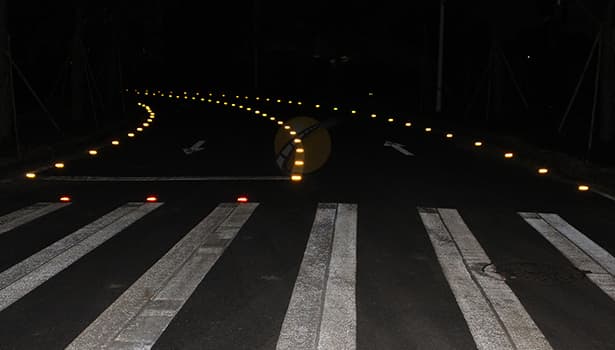
When we see solar cat's eyes road studs on the road, they convey not only light but also four key types of information: road boundaries and directions, visibility of the road surface in low visibility, lane boundary regulations, and warnings of potential hazards ahead. These pieces of information together form an "active safety protection network", helping drivers make correct judgments in complex environments and reduce the risk of accidents. This small device, the solar cat's eye road stud, will play a greater role in enhancing road safety and building a smart transportation system.