In the motorway safety guarantee system, road signs are the key facilities for guiding driving behavior and avoiding traffic risks. Among them, the cat eye road stud (Cat’s Eye) as a classic road sign product has served the transportation field for decades. With the development of new energy and LED technology, solar cat eye road studs have gradually replaced traditional products and become the "nighttime safety guardian" of modern highways.
The core difference between traditional cat eyes and solar cat eyes lies in energy supply and lighting mode: Traditional cat eyes rely on passive reflective structures and need to rely on vehicle lights for reflection to be recognized; solar cat eyes, on the other hand, use active lighting technology to achieve autonomous lighting, and have better recognition effects in harsh environments. As an important upgrade direction for highway safety facilities, solar cat eyes (also known as solar road studs) are widely used on motorways and highways to enhance night-time driving safety.
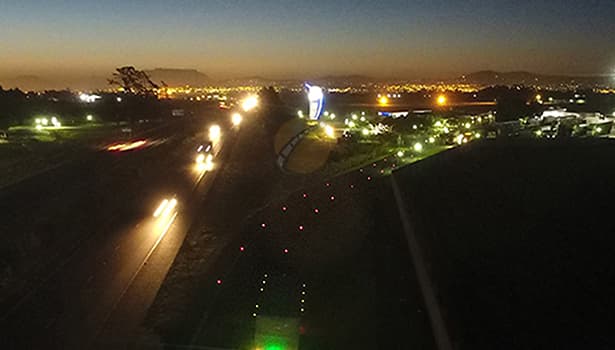
Solar cat eye road studs are an active lighting road sign device that integrates efficient solar panels, energy storage batteries and LED lights. The core working logic follows the "daytime energy absorption, nighttime lighting" cycle mode.
Specifically, under daylight conditions, the built-in solar panel converts solar energy into electrical energy and stores it in a dedicated battery; when the environmental brightness is below the set threshold, the light control switch automatically activates, and the battery releases electrical energy to drive the LED light to illuminate, forming clear road guidance signs. Some high-end models also have intelligent sensing functions, which can adjust the lighting intensity according to traffic volume, further improving energy utilization efficiency.
The core structure of traditional cat eyes is a passive reflective lens, and their lighting principle completely relies on the reflection of vehicle lights. This technical path determines that it has significant limitations:
Solar cat eyes for motorways adopt an active lighting architecture of "solar panel + energy storage battery + LED light", fundamentally breaking through the technical bottlenecks of traditional cat eyes. Their core advantages are:
|
Performance Index |
Traditional Cat Eye |
Solar Cat Eye |
|
Lighting Mode |
Passive reflection (relies on vehicle headlights) |
Active LED lighting |
|
Visible Distance |
≤ 100 meters |
Up to 900 meters |
|
Driver Reaction Time |
Approximately 3 seconds |
≥ 30 seconds |
|
Adverse Weather Adaptability |
Poor; visibility significantly reduced in rain and fog |
Strong; active light source penetrates haze and fog |
|
Energy Demand |
None; depends entirely on vehicle lights |
Solar-powered; fully self-sustaining |
Low visibility conditions such as night, rain, fog, and sandstorms are high-incidence accident periods on motorways. The identification effect of traditional reflective signs will significantly decline in these scenarios, while the active lighting characteristic of solar cat eyes for motorways can effectively solve this problem. Its LED light source has strong penetration power. Even in thick fog or heavy rain conditions, it can still maintain a clear identification effect, helping drivers predict the road direction in advance. In remote highway sections without street lighting coverage, the continuous light band formed by the solar cat eye can directly replace part of the road lighting function, significantly improving driving safety.
Motorway speed is fast, and lane deviation is one of the main causes of rear-end collisions and scraping accidents. The solar cat eye, through reasonable layout, can form clear lane boundaries and road edge markings, helping drivers accurately judge the driving range at night or in complex road conditions.
By adopting multi-color light design (white, yellow, red, green), the solar cat eyes for motorways can achieve functional zoning guidance: white light is used for normal lane separation, yellow light marks the road edge or lane boundaries, green light indicates emergency lanes, and red light warns dangerous areas, allowing drivers to quickly identify road information through light colors.
At dangerous points on the highway, such as sharp bends, steep slopes, construction areas, and accident-prone sections, the solar cat eye can achieve early warning through special lighting patterns (such as flashing, strobing) or color combinations.
For example, starting from 500 meters ahead of the construction area, red flashing solar cat eyes are set up, gradually increasing density, which can remind drivers to slow down in advance; in sharp bends, yellow constantly lit cat eyes are set up on the outer side of the curve, which can help drivers predict the curvature of the curve and avoid accidents caused by blocked vision.

The super long visibility range brought by active lighting technology is the core logic of the solar cat eye to improve road safety. Data shows that on motorways with solar cat eyes installed, the accident rate of lane deviation can be reduced by more than 60%, and the accident rate of rear-end collisions can be reduced by about 45%.
This is because drivers can identify road boundaries and the front road conditions at a greater distance, have enough time to adjust speed and driving direction. Especially in long-distance high-speed driving, the clear light band guidance can also alleviate drivers' visual fatigue, further improving driving safety.
Compared with traditional lighting or power-on signs, the solar cat eye has significant cost advantages, mainly reflected in three aspects:
The solar cat eye is completely powered by solar energy, and during operation, there is no carbon emission, conforming to the global green transportation development trend. Its built-in efficient solar panel can collect sufficient energy even on cloudy days to ensure normal lighting at night and achieve 24/7 independent power supply.
For remote mountainous motorway sections with poor power supply, the solar cat eye can work normally without relying on the power grid, significantly reducing the construction threshold of safety facilities in remote sections and helping to achieve "all-weather motorway safety coverage".
In the construction of intelligent motorways in the UK, solar cat eye road studs are used as the core identification equipment, especially in busy interchanges and high-speed nodes, networked variable information solar lights are deployed. The innovation of this project lies in that the solar-powered cat eye can be linked with the traffic signal control system. It can adjust the light color and flashing frequency according to the real-time traffic flow and weather conditions.
For example, in the gore area Interchange project, when traffic congestion is detected, the solar-powered cat eye will automatically switch to the yellow flashing mode to alert drivers to slow down; in case of an emergency, it can synchronously emit red light to guide vehicles to avoid. After the implementation of this project, the rate of night traffic accidents on this section decreased by 52%.
Apart from the UK, many countries and regions around the world have begun pilot projects and promoted active solar road signs. Sweden installed solar-powered cat eyes with sensors on the E4 highway in Europe, which can detect dangerous situations such as icy roads and traffic congestion, and give early warnings through color changes several hundred meters in advance.
At the policy level, many countries have included active LED road studs in their road marking modernization upgrade plans. The UK has explicitly stated that it will achieve full coverage of active illuminated road signs on motorways by 2030, and the EU has introduced relevant subsidy policies to encourage member states to promote solar traffic signs. This trend indicates that solar cat eye road studs have become the development direction of global road safety facilities.
The installation layout of solar cat eye road studs needs to be adjusted according to the type of section to ensure the guiding effect while controlling costs. The specific suggestions are as follows:
|
Section Type |
Installation Density |
Special Requirements |
|
Straight Main Lane |
15–20 meters per unit |
Aligned with road markings to form a continuous light band |
|
Ramp / Curve |
5–10 meters per unit |
Installed more densely along the outer side of the curve to emphasize road curvature |
|
Lane Change Area / Intersection |
3–5 meters per unit |
Installation begins approximately 300 meters in advance, with spacing gradually reduced |
|
Tunnel Entrance and Exit |
5 meters per unit |
Coordinated with the tunnel lighting system to avoid sudden changes in light intensity |
During installation, attention should also be paid to coordinating with road lighting and traffic signs to avoid light interference; choose a flat and dry road surface position to ensure a firm installation and prevent vehicle rolling and detachment.

Reasonable design of light color and flashing mode can enhance the information transmission efficiency of solar cat eye road studs. The specific design strategies are as follows:
Solar cat eye road studs through active lighting technology break through the performance limitations of traditional reflective signs, and have advantages that cannot be replaced in improving the safety of low visibility scenarios on motorways, reducing operating costs, and practicing green transportation concepts. From the practical application results, it can not only effectively reduce night traffic accidents, but also provide basic sensing nodes for intelligent transportation systems, and is the core direction of road safety facility upgrades.
In the future, with the integration of IoT and AI technologies, solar cat eye road studs for motorways will develop towards the "intelligent sensing + dynamic guidance" direction. For example, integrating traffic flow detection and road condition monitoring functions to achieve real-time warning of traffic events; linking with autonomous driving systems to provide precise road boundaries and path guidance. In the global road digitization and intelligence wave, solar cat eye road studs will become an important component in building an efficient, safe and green transportation network.