Reflective safety vests are the lowest-cost personal protective equipment (PPE) in construction sites, road construction, and warehouse operations, and are also the most easily overlooked safety line. Many workers habitually use them beyond their expiration dates, even if the reflective strips of the vests have become dull, cracked, or fallen off, and still continue to wear them.
According to data from the National Highway Traffic Safety Administration (NHTSA) in the United States, 76%–80% of pedestrian fatal accidents occur in low-visibility nighttime environments. For outdoor workers, a performance-deficient reflective vest is ineffective in reflecting vehicle lights and is equivalent to "running naked while wearing protective gear," significantly increasing the risk of work.
Most reflective safety vests do not have clearly marked expiration dates or fixed shelf lives. This has led many enterprise safety officers and front-line workers to question: Will reflective vests expire? How can one quickly determine if the vest is still usable and compliant?
In this article, NOKIN will provide direct and applicable standard answers, including the actual service life of reflective vests, a 60-second on-site rapid detection method, and decision-making standards for replacement in different scenarios, to help enterprises manage PPE compliance and avoid safety risks and audit penalties.

Reflective safety vests do not have a fixed printed shelf life or a unified expiration date. However, all high-visibility reflective vests have a "functional service life".
Once the reflective performance and fluorescent visibility of the vest have degraded below the industry's lowest standard, it no longer has safety protection capabilities and is only an ordinary piece of clothing, unable to meet compliance protection requirements.
This logic is consistent with that of safety helmets and safety ropes, which are professional PPE. The core value of protective equipment is to meet performance standards, not to have an intact appearance. Labels do not indicate the expiration time, but performance degradation indicates failure.
Based on industry general standards and massive practical data, in routine conditions, the effective service life of reflective safety vests is 6–12 months. The specific usage duration is mainly determined by three factors: usage intensity, working environment, and cleaning and maintenance methods.
The protective capabilities of high-visibility reflective vests are composed of two independent structures: the "nighttime reflective system" and the "daytime fluorescent visibility system". The decay rates and failure causes of the two systems are different, which is why many vests "look usable during the day but offer no protection at night".
Reflective strips are the core of night-time safety. They rely on microprisms or glass microbeads optical structures to reflect vehicle lights back to the source, allowing drivers to identify workers at a distance.
The main reasons for the degradation and failure of reflective strip performance include: frequent washing and friction, long-term bending and compression, surface stains, and long-term outdoor ultraviolet aging.
The two mainstream reflective processes in the industry have significant differences in performance and durability:
High-visibility fluorescent fabric uses special fluorescent dyes to convert environmental ultraviolet rays into visible light, making the vest stand out in daylight, cloudy days, and haze environments, avoiding daytime collision risks.
The core reason for fabric failure: long-term outdoor ultraviolet exposure leads to fading, and using strong acid or alkali chemical cleaning agents to clean damages the fluorescent dye structure.
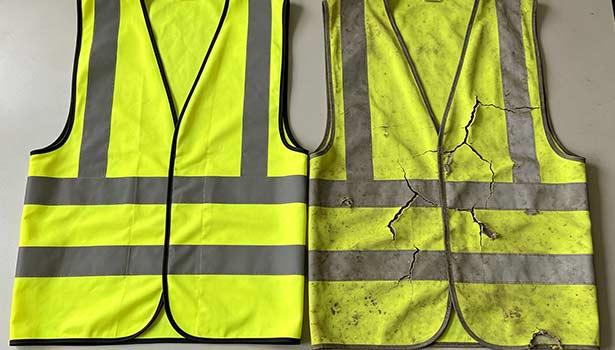
Fluorescent fabrics are more likely to fail first during the day, manifesting as the fabric turning gray, white, and losing its bright fluorescent effect; while reflective strips are more prone to fail first at night, showing signs of dull reflection, local black spots, and cracking and peeling.
Therefore, an intact appearance during the day does not imply effective protection at night, and vice versa. It is impossible to determine the compliance and usability of the vest solely based on its visual appearance.
The 6–12 month service life is not an arbitrary estimate by the industry, but a comprehensive scientific conclusion based on washing wear, environmental erosion, and compliance standards.
Industry unified measured data shows that after approximately 25 standard washes, the reflective coefficient of reflective vests will significantly decrease, and their protective performance will be greatly degraded.
In addition, incorrect cleaning methods will accelerate the vest's obsolescence: using fabric softeners, bleach, high-temperature water washing, and high-temperature drying will directly damage the optical structure of the reflective layer and the fabric's fluorescent coating. A single cleaning session can cause irreversible damage.
Backpacks used in long-term outdoor operations will continuously be exposed to ultraviolet radiation, wind-sand friction, and dust from construction sites. In high-ultraviolet and high-dust scenarios such as highlands, deserts, and expressways, the aging speed of the vest will increase by more than twice.
The ANSI/ISEA 107-2020 and ISO 20471 international safety standards only stipulate the initial performance parameters of reflective vests at the factory and the minimum performance threshold after washing, and do not set a fixed expiration date.
From a compliance and legal perspective: when the vest's retro-reflective coefficient and fluorescent brightness fall below the standard's minimum requirements, the function is expired and compliance is invalid, and it no longer belongs to qualified protective equipment, and is prohibited from being used in operations.
No need for professional detection equipment. Through four simple steps of testing, you can quickly determine the usage status of the reflective vest, suitable for pre-shift daily checks by teams and batch inspections by safety officers.
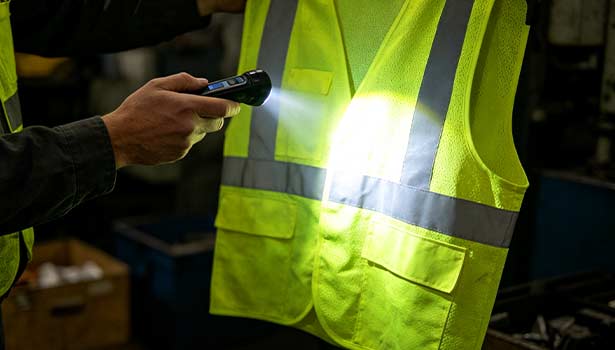
Operation steps: In a dim environment, stand at a distance of 20–30 feet and use a mobile phone flashlight or hand lamp to shine directly on the reflective strip of the vest.
Judgment criteria: Uniform and sufficient reflection → qualified; local dimness, black spots, uneven reflection → warning; almost no reflective effect → replace immediately.
Operation steps: In natural light, place an old vest and a brand-new identical vest side by side for comparison.
Judgment criteria: Bright fabric, sufficient fluorescence → qualified; overall gray, white, and dull colors → daytime visibility failure, need to replace.
Operation steps: Inspect all reflective strips one by one, focusing on the edges, bends, and seams.
Judgment criteria: Flat and undamaged reflective strip → qualified; more than 6mm (1/4 inch) crack, detachment, or damage → replace immediately; slight curling, local wear → enter the warning monitoring period.
If the surface of the reflective strip is covered with thick oil, paint, or cement dust and cannot be thoroughly cleaned, it will completely cover the optical structure and directly cause the reflective function to fail, regardless of the usage duration, and must be replaced immediately.
|
Test Result Grade |
Core Determination Characteristics |
Handling Plan |
|
Qualified Pass |
Uniform and bright reflection; no fabric fading; no damage to the reflective strip; no stubborn stains |
Can be used normally and included in the regular monthly inspection |
|
Warning Monitoring |
Slight fading; slight curling of the reflective strip; slight uneven reflection |
Shorten the inspection cycle; conduct weekly re-inspections; prepare spare parts and supplies |
|
Replace Immediately |
Reflective failure; obvious fading; cracking or damage to the reflective strip; stubborn stains covering the reflective area |
Scrap immediately on site and prohibit continued use for operations |
The replacement cycle of reflective vests mainly depends on the usage intensity and working environment. The following table presents the industry-standardized replacement plan that can be directly used for enterprise PPE procurement and inventory planning.
|
Usage Scenario |
Usage Intensity |
Cleaning Frequency |
Suggested Replacement Cycle |
|
High-speed roads / night construction |
High-intensity outdoor use every day |
3–4 times per week |
3–4 months |
|
Regular construction sites / outdoor operations |
Regular outdoor use every day |
1–2 times per week |
6 months |
|
Factory / indoor warehouse operations |
Low-frequency daily use, with less exposure to sunlight and wear |
Occasional cleaning |
9–12 months |
|
Emergency backup / occasional use |
Extremely low-frequency use, with long-term storage |
Rare cleaning |
More than 12 months (must be tested before each use) |
Hard rules: Regardless of the duration of use or whether the cycle has been reached, if any test fails, it must be replaced immediately. It is strictly prohibited to use it beyond the expiration date with faults.
Many enterprises have misconceptions: as long as the vest is not damaged, it is considered compliant equipment. However, in OSHA audits, safety inspections by the client, and insurance compliance checks, a visually intact vest does not mean it meets performance standards.
The key items for inspection during on-site audits include: whether the fabric fluorescence has faded, whether the reflective strips are intact and undamaged, and whether the product label is clear and legible. If the label is worn, the standard number is missing, or the washing instructions are illegible, it is also judged as non-compliant.
According to OSHA 1926.28(a) provisions on personal protective equipment, for road construction and high-risk outdoor operation scenarios, performance-qualified high-visibility protective equipment must be used. Compliance checks are based on the "actual protective performance" as the sole criterion, not "whether the equipment is worn".
Refer to OSHRC public enforcement cases and CCOHS high-visibility clothing inspection guidelines. Using an expired reflective vest will trigger safety rectification, on-site fines, project suspension, and in severe cases, lead to contract breach and insurance denial.
There is no official fixed expiration date, but there is a functional service life. If the performance degrades below the industry standard, it is considered to be ineffective. The regular working life is 6–12 months.
The industry's measured standard is: after approximately 25 standard washes, the reflective performance will show significant degradation. Incorrect cleaning methods will significantly shorten the number of washes tolerated.
It can be machine washed, but it is strictly prohibited to use bleach, fabric softeners, and prohibit high-temperature water washing or high-temperature drying. It is recommended to wash it in cold water gently and let it air dry naturally to maximize the service life.
The lifespan of the LED lighting module is determined by battery and diode wear, and regular checks on power supply and light emission are required; the failure standards of the basic reflective strip and fluorescent fabric are the same as those of ordinary reflective safety vests.
Through the 60-second four-step on-site testing method in this article to verify the performance, and at the same time check if the product label indicates the ANSI/ISEA 107 standard number, performance grade, and washing instructions. Dual verification of compliance is necessary.
There is a difference. The reflective jacket has a larger area of fluorescent fabric, and it fades and ages faster under long-term exposure to the sun; the vest has a simpler structure and fewer wear points, and its durability is slightly better than the reflective jacket under the same working conditions.

Reflective vests do not have a paper expiration date, but they have strict functional service lives. 6–12 months is the industry's general experience value, and the on-site test results are the only standard answer to determine whether it is usable or not. Incorporating the 60-second testing method into the weekly pre-shift inspection can avoid nighttime visual safety risks and compliance penalties from the source.
Enterprises can plan the annual inventory quantity in advance based on the replacement cycle of the operation site, and reduce the single purchase cost. For high-speed and high-frequency operation scenarios at night, priority should be given to using micro-prism process vests that are resistant to aging and have high reflectivity. When purchasing in bulk, priority should be given to requesting a third-party washing test report to ensure that the product complies with the ANSI/ISEA 107-2020 compliance standard.