Countries around the world are continuously increasing their investment in road safety infrastructure construction. The market demand for intelligent transportation and low-power safety facilities is increasing year by year. Solar road studs, with their advantages of no wiring, zero electricity cost, convenient installation, and adaptability to complex road conditions, have become the core standard products for urban and rural roads, expressways, scenic area roads, and park roads.
With a complete industrial support system and a mature export trade system, China's solar road stud export volume has continued to grow steadily in recent years, and the market penetration rate has increased year by year. The products are exported to infrastructure markets across all continents in the world. From remote rural roads in Africa, desert highways in the Middle East, to urban municipal roads in Europe and community side roads in North America, more and more overseas importers, engineering contractors, and municipal purchasing teams are choosing China as the core source for purchasing solar road studs.
In the following blog, NOKIN will truly analyze the 7 core reasons why global importers favor Chinese manufacturers, and clearly list the scenarios that are not suitable for importing from China, helping you precisely avoid procurement risks and make the best decision.
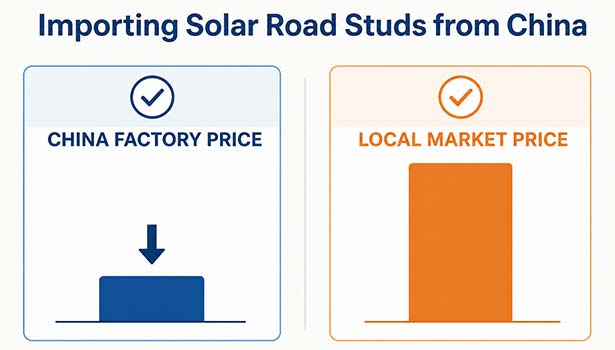
Many buyers have a misconception: Chinese solar road studs have advantages of "low price and poor quality". But the actual industry situation is the opposite. The core competitiveness of Chinese manufacturing lies in the price advantage under the same quality standards, rather than just low prices.
Under the unified standards of IP68 waterproof, high-strength anti-pressure, high-temperature and cold resistance, and compliance with export certifications, the purchase unit price of Chinese solar road studs is much lower than that of the same configuration products in Europe, Southeast Asia, etc. The industry consensus in the export market indicates that Chinese solar road studs that meet the EN1463 European high-end municipal standards, with a significant advantage in the overall purchase average price, are the top choice for overseas municipal projects and distributors with high cost‑performance.
To facilitate buyers to make intuitive comparisons and selections, a product price comparison framework for the same quality and parameters has been compiled. You can calculate the price difference by yourself based on the quotations from local suppliers:
|
Core Parameter / Standard |
Chinese Manufacturer Quotation (USD) |
Overseas Local Manufacturer Quotation (USD) |
Core Difference |
|
IP68 waterproofing, 20-ton load resistance, regular flashing mode |
General price range |
Generally 30%–60% higher |
Equivalent performance at a lower purchase cost from Chinese manufacturers |
|
EN 1463 certification, CE & RoHS compliance, complete shipping qualifications |
Generally lower |
Generally higher |
Similar compliance standards, but Chinese manufacturers typically offer more competitive pricing |
|
Industry-compliant average price (no false labeling, accurate specifications) |
Generally lower |
Generally 50% or more higher |
The price gap is particularly significant for compliant products |
|
High-end compliant products |
Generally lower |
Generally 50% or more higher |
The price difference is most obvious for compliant, high-end products |
|
Intelligent dimming, synchronized flashing, customized LOGO |
Lower customization premium |
Higher customization premium |
Customization costs are more controllable when sourcing from Chinese manufacturers |
This price advantage does not compromise product quality, but is achieved through cost optimization based on a mature industrial cluster, large-scale production, and low-loss processes, which is also the core reason for long-term repeat purchases by global buyers.
Solar road studs may seem structurally simple, but they are composed of four core components: photovoltaic solar panels, high-brightness LED light beads, energy storage lithium batteries, and aluminum alloy die-cast shells. The quality stability, delivery efficiency, and iteration speed of the product completely depend on the maturity of the industrial chain.
China has formed a complete solar road stud industrial cluster, and major production bases can supply all core components in one-stop, without the need for cross-regional or cross-country procurement of components. All the production, processing, assembly and testing procedures of the components can be completed within the same industrial ecosystem.
The complete industrial chain brings two core procurement advantages:
First, it significantly reduces communication and trial-and-error costs.
The purchaser does not need to interface with multiple suppliers. They can complete the selection, customization, production and inspection in one step, effectively avoiding problems such as component compatibility failure, batch color difference, and specification mismatch.
Second, the process iteration speed is faster.
The component manufacturers and the solar road stud production factories are deeply linked. They can quickly optimize the waterproof structure, anti-pressure process, and battery life plan based on overseas market demands, continuously improving the product adaptability.
In contrast, in other countries' markets, most require cross-supplier procurement of photovoltaic panels, batteries, shells, and other components. Not only does the communication cycle lengthen and the compatibility risk increase, but the overall procurement cost will also rise significantly.
The compliance certification for solar road studs exported overseas is the prerequisite for entry and also the core assessment standard for municipal engineering and large orders. Chinese leading solar road stud manufacturers have delved deep into the export market for many years and have established a complete and mature global certification system, which can adapt to the entry rules of various regional markets. The mainstream compliance certification list is as follows, covering the vast majority of overseas import scenarios:
Purchase reminder: Certification does not mean high quality. When purchasing, do not only rely on the promotional copy of the merchant. You must require the supplier to provide the complete certification number, the original official test report, and verify the validity period of the certificate and the consistency with the product batch. This can avoid compliance risks from the source.
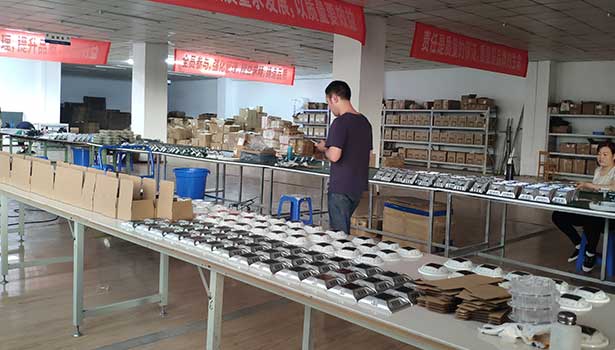
For importers, the stability of production capacity and the flexibility of delivery time directly determine the inventory turnover efficiency and the progress of project implementation. Chinese solar road stud manufacturers have both large-scale production capabilities and the flexibility for small-batch customization, perfectly adapting to different purchasing needs.
In terms of large-scale orders, mature factories have automated assembly, injection molding, and die-casting production lines, which can undertake orders of tens of thousands of solar road studs, ensuring stable construction period and uniform batch quality, and fully meeting the needs of national-level infrastructure and large-scale road renovation projects.
In terms of small orders, the industry MOQ (minimum order quantity) is flexible, and hundreds of solar road studs can be ordered, suitable for small distributors, small municipal projects, and sample trial orders, reducing the stocking pressure of the purchaser.
At the same time, Chinese solar road studs manufacturers can provide comprehensive OEM/ODM customization services, supporting logo printing, shell color customization, light flashing mode debugging, and customized packaging specifications, to meet the differentiated needs of different brands and different scenarios.
Industry peak season reminder: Every Q3-Q4 is the peak period for global infrastructure projects, which is the peak season for solar road stud procurement. The factory's order scheduling is saturated, and the delivery period will significantly lengthen. It is recommended that overseas purchasers place orders 3-4 months in advance to avoid project progress delays.
The solar road studs requirements in different countries and scenarios in overseas are greatly different. The African and Middle East markets focus on high battery life and high-temperature resistance models, the European municipal areas focus on compliance high-brightness and synchronous flashing models, and the North American communities focus on low-power consumption and intelligent dimming models.
Chinese manufacturers have the most comprehensive product range in the industry, covering low-end basic reflective models, mid-range conventional luminous models, and high-end intelligent synchronous flashing models, which can meet the purchasing needs of all grades from high to low in one-stop. The purchaser does not need to deal with multiple suppliers to complete the stock preparation for all categories, significantly reducing the cost of supply chain management.
Meanwhile, Chinese solar road stud manufacturers have the world's leading speed in technological iteration. They closely follow the development trend of intelligent transportation and continuously launch new types of solar road studs with LoRa communication, intelligent sensing, fault self-checking, and high-brightness flashing, suitable for new infrastructure scenarios such as smart roads and vehicle-road collaboration. The export proportion of new products like intelligent and synchronous flashing models has been continuously increasing, becoming a new growth point for industry exports.
Solar road studs are special transportation products with lithium batteries. They have extremely high requirements for logistics transportation, customs documents, and maritime qualifications. China relies on a complete port system and a mature cross-border freight forwarding ecosystem to build a global logistics network.
Starting from major ports in China, they can directly reach core markets such as Southeast Asia, the Middle East, Africa, Europe, and North America. Full container and partial container logistics solutions are available, suitable for different order volumes of transportation needs.
The more core advantage is that the domestic freight forwarding system is extremely familiar with the export process of battery-equipped road studs, can efficiently handle export customs declaration, origin certificates, UN38.3 battery transportation documents, etc., significantly reducing customs delays and risk of seizure.
Solar road studs are not one-time engineering consumables, but road safety facilities that require long-term maintenance and regular replacement. Factors such as road wear, rain soaking, and sunlight aging will lead to the loss of road studs, and continuous replenishment is a common practice in the industry.
Chinese leading solar road stud manufacturers have a long-term stable supply capability, with sufficient core component inventories and continuous stable production lines, which can ensure that purchasers can replenish regularly, have uniform batch quality, and avoid supply disruptions and batch parameter deviations.
In terms of the quality assurance system, Chinese solar road stud manufacturers have formed standardized quality assurance plans, distinguishing quality assurance for batteries, complete machines, and shells, with clear rights and responsibilities. In a long-term cooperation model, suppliers can provide spare parts reissue, after-sales technical support, and fault solutions to help purchasers reduce long-term operational risks.

Fixed costs for shipping, customs declaration, and customs clearance cannot be shared. Small batch purchases will lead to a significant increase in the overall cost of a single product. Adding tariffs and logistics fees, the final unit price will be far higher than local spot prices, completely losing the price advantage. Direct purchasing of local spot prices is more cost-effective in such scenarios.
The regular cross-border shipping cycle is generally 20-40 days. Even with expedited air freight, production, customs declaration, and transportation time need to be reserved. For urgent orders shorter than 2 weeks, the time cost and air freight premium of cross-border procurement are extremely high, which will directly consume all the price advantages, and it is more prudent to choose local spot suppliers.
Some countries and regions have exclusive local entry standards, such as DOT certification in some US states, which requires on-site inspection and filing by local institutions, a complex and costly certification process. If your order needs to be specifically adapted to local special certifications, the additional certification costs may offset the price advantage of Chinese procurement, and it is necessary to carefully evaluate.
The biggest risk of cross-border procurement is information asymmetry. If it is impossible to verify the strength of the supplier through on-site inspection, third-party testing, or sample measurement, it is very easy to encounter substandard products, false parameter marking, and certification fraud, making the quality risk uncontrollable. It is not recommended to blindly purchase.
Precisely determine the usage scenarios, purchase quantity, target market certification requirements, lighting parameters, battery life standards, and delivery timeline to avoid blind selection and repeated changes.
Through on-site factory inspections, third-party qualification verification, and historical export order verification, the factory's production capacity, quality control system, and compliance qualifications are verified, and non-compliant small workshops are excluded.
Before placing large-scale orders, sample actual measurement must be conducted, focusing on testing core performance such as low-temperature anti-freezing, high-temperature endurance, vehicle crushing, and waterproof immersion. Confirm that the product is suitable for local climate and road conditions.
Based on the order volume and delivery time requirements, select FOB/CIF/DDP compatible logistics solutions, and prepare all necessary documents for battery transportation, customs declaration, and origin at an early stage to avoid customs clearance delays.
After arrival, check product parameters, quantity, certification reports, and appearance quality against the acceptance list, investigate batch defects, damages, and parameter mismatches, and promptly connect with after-sales handling.
The core decision-making logic for importing solar road studs from China essentially involves a comprehensive weighing of four variables: cost, production capacity, certification, and risk.
The 7 core advantages explain the underlying reasons why global importers, engineering contractors, and municipal procurement teams continue to choose Chinese manufacturers - high-quality, cost-effective, full-process support, complete compliance certification, flexible production capacity and delivery schedule, rapid product category iteration, mature logistics system, and long-term stable supply chain. And the 4 types of reverse procurement scenarios have clearly defined the risk boundaries for all solar road stud purchasers, preventing the occurrence of cost losses, project delays, and compliance failures due to blind cross-border procurement.
As a responsible Chinese solar road studs manufacturer, NOKIN suggests that you combine your own purchase quantity, target market, project timeline, and certification requirements to complete a complete procurement feasibility assessment and formulate the optimal procurement plan that suits your business.