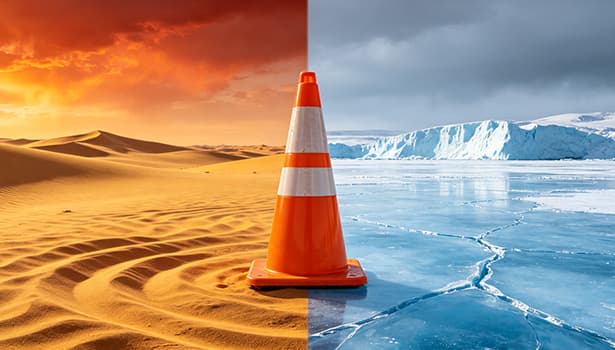
Traffic cones, as all-weather outdoor security facilities, are exposed to high temperatures, low temperatures, day-night temperature differences, and strong ultraviolet rays all the time. They continuously suffer from climatic erosion, which is the core reason for performance degradation and equipment damage. Different extreme environments not only shorten the service life of traffic cones but also cause various road safety hazards and increase maintenance costs.
The temperature and weather resistance of traffic cones is completely determined by the core manufacturing material. Different raw materials have significantly different molecular structures and stability, and the climate scenarios they are adapted to and their service life are also completely different. Currently, the mainstream materials for engineering-grade traffic cones in the industry are PVC and PE (polyethylene), combined with rubber weight bases. The performance of these three materials has different emphases.
|
Material Type |
Core Advantages |
Performance Shortcomings |
Adapted Scenarios |
|
Ordinary PVC |
Excellent flexibility, stable molding performance, strong reflective film adhesion, and outstanding cost-effectiveness |
Without modification, it is prone to softening under high temperatures, becoming brittle in low temperatures, and has relatively weak UV resistance |
Regular short-term construction projects in normal temperature environments |
|
UV-Stabilized Modified PVC |
Strong heat resistance, excellent UV fade resistance, stable structural performance, and superior overall weather resistance |
Slightly lower low-temperature toughness compared to PE materials and relatively higher procurement cost |
High-temperature regions, strong sunlight exposure, and long-term outdoor applications |
|
LDPE Polyethylene |
Outstanding low-temperature performance, strong impact resistance, resistant to cracking, and excellent flexibility |
Moderate heat resistance stability; wind resistance and impact resistance may decrease after prolonged heating |
Cold climates, snowy regions, and low-temperature freeze-thaw environments |
|
Rubber Base |
Excellent all-weather and temperature resistance, stable weight, strong wind and impact resistance, and good anti-slip performance |
Functions only as the base component and does not contribute to the cone’s warning structure |
Suitable for all climate conditions and compatible with various types of traffic cones |
Plastic materials such as PVC and PE are essentially high-molecular polymers, and the stability of their molecular structures is greatly affected by temperature. This is the core principle of how weather affects the performance of traffic cones.
In high-temperature environments, the activity of polymer molecules increases, the hardness of the material decreases, the overall becomes softer, and the extensibility becomes worse, and it is prone to irreversible deformation.
In low-temperature environments, the molecular activity is inhibited, the flexibility of the material is significantly reduced, and the originally flexible plastic and rubber become hard and brittle, and will crack and break under slight impact and compression.
In addition, outdoor ultraviolet rays will continuously damage the molecular chains of the materials, and long-term exposure to the sun will cause the materials to age, powderize, and fade, completely degrading the core performance of traffic cones.
When the outdoor air temperature reaches 30°C - 35°C in summer, the black asphalt road has an extremely strong heat absorption capacity, and the surface temperature can soar above 55°C.
The base of the traffic cone is in contact with the high-temperature road surface for a long time, continuously receiving heat conduction from the ground, and is in a state of high-temperature baking, with the bottom being the most severely damaged.
Ordinary low-cost PVC traffic cones without reinforcement have extremely poor heat resistance and will show obvious softening problems after long-term high-temperature baking.
Common faults include base bending, cone collapse, overall tilt, and being unable to stand upright after placement, completely losing the regular warning and isolation function.
The fluorescent orange warning color of traffic cones is the core for ensuring visibility during the day, and ultraviolet rays are the main cause of fading.
After long-term unprotected exposure to the sun, the fluorescent orange will gradually become dull, yellowish, and white, significantly reducing the color recognition degree.
Color fading directly shortens the visibility distance, and at the same time, it damages the reflective membrane structure on the surface, resulting in a significant reduction in night-time reflective effect and failure of the warning in dim environments.
Summer high temperatures and ultraviolet rays constitute a double overlapped damage, accelerating the aging process of traffic cones exponentially.
After long-term exposure to high temperatures, the surface of traffic cones will gradually become brittle, the material will experience fatigue and aging, and the toughness will completely disappear.
At the same time, high temperatures will cause the reflective film gel to melt and fall off, resulting in peeling and detachment of reflective strips, completely losing their night-time security function.
For high-temperature exposure scenarios, the selection should focus on three core points: heat resistance, UV resistance, and stable structure. Avoid problems such as deformation and fading due to high temperatures.
Prioritize the addition of UV-stabilized anti-UV additives, which can prevent UV aging from the source and lock in color and material stability.
Opt for traffic cones formed by a one-piece injection molding process, with no joint gaps, and higher structural strength, making them less prone to deformation and cracking due to high temperatures.
Finally, prefer thicker PVC or high-density PE materials, with greater wall thickness and stronger heat resistance, capable of enduring long-term exposure to high-temperature road surfaces.
.jpg)
Low temperatures are the main enemy of plastic material traffic cones, especially ordinary PVC materials, which have extremely poor cold resistance.
Low-temperature environments will significantly reduce the flexibility of PVC materials, making the overall structure rigid and brittle, losing its buffering and pressure-bearing capacity.
During winter wind and snow, vehicle air flow impact, and manual relocation and knocking, ordinary PVC traffic cones are prone to cracks and direct breakage, completely becoming unusable.
After winter road icing and frost, friction is significantly reduced, and the base of regular lightweight traffic cones has insufficient grip.
Even slight wind and vehicle passage air flow can cause traffic cones to slide and shift, disrupting the layout of the construction area isolation.
During heavy snowfall, snow will cover the cone body and reflective strips, completely blocking the warning signs.
If the snow is not cleared in time, traffic cones will lose visibility completely, unable to perform traffic guidance and risk warning functions.
In northern regions with low temperatures and many icy conditions, priority should be given to choosing materials that are resistant to low temperatures and can resist cracking, to avoid frequent damage in winter.
Low-density polyethylene (LDPE) is one of the best materials for low-temperature scenarios, as it still maintains good flexibility in low-temperature environments and is not prone to cracking or aging.
Combined with a reinforced rubber base design, it can significantly improve the grip on icy and snowy road surfaces, effectively preventing sliding and shifting.
When purchasing, prioritize marking Cold Resistant dedicated traffic cones that are suitable for low-temperature outdoor conditions.
Carefully check the minimum operating temperature parameters of the product. High-quality Cold-resistant traffic cones can withstand extreme temperatures of -45°F without cracking or deforming.
Based on regional temperature, ultraviolet, and climate characteristics, select models specifically, to maximize the durability of traffic cones, reduce long-term operation costs, and ensure road safety. Here is a precise selection guide for all scenarios:
|
Applicable Climate Regions |
Core Selection Configuration |
Core Advantages |
|
Hot and High-UV Regions |
Thick-wall UV-stabilized PVC, high heat-resistance base, one-piece molding structure |
Heat-resistant, resistant to softening under extreme temperatures, resistant to fading under strong sunlight, maintains excellent daytime and nighttime warning visibility over time |
|
Cold and Icy Regions |
LDPE material, anti-freezing modified PVC, thick flexible rubber base |
Maintains flexibility in low temperatures, stable on icy road surfaces, resistant to cracking, freezing, and aging |
|
Strong Wind and Large Temperature Difference Regions |
Heavy rubber base, wide base design, low center of gravity, adjustable structure |
Resistant to strong wind and vehicle airflow, less likely to topple or shift, suitable for environments with repeated temperature cycles |
|
All Outdoor Long-Term Scenarios |
UV-resistant certification, high-strength reflective film, all-weather engineering-grade design |
Suitable for various temperature conditions, extended service life, reduced long-term maintenance and replacement costs |
.jpg)
Scientific daily maintenance and storage methods can effectively alleviate aging damage caused by temperature and ultraviolet rays, significantly extend the service life of traffic cones, and reduce long-term replacement costs (the purchase cost of a single high-quality traffic cone is approximately $15 - $45, reducing replacement costs can significantly reduce annual operation and maintenance expenses.
Avoid long-term exposure to high temperatures. Collect traffic cones in non-construction periods and store them in a cool and ventilated warehouse. Avoid all-day exposure to the sun to reduce the double damage from high temperature and ultraviolet rays, and delay material aging.
In summer, it is strictly prohibited to stack traffic cones in large quantities. When softened by high temperature, the material will undergo permanent compression deformation, causing the cone to be unable to stand upright and the structure to be damaged, resulting in immediate scrapped.
In winter, when the material is brittle, handle and store traffic cones gently to avoid violent impacts and compressions, preventing the cone from cracking and breaking. At the same time, reduce the stacking height in winter to lower the risk of pressure damage.
Regularly inspect the condition of traffic cones, clean the surface of dust, oil, and snow, and keep the reflective film clean and the color bright. Timely detect hidden problems such as surface powdering, fading of the reflective film, and slight cracking.
For traffic cones with severely darkened color, detached reflective film, or brittle and loose material, immediately eliminate and replace them. Avoid causing traffic accidents due to warning failure and avoid high accident losses and operation risks.
Regular engineering-grade traffic cones will not melt. However, low-price and inferior ordinary PVC traffic cones, when exposed to a long-term baking of 55°C or higher on a hot road surface in summer, will show obvious softening, collapse, and bottom bending, etc., irreversible deformations. High-quality anti-UV and thick-walled traffic cones can withstand high-temperature environments and maintain structural stability without deformation problems.
The core reason is that the ordinary PVC material has poor low-temperature resistance. In low-temperature environments, the molecular activity decreases, and the material's flexibility significantly decreases, making it brittle. Winter wind and snow impact, manual movement, and slight collisions from vehicle air currents can all cause the cone to crack and break. While LDPE and cold-resistant materials can effectively avoid this problem.
From the perspective of all climate scenarios, rubber material traffic cones have the most comprehensive weather resistance, covering high-temperature, cold, wind, impact, and UV resistance. They are suitable for high-speed,wind mouth, extreme temperature, and other complex scenarios. Secondly, UV-stabilized thick-walled PVC and LDPE materials are suitable for exclusive high-temperature and low-temperature scenarios, with higher cost performance.
Absolutely. The initial purchase price of anti-UV traffic cones is slightly higher, but their outdoor service life can reach 3-5 years, which is 2-3 times that of ordinary inferior products. It can significantly reduce replacement frequency, lower labor and operation costs, and maintain stable warning performance throughout the process, avoiding safety accidents and lower overall costs and higher safety.
In high-temperature and strong ultraviolet areas, UV Stabilized thick-walled PVC traffic cones should be selected, combined with the integrated injection molding process and high-temperature-resistant base. This style can resist high-temperature softening, ultraviolet fading aging, and maintain structural stability and warning performance for a long time, suitable for tropical and high-temperature construction scenarios.
Extreme high temperatures and extreme low temperatures do not affect independently, but rather cause damage to the structure, material, and performance from multiple dimensions. High temperatures cause softening and deformation, while low temperatures cause brittleness and cracking. Temperature differences accelerate structural fatigue, significantly shortening the equipment's service life.
Physical deformation and cracking can be detected directly, while ultraviolet aging is a long-term and hidden process. The slow fading, powdering, and attenuation of reflection are not easily noticed, but they will continuously reduce the security level of the road and pose hidden safety risks.
Blindly purchasing low-cost traffic cones will lead to a vicious cycle of "low-cost procurement, high-cost operation and maintenance". Poor-quality products are frequently replaced and have frequent failures, and the annual comprehensive operation and maintenance cost is much higher than that of high-quality products, with extremely high safety risks. High-quality temperature-resistant and weather-resistant materials can ensure long-term stable use.
Choosing traffic cones suitable for the local climate can reduce long-term costs. There is no universal and universal traffic cone. Selecting the right type based on local conditions is the core of cost reduction and efficiency improvement and ensuring safety. In hot regions, focus on UV resistance and heat resistance; in cold regions, focus on cold resistance and anti-cracking; in windy areas, focus on weight distribution and wind resistance. An appropriate selection scheme adapted to the climate can maximize equipment lifespan and minimize long-term operation and maintenance costs.