In low-visibility scenarios such as at night, foggy days and heavy rain, traditional road signs often cause traffic accidents due to insufficient recognizability. According to data from the Ministry of Transport, 30% of road accidents are directly related to "poor visibility", and the emergence of embedded solar-powered road studs has provided an efficient solution to this problem.
Embedded solar road studs are self-powered LED traffic facilities integrated into the road surface. Their core components include solar panels, energy storage batteries, LED light groups and light sensors. Embedded solar road studs capture solar energy for energy storage during the day and automatically emit light at night, providing active guidance for vehicles. Especially on unlit roads or in bad weather, they can significantly enhance road visibility and driving safety.
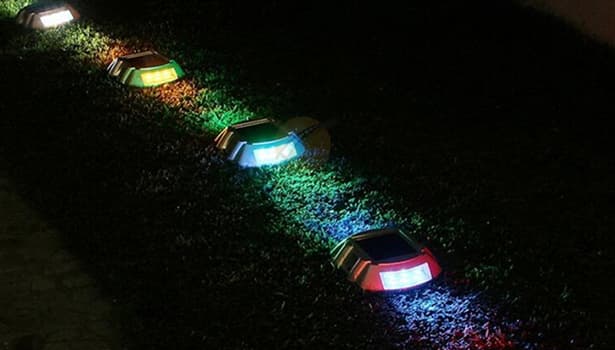
The top of the embedded solar road studs is equipped with a high-efficiency photovoltaic (PV) panel. Common sizes are 5cm×8cm or 6cm×10cm, and the materials are mostly monocrystalline silicon or polycrystalline silicon. The conversion efficiency of monocrystalline silicon photovoltaic panels can reach 18% to 22%. Even in weak light conditions such as overcast or cloudy days, they can capture sufficient sunlight and convert solar energy into direct current.
The converted direct current will be stored in the energy storage component through a voltage stabilizing circuit. Currently, there are two mainstream solutions:
Rechargeable lithium batteries: With capacities mostly ranging from 1000 to 2000mAh, they have a cycle life of over 1000 times and are suitable for urban roads with small temperature differences.
Supercapacitors: They have stronger resistance to high and low temperatures (-40℃ to 85℃), fast charging and discharging speeds, and are suitable for extremely cold regions in the north or high-temperature areas in the south. Their service life can reach over 5 years.
Energy storage components need to have waterproof and shockproof properties. They are usually sealed with epoxy resin to prevent rainwater from the road surface from seeping in and causing damage.
The embedded solar road studs are equipped with 2 to 4 high-brightness LED beads inside, with a luminous intensity of up to 2000 to 5000 MCD, far exceeding the 100 to 500mcd of traditional reflective road studs. The color of the lamp beads should be selected according to the function of the road
White: Used for normal lane boundaries and straight section guidance;
Red: Used in areas where overtaking is prohibited, at the end of roads or on dangerous sections;
Amber color: It is used in areas such as curves, slopes, and tunnel entrances and exits where deceleration is required.
Some high-end models support stroboscopic mode (frequency 1-3Hz), further enhancing long-distance recognition.
The embedded solar road studs integrate photoresistors or digital light sensors at the bottom, which can detect the intensity of ambient light in real time. When the light intensity drops below 100lux (approximately the brightness at dusk or on a cloudy day), the sensor will trigger the LED light group to automatically turn on. When the light intensity exceeds 300lux (approximately in the early morning or on a sunny day), the light will automatically turn off to prevent waste of electricity during the day.
The trigger threshold can be adjusted through the built-in chip to adapt to the differences in sunshine duration in different regions.
The above four steps form a closed loop, eliminating the need for external wires or manual switches, and achieving autonomous operation that is "forgotten after installation". Even in the event of short-term malfunctions (such as photovoltaic panels being blocked), the energy storage battery can maintain normal lighting for 3 to 7 days, ensuring that road guidance is not interrupted.
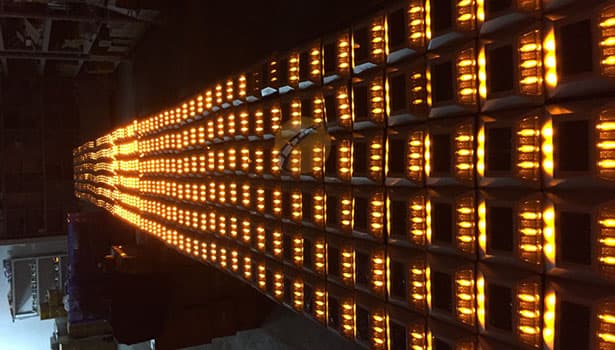
Traditional reflective road studs rely on the reflection of vehicle lights. In foggy, rainy or unlit sections, their visibility drops significantly. The embedded solar road studs actively emit light through leds, with a visible distance of up to 200 to 300 meters, which is 3 to 5 times that of reflective road studs.
Take foggy conditions as an example. When visibility is only 50 meters, reflective road studs are almost unrecognizable. However, the red/amber LED light groups of embedded road studs can enable drivers to spot the road boundary 10 to 15 seconds in advance, leaving sufficient time for emergency braking.
Embedded road studs need to withstand the long-term pressure of vehicles, so durability is particularly emphasized in terms of material and structural design.
Shell: Made of 6061 aluminum alloy or stainless steel, with a compressive strength of up to 100-150kN (approximately 10-15 tons in weight), it meets the passage requirements of heavy-duty trucks.
Surface cover: Made of polycarbonate (PC) material, it has an impact resistance 200 times that of glass and is less likely to be damaged by impacts from gravel or scratches from vehicles.
Sealing grade: Reaching IP68 standard, it can be immersed in water for a long time (within a depth of 1.5 meters), suitable for waterlogged roads or rainy season environments.
After testing, high-quality embedded road studs have a service life of 5 to 8 years on roads with an average daily traffic volume of 10,000 vehicles, which is much longer than the 2 to 3 years of traditional road studs.
Embedded road studs rely solely on solar power supply and do not require cable laying or connection to municipal power sources. This feature gives them significant advantages in the following scenarios:
Remote suburban roads: Areas without power supply infrastructure, no additional investment in power transformation is required;
Highway maintenance section: When temporarily adding guidance signs, there is no need to cut off power for construction.
New road construction: It can be installed simultaneously with the road surface construction to avoid secondary excavation later.
Even in high-latitude regions, where the duration of winter sunlight is short, normal operation can still be guaranteed by combining high-efficiency photovoltaic panels with large-capacity batteries.
To further enhance safety, most embedded road studs integrate retroreflective materials (such as microprism reflective films) around the LED light groups. When there is no LED light during the day, the reflective film can provide basic guidance through the reflection of vehicle lights. When the LED is turned on at night, the light emission and reflection are superimposed, creating a "dual visibility" effect.
This design can handle extreme situations (such as battery depletion), ensuring that the road studs always have basic recognizability.
In actual selection, embedded road studs are often confused with adhesive road studs (also known as "adhesive raised road signs"). Adhesive road studs are fixed to the surface of the road surface with special road adhesives, without the need for mechanical fixation or road excavation. They are mostly used in temporary scenarios or areas where it is inconvenient to damage the road surface. There are significant differences between the two in terms of structure, performance, and applicable scenarios. The following table compares them from seven core dimensions to help precisely match the requirements:
|
Comparison Dimension |
Embedded Solar Road Studs |
Adhesive Road Studs (including solar models) |
|
Structural Form |
Integrated into the pavement as a whole, with the top flush with the pavement, no protrusions or thin protrusions (≤1cm), and a high degree of integration with the pavement. |
A thin sheet-like structure with a rubber layer at the bottom and a slight protrusion at the top (1-3cm in height), without any part penetrating into the pavement. |
|
Installation Method |
Requires cutting the road surface groove (10-15cm deep), embedding the stud, and sealing with asphalt/epoxy resin. A professional construction team is needed; installation period is 1-2 days per kilometer. |
Directly apply special adhesive (e.g., epoxy road adhesive) on the cleaned road surface, stick the stud, then press and fix it. No professional equipment is required; installation period is 0.3-0.5 days per kilometer. |
|
Fixed Stability |
Physical embedding and sealing fixation form an integral part with the pavement, featuring strong resistance to pushing and rolling, and it is not easy to fall off. |
Fixed solely by adhesive; after long-term exposure to vehicle rolling and rainwater immersion, the adhesive is prone to aging and failure, with a relatively high falling-off rate (5%-10% per year). |
|
Durability & Lifespan |
Compressive strength of 100-150kN, PC cover with impact resistance, IP68 waterproof rating, service life of 5-8 years, and low maintenance frequency (once every 3 years). |
Compressive strength of 50-80kN, IP65 waterproof rating (splash-proof only), adhesive lifespan of 1-2 years, overall service life of 2-3 years, and high maintenance frequency (once a year). |
|
Driving Experience |
Flush with the pavement; no jolts or abnormal noises during vehicle travel, no tire scratching, and no interference with autonomous vehicle sensors. |
The micro-protruding design may cause slight jolts when small vehicles (e.g., electric vehicles, sedans) travel at high speeds; residual rubber layers from fallen studs may affect tire smoothness. |
|
Applicable Scenarios |
High-traffic main roads, expressways, urban express roads, and long-term use sections (over 5 years). |
Short-term construction sections of newly built roads (1-2 years), non-excavation roads in old urban areas, exhibition/temporary parking lots, low-traffic rural roads, and temporary traffic diversion areas. |
|
Cost |
Higher initial cost, but lower total cost over five years. |
Lower initial cost, but higher total cost over five years. |
As can be seen from the above table, the core advantages of embedded road studs lie in "long-term stability" and "high durability", making them suitable for core sections with high requirements for service life and driving experience. Adhesive road studs are highlighted for their "easy installation" and "low cost", making them more suitable for temporary, short-term or inconvenient road excavation scenarios. There is no absolute superiority or inferiority between the two, and the selection should be based on the service life and road section characteristics.
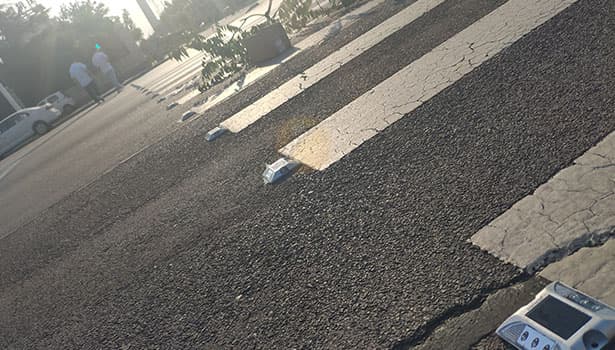
The active luminescence feature can significantly reduce accidents in low visibility scenarios. Taking the case of expressways as an example, after installing embedded solar road studs, the number of night-time rear-end collisions decreased by 42%, and the number of curve deviation accidents decreased by 38%. On the main roads of rainy cities, the rate of traffic accidents during heavy rain days has decreased by 55%.
In addition, road studs can precisely mark key locations such as the edge of the road, median strips, and construction areas, helping drivers stay in their lanes when visibility is poor and avoiding serious accidents such as "running off the road" or "scraping against guardrails".
Although the initial unit price of embedded road studs is 5 to 8 times that of traditional reflective road studs, in the long run, the total cost is lower.
Electricity cost savings: No external power supply is required. Each kilometer of road studs (about 50) can save $171 to $257 in electricity costs annually.
Maintenance savings: With a service life of 5 to 8 years, it only requires an inspection every 3 years, and the annual maintenance cost per kilometer is approximately $29. In contrast, the adhesive type of road studs need to be replaced every 2 years, and the annual maintenance cost per kilometer is about $114.
Cost savings in accidents: Based on an average loss of $7,143 per accident, if one accident is reduced per kilometer of road studs, it can cover the investment cost for 5 to 10 years.
Embedded road studs have strong stability after installation and do not require frequent maintenance or replacement, which can significantly reduce the amount of road maintenance work.
There is no need to regularly check "whether it has fallen off" or "whether the adhesive has aged" as with the adhesive road studs.
There is no need to regularly maintain the circuits or replace the bulbs as with traditional street lamps;
The sealed design can prevent rainwater and sand from seeping in, reducing the probability of internal component failure.
After installing embedded road studs, the workload of road maintenance personnel was reduced by 30%, and the number of road excavations was decreased by 60%, avoiding the interference of maintenance operations on traffic.
Embedded road studs are powered by solar energy and have zero carbon emissions. Each kilometer of road studs (50 in total) can reduce carbon dioxide emissions by approximately 0.8 tons annually, which is equivalent to the carbon sequestration of 40 trees.
In addition, the materials of the road studs (aluminum alloy, PC, lithium batteries) can all be recycled, avoiding the environmental pollution caused by the disposal of traditional road studs (such as plastic reflective road studs), which is in line with the development trend of "green transportation infrastructure" and is also an added point for some cities to apply for the title of "Low-carbon City".
Not all roads require the installation of embedded solar road studs. Considering their characteristics of "high durability, high visibility, and autonomous operation", the following four scenarios can best demonstrate their value:
The main urban roads (such as those with six or more lanes in both directions) have a large volume of traffic at night, and some sections have no street lamps or the brightness of the street lamps is insufficient (such as in old urban areas). Embedded road studs can be installed along the edge of the lane and the median strip. They clearly mark the lane boundaries through white LED light groups, reducing accidents such as "lane crossing" and "rear-end collisions".
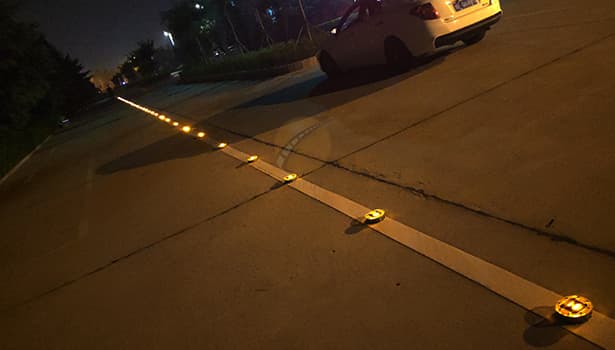
Most expressways pass through remote areas, with a large number of unlit sections (especially from 10 p.m. to 6 a.m. the next day), and foggy and rainy days occur frequently. Embedded road studs can be installed at intervals of 5 to 10 meters. Amber leds are used at the entrances and exits of curves, slopes and tunnels to remind drivers to slow down. Use white leds on long straight sections to maintain lane guidance.
Suburban and rural roads often lack power supply infrastructure, and the cost of installing traditional street lights is high (about $7,143 to $11,429 per kilometer of street lights). Embedded road studs cost approximately $5,714 to $8,571 per kilometer and do not require subsequent electricity charges. They can be used as a "low-cost alternative to lighting", installed along both sides of the road to enhance the safety of pedestrians, electric bikes, and motor vehicles at night.
Large parking lots (such as those in shopping malls and airports) and park roads (such as those in universities and industrial parks) have interwoven pedestrian and vehicle traffic at night, and the roads are relatively narrow, making it easy for "pedestrian and vehicle scraping" accidents to occur. Embedded road studs can be installed along the boundaries of parking Spaces and the edges of sidewalks. Red leds are used to mark the "No Vehicle Entry" areas, and white leds are used to mark the driving lanes. At the same time, they provide "safety boundary" guidance for pedestrians.
There are numerous brands of embedded solar road studs on the market, with varying quality. When making a purchase, pay close attention to the following three dimensions to avoid potential risks brought by "low-priced and low-quality" products in the later stage:
The core components directly determine the performance and lifespan of the road studs. When purchasing, the following parameters need to be confirmed:
Photovoltaic panels: Prioritize monocrystalline silicon (conversion efficiency ≥18%), and avoid polycrystalline silicon (efficiency 12%-15%) or amorphous silicon (efficiency < 10%), as they provide more stable energy storage in low-light conditions.
Battery: In northern regions, choose supercapacitors (resistant to -40 ℃ low temperature), while in southern regions, lithium batteries (capacity≥1500mAh) can be selected. It is necessary to confirm that the cycle life is ≥1000 times.
LED beads: Select imported brands, with a luminous intensity of ≥3000mcd and stable color temperature (to avoid "color cast" affecting recognition).
You can ask the manufacturer to provide component inspection reports to avoid "passing off inferior goods as good ones".
Road studs need to withstand the long-term pressure of vehicles and the immersion of rainwater, and their protective performance is of vital importance.
Compressive strength grade: It must comply with the requirements of "Road Traffic Signs and Markings" (GB 5768), with a compressive strength of ≥100kN (capable of withstanding the pressure of vehicles weighing over 10 tons).
Waterproof rating: At least IP67 (suitable for short-term immersion), preferably IP68 (suitable for long-term immersion), to prevent rainwater from seeping in and causing internal short circuits;
Anti-aging: The surface PC cover needs to be added with ultraviolet absorbers to ensure that it does not turn yellow and the light transmittance drops by no more than 10% within 5 years, avoiding any impact on the energy storage of photovoltaic panels and the light emission of leds.
Formal embedded solar road studs must have the following certifications to ensure compliance with national standards and safety requirements:
Product Certification: Passed the inspection of the "National Quality Supervision and Inspection Center for Traffic Safety Facilities" and obtained the "Conformity Certificate for Traffic Engineering Products".
Production qualification: The manufacturer must possess the "Professional Contracting Qualification for Highway Traffic Engineering" to avoid products from "small workshops" without production capacity.
Warranty service: At least 3 years of warranty is provided (5 years for core components), and the response time for "repair/replacement" is clearly defined (e.g., on-site presence within 48 hours).
Avoid purchasing "low-priced products" without certification or warranty. Such products usually have a service life of less than one year and higher maintenance costs in the later stage.