In scenarios such as night commuting, outdoor work or night running, low light and dark environments always pose an "invisible challenge" to safety protection. According to relevant data statistics, about 30% of road accidents at night are related to insufficient visibility of pedestrians or workers. As a key piece of equipment for enhancing visibility, safety vests are currently mainly divided into two categories on the market: "reflective safety vests" and "LED vests".
With the improvement of safety awareness, the popularity of these two types of vests is increasing. However, many people are still unclear about the core difference between the two - which one is more suitable for their own usage scenarios? Next, NOKIN will comprehensively analyze the differences between the two types of vests from dimensions such as working principle, visibility features, and applicable scenarios, helping you choose the safety protection equipment that truly meets your needs.
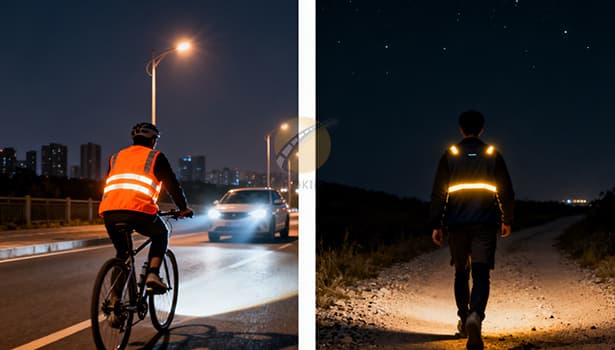
Whether it is the non-motorized vehicle lanes at night in cities or the outdoor work sites in remote areas, "invisibility" is the core cause of safety accidents. For outdoor workers such as construction workers and power inspectors, the risk of "insufficient visibility" is further magnified in construction areas or mountainous roads without lights at night. At this point, choosing the right safety vest is equivalent to adding an extra "protective barrier" for your own safety.
In recent years, with the improvement of safety standards, reflective safety vests have become a standard feature for occupations such as traffic police, couriers, and sanitation workers. LED vests, with their advantage of "active light emission", have gradually become popular in scenarios such as night running, outdoor adventures, and late-night construction.
However, many consumers are confused when making a purchase: "When it comes to safety vests, should I choose reflective ones or LED ones?" "LED vests are more expensive than reflective vests. Are they really worth buying?" " The essence of these problems is actually a lack of understanding of the core differences between the two types of vests.
The core advantage of reflective safety vests lies in their "high cost performance and suitability for scenarios with light sources", making them the most widely used type of safety vest at present. To understand it, we first need to start with "how it achieves visibility".
The "visibility" of reflective safety vests comes from the combination of "retroreflective materials" and "fluorescent color fabrics", which respectively correspond to the two demands of "nighttime reflection" and "daytime/low light visibility".
Retroreflective materials are the "core components" of reflective vests. Common structures include "glass microsphere type" and "prism type". Its principle is similar to "mirror reflection", but it is more precise than ordinary mirrors - it can reflect the light emitted by external light sources (such as car headlights and street lamps) back to the light source along the "incident direction" along the original path.
For instance, when a car's headlights shine on a reflective vest, the retroreflective material will directly reflect the light back into the driver's eyes, allowing the driver to quickly spot the person in front of them in the dark. This "directional reflection" feature enables the reflective vest to maintain high visibility even in weak light sources.
In addition to retroreflective materials, reflective safety vests usually adopt bright-colored fabrics such as fluorescent yellow and fluorescent orange. This type of fabric can absorb light from the environment (such as sunlight) during the day and release it through "diffuse reflection", making the vest more eye-catching in complex environments.
Even during low-light periods such as dusk and dawn, fluorescence-colored fabrics can be more easily identified than ordinary dark-colored clothing, which is equivalent to providing "supplementary protection" for "retroreflective materials" - fluorescent colors during the day and retroreflective colors at night, forming "all-weather basic protection".
The visibility of reflective safety vests is "passive", which means they cannot emit light by themselves and must rely on external light sources to function.
For instance, on urban roads with street lamps, when the light from the lamps shines on reflective vests, it will be reflected back into the sight of people around, and at this time, the visibility of the vests is good. However, if you move to a remote section of the road without street lamps or vehicle lights, even if you are wearing a reflective vest, it is very difficult to be noticed - because there is no external light source for reflection, the vest loses its "reflective ability".
In addition, passive visibility is also affected by "light source intensity" and "distance" : the stronger the light source and the closer the distance, the higher the visibility of the reflective vest. Conversely, if the light source is weak and the distance is long, the reflective effect will significantly decline.
Based on the feature of "passive reflection", reflective safety vests are more suitable for scenarios with "external light sources", and can be specifically classified into the following categories:
For instance, construction workers carry out construction during the day, sanitation workers clean the streets during the day, and traffic police direct traffic during the day, etc. At this time, the fluorescent fabric can make the workers stand out more in the crowd or construction environment, avoiding being accidentally hit by vehicles or machinery.
For instance, couriers deliver goods at night (most of the routes are urban roads with lights), citizens go jogging at night in parks with street lamps, and cyclists travel along the illuminated non-motorized vehicle lanes at night, etc. In these scenarios, the lights from street lamps or passing vehicles can provide sufficient reflective light sources for reflective vests, meeting the basic safety requirements.
Such as foggy days, cloudy days, dusk or dawn. Although the light is relatively weak during these periods, there is still ambient light or vehicle headlights. The retroreflective material and fluorescent fabric of the reflective vest can work together to enhance visibility.
The biggest drawback of reflective safety vests lies in the fact that they cannot function without an external light source. In the following scenarios, its security protection effect will significantly decline or even fail:
Mountain roads, unlit paths in the suburbs, and construction sections closed at night, etc. In these scenes, there are no street lamps, few passing vehicles, and insufficient external light sources. Even if one is wearing a reflective vest, it is difficult to be noticed by distant vehicles or people.
When the lighting in underground parking lots malfunctions, in warehouses without lights at night, or in tunnels with power outages or dim lighting, etc., these Spaces are completely dependent on artificial light sources. Once the light source is missing, the reflective vest loses its "reflective basis" and cannot provide visibility protection.
Such as rural roads in the suburbs at night and uninhabited areas for outdoor adventures. These areas have almost no passing vehicles and lack reflective light sources, so the effect of reflective vests will be greatly weakened.

If reflective safety vests are the "basic protection", then LED vests are the "upgraded protection". It solves the pain point of reflective vests "relying on external light sources" through the feature of "active light emission", and is especially suitable for complex dark environments.
The core of an LED vest is "self-luminescence", and its working principle relies on the coordination of "embedded LED components" and "battery power supply systems". Specifically, it can be divided into two parts:
The LED lights of LED vests are usually embedded in the fabric in the form of "light strips" or "patches"
|
Type |
Description |
Features / Application |
|
Light strip style |
Flexible LED light strips are sewn onto key positions (front, back, shoulders) to create a wraparound light-emitting area. |
Visible from all angles, providing comprehensive illumination. |
|
Surface mount type |
Small LED patches are directly printed on the fabric of the vest. |
Smaller and lighter in size, suitable for daily wear such as night running vests. |
No matter what form it takes, the colors of LED lights are mostly red, yellow or white - these colors have strong penetration in the dark and are easier to be recognized.
The power supply of LED vests relies on built-in batteries. Currently, there are mainly two types:
|
Power Type |
Specifications & Features |
Usage Scenarios |
|
Rechargeable battery |
Mostly lithium batteries, 500–1000mAh capacity; USB rechargeable; 4–12 hours runtime (flashing mode lasts longer than always-on). |
Long-term use, suitable for daily activities requiring extended visibility. |
|
Disposable batteries |
Mostly button or AA batteries; easy to replace; short battery life (1–3 hours). |
Short-term or temporary use, such as emergency scenarios. |
Most LED vests are designed with "battery storage bags" to hide the batteries inside the vest, avoiding any impact on wearing comfort and preventing water from entering or the batteries from falling off.
Unlike the "passive reflection" of reflective safety vests, the visibility of LED safety vests is "active" - it does not require an external light source and can continuously emit light by itself, functioning as a "mobile warning light" in the dark.
For instance, when running at night in a completely dark mountainous area, even without street lamps or vehicle lights, the light emitted by the LED safety vest can still make pedestrians or vehicles at a distance spot you from 100 meters away. When working in a warehouse without lights at night, the light of the LED safety vest enables colleagues to clearly see your position, avoiding collisions or misoperations.
In addition, active visibility is not affected by "distance" or "light source intensity" : no matter how far the distance is, as long as the line of sight is unobstructed, the light of the LED vest can be seen. Even in environments with low visibility such as foggy or rainy days, the penetrating power of LED lights is stronger than the reflected light of reflective vests.
Based on the advantage of "active light emission", LED safety vests are more suitable for scenarios where "external light sources are lacking" or "safety requirements are higher", specifically including:
Such as road construction at night (without temporary lighting), power inspectors patrolling lines in mountainous areas at night, and railway workers repairing tracks late at night, etc. These scenes have no external light sources at all. The active lighting of the LED safety vest can ensure that the workers are promptly detected by equipment operators or passing vehicles.
Such as underground mine operations (with insufficient lighting in some areas), sorting in warehouses without lights at night, tunnel maintenance (when lighting malfunctions), etc. This type of space is dimly lit and enclosed. LED safety vests can provide "active warnings" to prevent people from colliding or getting lost.
Such as outdoor enthusiasts jogging at night (with routes on unlit paths in the suburbs), cyclists crossing remote sections at night, and campers engaging in activities around the campsite at night, etc. These scenes lack stable light sources. LED vests can make athletes "visible" in the dark, reducing the risk of encountering wild animals or passing vehicles.
For instance, rural doctors make night calls (rural roads have no lights and few vehicles), and couriers deliver orders to remote mountainous areas (routes have no street lamps), etc. These areas have very few external light sources. The active light emission of LED safety vests can fill the gap of "the failure of reflective vests".
This is the most core advantage of the LED vest. Whether there is an external light source in the environment or not, it can continuously provide visibility through its own light emission, solving the pain point of reflective vests being "completely black and ineffective". For instance, on a construction site without lights at night, the light from the LED vest enables the excavator operator 50 meters away to clearly see the workers' positions, thus avoiding misoperation.
Most LED vests support three lighting modes: "constant on", "slow flash", and "fast flash". Users can switch between them according to the scene:
|
Mode |
Applicable Scenarios |
Characteristics |
|
Always-on mode |
Warehouse sorting |
Continuously marks the position, suitable for long-term use. |
|
Slow-flash mode |
Night sports (e.g., night running) |
Eye-catching but not dazzling, enhances a sense of security. |
|
Flash mode |
Late-night road construction, high-risk scenarios |
Quickly draws attention, provides a stronger warning effect. |
Visibility is low on foggy days, rainy days, sandstorms, etc.
In such an environment, the "active light emission" of LED lights has a stronger penetrating power than the "reflected light" of reflective vests. For instance, in foggy weather, the reflected light from a reflective vest may be scattered by the fog, making it difficult to see clearly from a distance of 50 meters. The light of the LED vest can penetrate the fog and still be recognized from 100 meters away.

Through the analysis in the previous text, we can clearly distinguish the differences between reflective safety vests and LED vests from four core dimensions: "light source", "working mode", "visibility effect", and "applicable scenarios", as follows:
|
Dimension |
Reflective Safety Vest |
LED Safety Vest |
|
Light source |
Relies on external light sources (reflection effect). |
Actively emits light through built-in LED lamps (battery-powered). |
|
Working mode |
Passive – triggered by an external light source. |
Active – continuously emits light after being turned on. |
|
Visibility effect |
Effective only when there is a light source; fails in complete darkness. |
Effective in all scenarios; highly visible in the dark; not affected by the external environment. |
|
Applicable scenarios |
Daytime, low-light environments with light sources (e.g., street lamp areas, daytime construction). |
Completely dark environments, dim/enclosed spaces, and low-traffic areas (e.g., late-night construction, night running without street lamps). |
|
Core advantages |
High cost performance; strong adaptability to daily scenarios. |
Excellent all-dark visibility; multiple lighting modes; strong adaptability to harsh environments. |
|
Main drawbacks |
Ineffective in complete darkness without external light. |
Requires charging or battery replacement; slightly higher price. |
After understanding the differences between the two types of vests, how to choose according to your own needs? In fact, it only takes three steps to precisely match a suitable safety vest.
The core principle of selection is "scene matching" - first figure out "where you will use it", and then decide which type of vest to choose:
If the scene has a stable external light source: Choose a reflective safety vest
|
Scenario Type |
Examples / Description |
|
Daily commuting |
Routes with street lamps or mainly traveling during the day. |
|
Occupational requirements |
Couriers, sanitation workers, traffic police; mostly urban roads with street lamps or vehicle lights. |
|
Daytime outdoor activities |
Daytime hiking, daytime construction, daytime cycling. |
In such scenarios, the "passive reflection" of reflective safety vests can already meet safety requirements and is more cost-effective, without the need to pay additional costs for "active illumination".
If the scene has no external light source or high safety requirements: Choose an LED vest
|
Scenario Type |
Examples |
|
Nighttime operations |
Road construction at night, power line inspection in mountainous areas, sorting in unlit warehouses |
|
Nighttime sports |
Night running in suburbs without street lamps, cycling through remote sections at night |
|
Special environments |
Foggy night commutes, underground mine operations, camping night activities |
In such scenarios, the "active light emission" of LED vests is the key to safety. Even if the price is slightly higher, it can avoid the risk of "reflective vest failure".
After determining the type of vest, it is also necessary to pay attention to specific parameters to avoid buying "inferior products".
Reflective strips: Prioritize products that comply with national standards. The width of the reflective strips should be no less than 50mm and the length no less than 200mm, and they should cover key areas such as the front and back of the vest and the shoulders. The larger the area and the more comprehensive the position of the reflective strips, the better the reflective effect.
Fabric: For daily use, choose "mesh fabric" (with good breathability, suitable for summer), and for outdoor work, select "Oxford fabric" (wear-resistant, waterproof, suitable for complex environments). At the same time, confirm whether the fluorescent color of the fabric is bright to avoid affecting visibility after fading.
Battery life: Select based on usage duration. For daily night runs (1-2 hours), choose one with a battery life of over 4 hours. For outdoor work (4 to 8 hours), choose those with a battery life of more than 8 hours. Give priority to rechargeable models (more environmentally friendly and with lower long-term usage costs);
Lighting mode: At least two modes, "constant on" and "flashing", are supported. For high-risk scenarios (such as construction), it is recommended to choose the mode that supports "flash".
Water resistance: Check the water resistance grade. For daily commuting, choose IPX4 (splash-proof, suitable for rainy days), and for outdoor work, choose IPX5 (spray-proof, suitable for heavy rain) to prevent rain from damaging the LED lights or batteries.
If the budget is limited but there is a need for a completely dark scene: You can choose the "reflective + LED two-in-one vest" - this type of vest has both reflective strips and LED lights. Use the reflective function when there is a light source in daily life, and turn on the LED lights when it is completely dark. It offers better value for money.
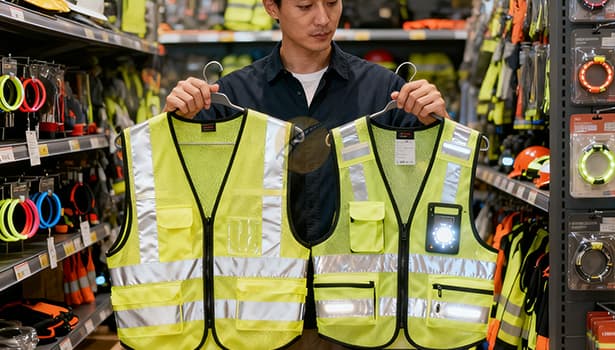
Whether it is a reflective safety vest or an LED vest, the core value is "enhancing visibility and reducing safety risks". There is no absolute "good or bad" between the two; there is only a difference in "whether they are suitable for the scene".
Reflective safety vests are "basic protection for regular scenarios", suitable for daily environments with light sources, and offer high cost performance.
The LED vest is an "upgraded protection for complex scenarios", suitable for high-risk environments without light sources, and has a higher safety level.
The last thing I want to remind you of is that there is no "compromise" in safety protection - in a completely dark environment, don't expect reflective vests to "save lives". In daily illuminated scenarios, there is no need to overly pursue the "high-end functions" of LED vests. Only by choosing the right vest based on your core usage scenarios can you truly ensure the safety of every trip and work.