According to different road scenarios, environmental conditions and project budgets in Saudi Arabia, the optimal choice of the two types of road studs is clearly defined, enabling quick matching of procurement and construction needs:
The road environment in Saudi Arabia has strong regional specificity, and common road sign accessories are difficult to adapt. As the core pavement warning facility, incorrect selection of road studs will directly increase the risk of traffic accidents and affect the stability of road traffic.
Saudi residents have a strong demand for night travel, long-distance commuting and freight transportation. The density of night traffic is high. The visibility conditions at night are poor, and the boundaries and lane divisions on the road are blurred. The visual effect of the road studs for warning is extremely high.
A large number of cross-border and cross-city roads in Saudi Arabia run through desert areas, with long routes and sparse population. Such roads generally do not have a lighting system for street lamps, relying solely on pavement sign facilities to guide vehicle passage.
Saudi Arabia has a tropical desert climate and frequently experiences sandstorms. Sand suspension and road dust can block pavement signs, significantly reducing the recognition effect of traditional reflective facilities, and easily causing lane deviation, rear-end collisions, etc.
Saudi desert roads are mostly extremely long straight sections, with monotonous and boring road conditions. Drivers are prone to visual fatigue and distraction after long driving, and need continuous and clear pavement warning signs to awaken their driving attention.
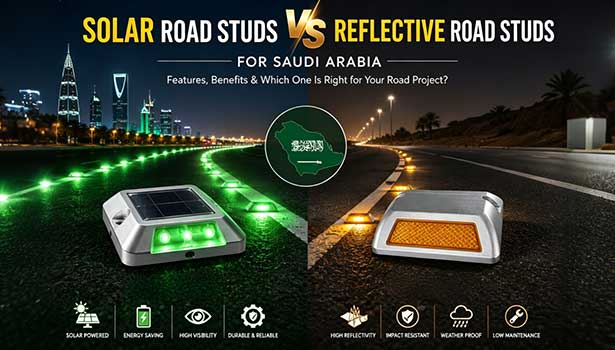
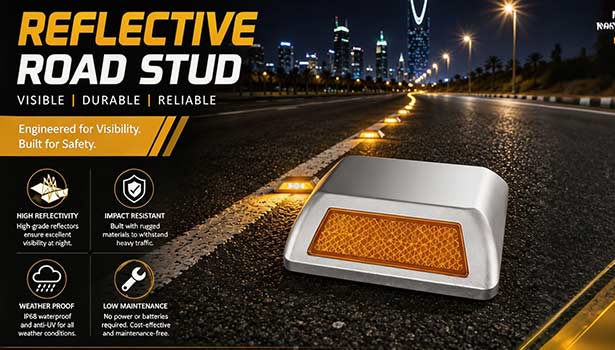
Reflective road studs are passive warning facilities without self-luminous ability. They mainly rely on the headlights of vehicles during driving, which shine on the reflective layer on the surface of the road studs to form light reflection, allowing drivers to clearly identify the lane outline and road direction, achieving pavement warning effect.
The structure of reflective road studs is simple and has few accessories. The core composition is divided into three parts, suitable for various regular pavement construction:
Reflective road studs are traditional mainstream pavement warning products, suitable for conventional municipal road scenarios. Their core advantages lie in cost and maintenance:
Due to the limitations of its working principle, reflective road studs have obvious shortcomings in special road conditions in Saudi Arabia and are applicable to limited scenarios:
Solar road studs are active intelligent warning facilities that rely on solar energy storage to achieve autonomous illumination. During the day, they absorb abundant sunlight in Saudi Arabia through solar panels and store it in the built-in battery; at night, when there is insufficient light, they automatically activate LED light beads to actively emit light, continuously providing clear warning light sources.
Solar road studs are integrated intelligent devices, and the core four components ensure stable operation throughout the day:
For the desert climate and unlit road scenarios in Saudi Arabia, solar road studs have significant advantages and perfectly fit the complex road conditions there:
Compared to reflective road studs, solar road studs have two obvious shortcomings, which are important considerations for project selection:
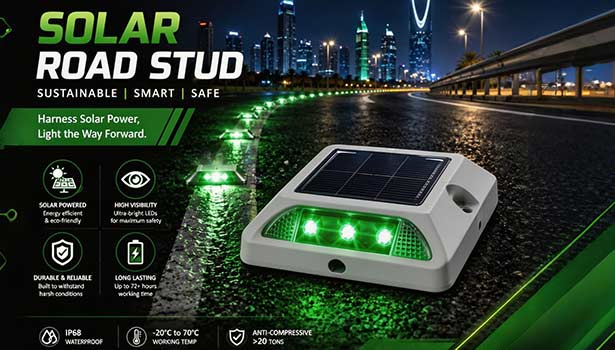
This section comprehensively compares the two road stud products from 8 major dimensions: core performance, scene adaptation, cost and lifespan, and operation and environmental protection. It precisely meets the various road procurement needs in Saudi Arabia.
The core differences between the two products stem from the lighting mode and energy supply method, directly determining the scene adaptation ability:
|
Comparison Item |
Solar Road Studs |
Reflective Road Studs |
|
Lighting Mode |
Active LED illumination |
Passive light reflection |
|
Energy Source |
Solar energy (renewable energy) |
Vehicle headlights |
Visibility distance and clarity are the core indicators of road safety in Saudi Arabia. The performance of the two products varies significantly under different weather and lighting conditions. Industry data shows that solar road studs have a visibility distance of 500-1000 meters, while reflective road studs are generally lower than 200 meters:
|
Usage Scenario |
Solar Road Studs |
Reflective Road Studs |
|
Clear Night |
Excellent |
Good |
|
Unlit Road Sections |
Excellent |
Poor |
|
Foggy Conditions |
Excellent |
Average |
|
Sandstorm Weather |
Good |
Poor |
Sandstorms are the most critical adverse conditions on Saudi roads, and they are also the key differences in product selection, directly determining the long-term safety of road passage.
Reflective road studs highly rely on the surface reflective layer. Sand accumulation and wind-blown dust will directly cover the reflective area. Once the reflective surface is covered, the product basically loses its warning function and fails with extremely high probability in continuous sandstorm weather.
Solar road studs adopt an external high-brightness LED active lighting design, with strong light penetration ability. Even if the surface is covered with a small amount of sand, it can still penetrate the obstruction and continuously output clear warning signals.
At the same time, its integrated sealing structure can effectively prevent sand from invading the internal components, avoiding equipment failure, and being more suitable for the long-term sandy climate characteristics of Saudi Arabia.
The visibility distance directly determines the driver's emergency reaction time, which is the core key to avoiding accidents on desert highways.
The 500-1000-meter long visibility distance of solar road studs allows drivers to predict road directions, bends, and lane changes in advance, leaving sufficient time for deceleration, lane change, and emergency avoidance.
The visibility distance of reflective road studs is less than 200 meters, and drivers have a very short reaction time when they detect changes in the road conditions. In the scenario of rapid driving on desert highways, it is very likely to cause traffic accidents due to insufficient reaction time.
In summary: The farther the visibility distance, the longer the driver's reaction time, and the higher the road safety.
From the perspective of construction efficiency and later maintenance costs, the two products are suitable for different project schedules and maintenance budgets in Saudi Arabia:
|
Comparison Item |
Solar Road Studs |
Reflective Road Studs |
|
Installation Difficulty |
Medium (No wiring required, but proper alignment and positioning are necessary) |
Simple (Direct pavement installation with no complex procedures) |
|
Maintenance Difficulty |
Medium (Requires periodic cleaning of dust and debris from the solar panel surface) |
Very Low (Virtually maintenance-free under normal conditions) |
|
Inspection Frequency |
Regular periodic inspections recommended |
Rarely requires inspection or maintenance |
Different materials and types of road studs have significant differences in their lifespan under the harsh conditions of high temperatures, sand, and compaction in Saudi Arabia, directly affecting the long-term replacement cost:
|
Product Type |
Regular Lifespan |
|
Plastic Reflective Road Studs |
1–3 Years |
|
Aluminum Reflective Road Studs |
More Than 5 Years |
|
Solar Road Studs |
4–6 Years |
Most purchasers only focus on the initial price of individual items, ignoring the total life cycle cost. Considering the long-term operation requirements of the Saudi project, it is necessary to comprehensively calculate from four dimensions to break the conventional perception that "reflective road studs are cheaper":
The unit price of reflective road studs is lower, and the initial batch purchase investment is less; the solar road studs have a higher initial purchase unit price due to the addition of intelligent components, and the initial investment is larger.
Reflective road studs do not require maintenance, but they are prone to failure, aging, and damage in sandy weather, and need frequent batch replacements; the solar road studs only require regular cleaning of the board surface dust, with no high-frequency maintenance costs, and the long-term operation cost is lower.
Plastic reflective road studs need to be replaced as a whole after 2-3 years, and the long-term cumulative replacement cost is extremely high; the solar road studs have a lifespan of 4-6 years, a longer replacement cycle, and significantly reduces iterative investment.
The stable warning effect of solar road studs in low-light and high-sand-risk scenarios can significantly reduce the accident rate. Reducing accident compensation, road repair, and traffic congestion losses, the hidden economic benefits far exceed the initial price difference.
In line with Saudi Arabia's 2030 vision for green transportation and energy conservation and carbon reduction, both products have their own advantages in environmental attributes:
Solar road studs rely entirely on solar energy to work, have zero electricity costs and zero carbon emissions, belong to green intelligent transportation facilities, and are suitable for Saudi Arabia's smart and low-carbon road construction planning.
Reflective road studs have no electricity consumption, no energy supply required, no operating energy cost, have a simple structure, and can be recycled after scrapped, with stable basic environmental attributes.
Based on the environmental characteristics and traffic demands of the mainstream road scenarios in Saudi Arabia, precise selection suggestions are provided to adapt to various engineering procurement standards.
Saudi Arabia has fast-moving vehicles and large traffic flows. Some sections lack lighting, and long straight sections are prone to fatigue driving. The long-distance active lighting effect of solar road studs can precisely guide traffic and avoid safety risks on highways.
Such sections have no streetlights, frequent sandstorms, and extremely poor visibility. Reflective road studs basically cannot function. Solar road studs are not limited by external light sources and can work stably in adverse weather conditions. They are the optimal choice for remote desert roads.
Saudi Arabia has well-equipped urban roads and full coverage of streetlights, with sufficient nighttime lighting. Reflective road studs can achieve good warning effects relying on vehicle lights and are more cost-effective and easier to install, fully meeting urban traffic needs.
Industrial parks have a large number of heavy vehicles and frequent road crushing, with high requirements for the compressive strength, durability, and wear resistance of road studs. Aluminum reflective road studs have high hardness, wear resistance, and durability, and have a long lifespan. They are suitable for the high-frequency heavy-load traffic scenarios in industrial parks and have an extremely high cost-performance ratio.
Airport runways and taxiways have extremely high requirements for the accuracy and stability of signs and the stability of the system. The absence of lighting blind spots and no failure risks are core standards. High-performance solar road studs ensure 24/7 warnings, and glass road studs enhance wear resistance and light transmission. The combination perfectly meets the high standards of airport traffic.
In recent years, Saudi road projects have gradually replaced traditional reflective road studs with large-scale adoption of solar road studs. The core reason aligns with the national development strategy and the upgrade of road safety:
The 2030 Vision of Saudi Arabia focuses on promoting smart transportation and green energy transformation. Solar road studs rely on clean energy and have zero energy consumption and low maintenance costs. They perfectly match the country's low-carbon infrastructure and smart road network construction goals, making them the core preferred product for road upgrades.
Saudi Arabia is fully upgrading its all-weather smart transportation network. Passive reflective road studs cannot meet the requirements for intelligent and all-weather traffic control. Solar road studs can achieve autonomous intelligent start-stop and all-weather visual warnings, helping to upgrade road smartness.
Saudi Arabia has abundant sunlight resources. Solar road studs fully utilize the local natural light advantages and replace traditional power-consuming lighting facilities, significantly reducing road infrastructure energy consumption and achieving efficient energy recycling.
A large number of remote desert roads in Saudi Arabia have no streetlights and have long had safety hazards. Solar road studs do not require external power supply and are suitable for harsh desert environments. They can quickly fill the safety gaps in remote sections and reduce accident rates.
Yes. Although the initial purchase cost of solar energy road studs is higher than that of reflective road studs, from a full life cycle perspective, they have a longer service life, do not require frequent replacement, and have extremely low operation and maintenance costs. At the same time, they can significantly reduce the accident risk on high-risk desert sections, and the comprehensive economic benefits and safety value far exceed traditional reflective road studs. The long-term project return on investment is higher.
Yes, they can. Solar energy road studs rely on LED active lighting, and the light has strong penetrating power. A small amount of sand dust blocking does not affect the warning effect. Their fully sealed waterproof and dust-proof structure can withstand the strong sand dust invasion in Saudi Arabia and will not have the problem of complete failure of reflective road studs. Only in severe sand dust weather, the visible distance will slightly decrease, but it does not affect the basic traffic warning.
Comprehensive performance matching ranking:
Aluminum reflective road studs (5 years or more) > Solar energy road studs (4-6 years) > Plastic reflective road studs (1-3 years).
Aluminum reflective road studs are the most wear-resistant and stable in structure, with the best lifespan; solar energy road studs are affected by battery energy loss and have a middle-level lifespan; plastic reflective road studs are prone to aging and damage, with the shortest lifespan.
Not recommended. Desert highways have no lighting, frequent sandstorms, and fast vehicle speeds. Reflective road studs rely on passive reflection from vehicle lights, and in a completely dark environment, they will completely fail. Their performance will significantly decline in sandstorm weather, and the visible distance will be insufficient, which cannot meet the safety standards for high-speed travel, and there is a great safety hazard.
Compliant high-quality solar energy road studs can meet the latest standards of the EN1463 series (EN 1463-1:2021, EN 1463-2:2021). This standard is the authoritative testing specification for road studs worldwide, covering core indicators such as initial performance, mechanical strength, environmental durability, and road measurement performance. It should be noted that the original EN1463 standard is for reflective road studs, and active lighting solar energy road studs need to pass special adaptation testing to be fully compliant with the requirements of Saudi road engineering bidding.
There is no unified standard answer. It needs to be matched according to the needs: high-risk desert highways, expressways, and sections without lighting should prioritize solar energy road studs; urban municipal roads, conventional lighting sections should prioritize reflective road studs; heavy-load industrial parks should prefer aluminum reflective road studs; airport high-end scenarios should prefer a combination of solar energy and glass road studs.
Based on Saudi road conditions, climate, cost, and safety requirements, a comprehensive selection comparison table is compiled to facilitate quick and accurate procurement:
|
Application Scenario |
Recommended Road Stud Product |
|
Desert Expressways |
Solar Road Studs |
|
Urban Municipal Roads |
Reflective Road Studs |
|
Industrial Park Areas |
Aluminum Reflective Road Studs |
|
Airport Access Roads and Runway Service Roads |
Solar Road Studs + Glass Road Studs |
|
High-Risk Mountain Curves and Winding Roads |
Solar Road Studs |
The road environment in Saudi Arabia is highly differentiated. The core of selecting road studs lies in scene adaptation, safety priority, and cost consideration.
For high-risk sections such as desert roads without lighting, intercity expressways, high-risk bends, and accident-prone areas, solar road studs, with their core advantages of active lighting, strong adaptability in adverse weather conditions, and long visibility distance, are the optimal choice for ensuring road safety and have a higher long-term comprehensive value.
For urban municipal roads with full lighting coverage, parking lots, regular low-risk sections, and basic renovation projects with limited budgets, reflective road studs, with their advantages of low cost, easy installation, and no maintenance requirements, are the most cost-effective on-the-ground solution.